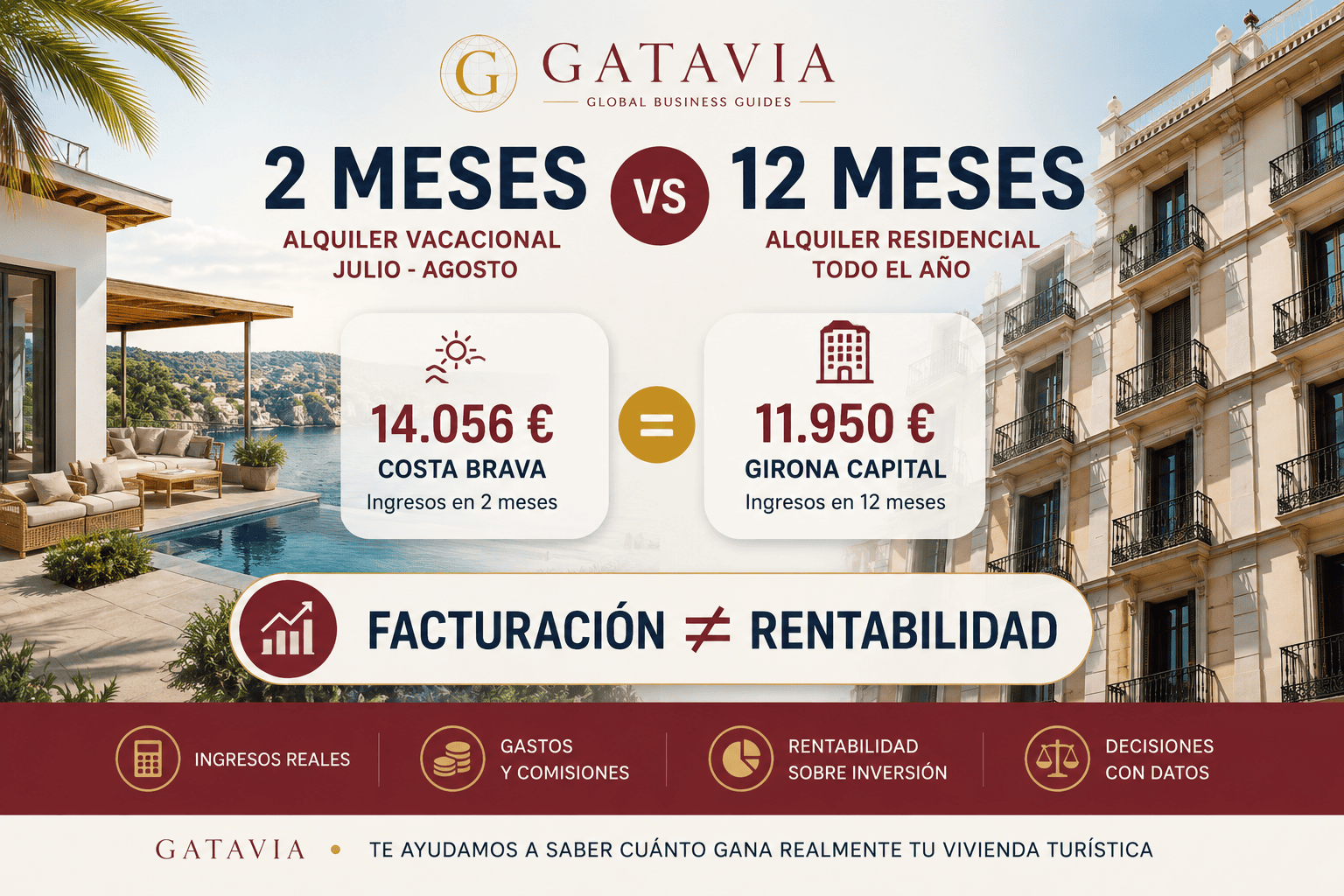
Can two months of vacation rental generate the same as a year? The data from 2026 that compels us to rethink profitability
Eight weeks of summer can generate in some Spanish coastlines more than half of the income obtained during an entire year of residential rental in the reference provincial capital. And in certain markets, the figure approaches—or even exceeds—the equivalent of twelve months.
The data is striking enough to go viral. But it is also dangerous enough to misinterpret.
Because earning more in July and August does not necessarily mean achieving greater profitability. Between one factor and another are the purchase price, occupancy, platform commissions, utilities, cleaning, maintenance, insurance, taxation, financing, replacements, management, and, of course, the legal possibility of exploiting the property for tourism.
Quick Read Gatavia
The news: an analysis by pisos.com published this August 18 compares the income from July and August in different Spanish coastlines with the income from twelve months of residential rental in their reference capitals.
The viral data: in markets such as Costa Brava, the Balearic Islands, and Costa de la Luz, the income from those eight weeks is around the equivalent of nearly a year of residential rental, and in some cases even exceeds it.
The fundamental nuance: different locations, acquisition prices, and exploitation models are compared. It does not mean that any tourist property will generate in two months what a residential property does in a year.
The Gatavia conclusion: the owner should not only ask how much their property earns, but how much money they really retain after all costs and on the capital invested.
The data that is drawing attention: eight weeks versus twelve months
The analysis compares the income obtained during July and August in 16 Spanish coastal areas with what a residential rental produces over twelve months in different provincial capitals.
The results highlight to what extent the high season can concentrate an extraordinarily high part of the annual revenue.
Tourism Market
July-August Income
Residential Comparison
Equivalence
Costa Brava
14,056 €
11,950 € annually in Girona
≈117.6%
Balearic Islands
23,384 €
Annual reference of Palma
≈98.9%
Costa del Sol
13,128 €
18,664 € annually in Malaga
70.3%
Canary Islands
9,640 €
15,041 € annually in Santa Cruz de Tenerife
64.1%
Costa Blanca
9,088 €
14,707 € annually in Alicante
61.8%
Costa Dorada
7,960 €
14,264 € annually in Tarragona
55.8%
Costa Cálida
6,376 €
11,869 € annually in Murcia
53.7%
Rías Baixas
5,440 €
10,673 € annually in Pontevedra
51.0%
The figure for Costa Brava is particularly striking: 14,056 euros in two months compared to 11,950 euros for twelve months of residential rental in Girona.
And Costa del Sol allows us to observe the phenomenon from another angle: 13,128 euros during July and August equate to 70.3% of the 18,664 euros of annual income used as a reference for the capital of Malaga.
The first reaction seems inevitable: why rent for twelve months if I can earn a similar amount in a small part of the year?
This is precisely where the missing analysis begins.
The right question is not how much you earn. It’s how much you profit
Income and profitability are different concepts.
A property generating 25,000 euros a year can be a worse business than another generating 18,000. It all depends on how much it costs to produce that income and how much capital has been necessary to achieve it.
In fact, the very analysis that creates these headlines places the gross profitability of the coastal areas studied approximately between 1.79% and 4.04%, while some provincial capitals significantly exceed those percentages.
To know how much a tourist rental truly profits, you need to subtract, at a minimum:
✓
Commissions from Airbnb, Booking, and other platforms.
✓
Cleaning and laundry costs actually borne by the owner.
✓
Electricity, water, heating, internet, and other utilities.
✓
Maintenance, repairs, replacement of furniture, linens, and equipment.
✓
Insurance, community fees, property tax, and other costs associated with the property.
✓
Cost of a property management company when operations are outsourced.
✓
Financing and interest when there is a mortgage.
✓
Taxes related to the specific situation of the owner.
✓
Periods without occupancy and the actual seasonality of the accommodation.
Then there is a second, even more important question: how much money has been invested to achieve that profit?
A property that generates more revenue can be a worse investment
The Balearic Islands provide one of the best examples.
Summer income is extraordinarily high, but so is the capital needed to purchase a property. The analysis places the reference price at around 578,562 euros for 100 square meters on the Balearic coast.
In other words: looking solely at the 23,384 euros that can be generated in the summer provides a spectacular but incomplete picture.
An investment must be evaluated by relating the profit it generates to the price paid for the asset, the necessary expenses to operate it, and the risk assumed.
“How much do I earn?” is a commercial question. “How much do I actually make?” is a financial question.
The second mistake: believing that July and August represent the whole year
In coastal destinations, July and August typically concentrate some of the highest demand and prices.
This makes it particularly interesting to measure how much money can be captured during peak season, but it does not automatically allow for extrapolating those eight weeks to the 52 weeks of the year.
A property may charge 250 euros per night in August and struggle to get 90 euros in November. Another may maintain extraordinary occupancy for eight weeks and remain empty for much of the winter.
Therefore, a serious financial estimate needs to analyze the business by months or seasons and not just multiply the best price observed by 365 days.
And there is a third variable: being able to rent legally
A projection of tourist income is worthless if it assumes an operation that the property cannot legally maintain.
Before evaluating a property as a tourist investment, it is necessary to review the applicable regional and municipal regulations, the zoning situation of the property, the required tourist licensing, and, when applicable, the restrictions imposed by the homeowners' association and other obligations of the activity.
In other words: the economic value of a tourist property also depends on the legal security of the projected income.
So, tourist rental or residential rental?
There is no universal answer.
Neither tourist rental is always more profitable nor residential rental is always economically superior.
The decision should be made based on the specific property, not on general headlines.
✓
How much can actually be earned each month?
✓
What is the average price per night?
✓
What occupancy rate do you achieve outside of peak season?
✓
What do management and platform costs amount to?
✓
What are your fixed and variable costs?
✓
What initial investment is required?
✓
What alternative rental options does the property have?
✓
Can you continue operating as a tourist property during the timeframe used in the analysis?
The great opportunity of 2026 is not simply about having a tourist property
Spain continues to experience an extraordinarily strong tourism cycle, and the summer of 2026 is once again showcasing the ability of certain destinations to generate very high revenues in very short periods.
But this is also elevating the professionalization of the market.
It makes less and less sense to manage a tourist property by looking exclusively at the bookings coming in through Airbnb or Booking.
An owner who wants to manage their accommodation as an economic asset needs to know which nights generate income, which seasons destroy margins, what the platforms really cost, what expenses are increasing, and what the return on their investment is.
Because two owners can proudly state that they have earned 30,000 euros over the year and still have completely different businesses.
The Gatavia reading: the important data starts after the revenue
The new data from coastal Spain is great news for understanding the economic potential of the high season.
But they do not demonstrate that any tourist property is an extraordinary investment.
They demonstrate something more interesting: that certain assets can concentrate an enormous capacity for generating income in just a few weeks.
From there, the financial work begins.
It is necessary to determine what remains after expenses, what return it represents on the invested capital, how much the operation depends on July and August, what happens if occupancy decreases, what minimum price we need to avoid losing money, and how the results would change with a different rental model.
Because in the end, the question is not:
How much money comes from reservations?
The question is how much your tourist property truly earns.
At Gatavia, we analyze the market from that perspective: income, expenses, cash flow, profitability, scenarios, and decisions, not just reservations.
Sources consulted: analysis by pisos.com published on August 18, 2026, and economic publications that report its results.
The amounts and percentages presented are market references and do not constitute a forecast of profitability for a specific property. The operation of tourist accommodations is subject to state, regional, municipal regulations, and, when applicable, other limitations that may apply to the property.
Two months of vacation rental can concentrate very high income, but revenue and profitability are not the same.