
Sustainability, Efficiency, and Responsible Practices
Sustainability in vacation rental properties has ceased to be a mere marketing argument and has become a real piece of professional management. Today, it influences profitability, perceived quality, lodging reputation, and the overall guest experience. A space that consumes less energy, wastes fewer resources, and is better designed tends to be more comfortable, consistent, healthier, and easier to maintain.
In the current context, sustainability is at the same time a sector demand, a growing expectation from many travelers, a positioning factor, and a direct way to reduce operational costs. It is not just about "looking eco-friendly," but about implementing practical measures that improve the daily operation of the lodging and reinforce smarter management.
This chapter develops a professional approach to converting your vacation rental into a more efficient, more responsible, and more profitable lodging, without falling into superficial solutions or unnecessary investments. The key is not to do many things but to apply the right ones, measure their impact, and communicate it wisely.
Why Sustainability is Now a Strategic Criterion in a Vacation Rental
Many property owners still associate sustainability with institutional discourse, costly renovations, or decisions made only for large hotels. In vacation rentals, however, well-applied sustainability has a much more direct approach: reducing unnecessary consumption, extending equipment lifespan, improving comfort, facilitating more responsible use of space, and enhancing the perceived value of the lodging compared to competitors.
Additionally, today’s guests increasingly value aspects such as energy efficiency, reduced plastics, reusable products, waste management, or clear messaging for conscious consumption. Not all travelers will choose a lodging solely for this reason, but it can influence the final decision, satisfaction during the stay, and subsequent ratings.
Sector Demand
Sustainability is part of the natural evolution of professional tourist accommodations. Greater control over consumption, maintenance, and responsible use of resources is increasingly expected.
Growing Traveler Requirement
An increasing number of guests appreciate efficient, quiet, healthy, clean accommodations that align with more responsible habits.
Positioning Factor
A well-optimized lodging, well-communicated and with better operational standards, tends to reinforce its quality image and competitiveness on platforms and direct channels.
Cost Reduction
Well-understood sustainability is also economic efficiency: less electricity, less water, fewer unnecessary replacements, and less premature wear.
What Guests Especially Value in This Area
Real Benefits of Implementing Sustainable Measures in the Lodging
1. Direct Economic Savings
Sustainability reduces recurring expenses: electricity, water, maintenance, replacement of consumables, and excessive consumption associated with uncontrolled use. Many measures have an affordable cost and a relatively quick return on investment.
2. Better reputation and better brand storytelling
Responsible accommodation conveys professionalism, care, and long-term vision. When guests perceive consistency between what is communicated and what they encounter, the credibility of the host's or manager's brand increases.
3. Competitive differentiation
In saturated markets, a well-functioning tourist accommodation that is perceived positively and naturally communicates good practices can stand out against other similar options that continue to operate with more basic criteria.
4. Better guest experience
A more efficient space is often more comfortable: better lighting, more stable temperature, less noise from appliances, better ventilation, and a greater sense of order and cleanliness. All of this impacts reviews.
5. Compliance with obligations already in force
Sustainability also has a mandatory side: the property needs an energy efficiency certificate in order to be rented, and its rating must appear in listings (Real Decreto 390/2021); waste must be separated according to your municipality’s bylaw; and Ley 7/2022, de residuos y suelos contaminados para una economía circular, already bans several single-use plastic products. In addition, Regulation (EU) 2025/40 on packaging, applicable since 12 August 2026, will ban single-use individual packaging for cosmetic and hygiene products in the accommodation sector from 1 January 2030. Anticipating is always better than reacting late.
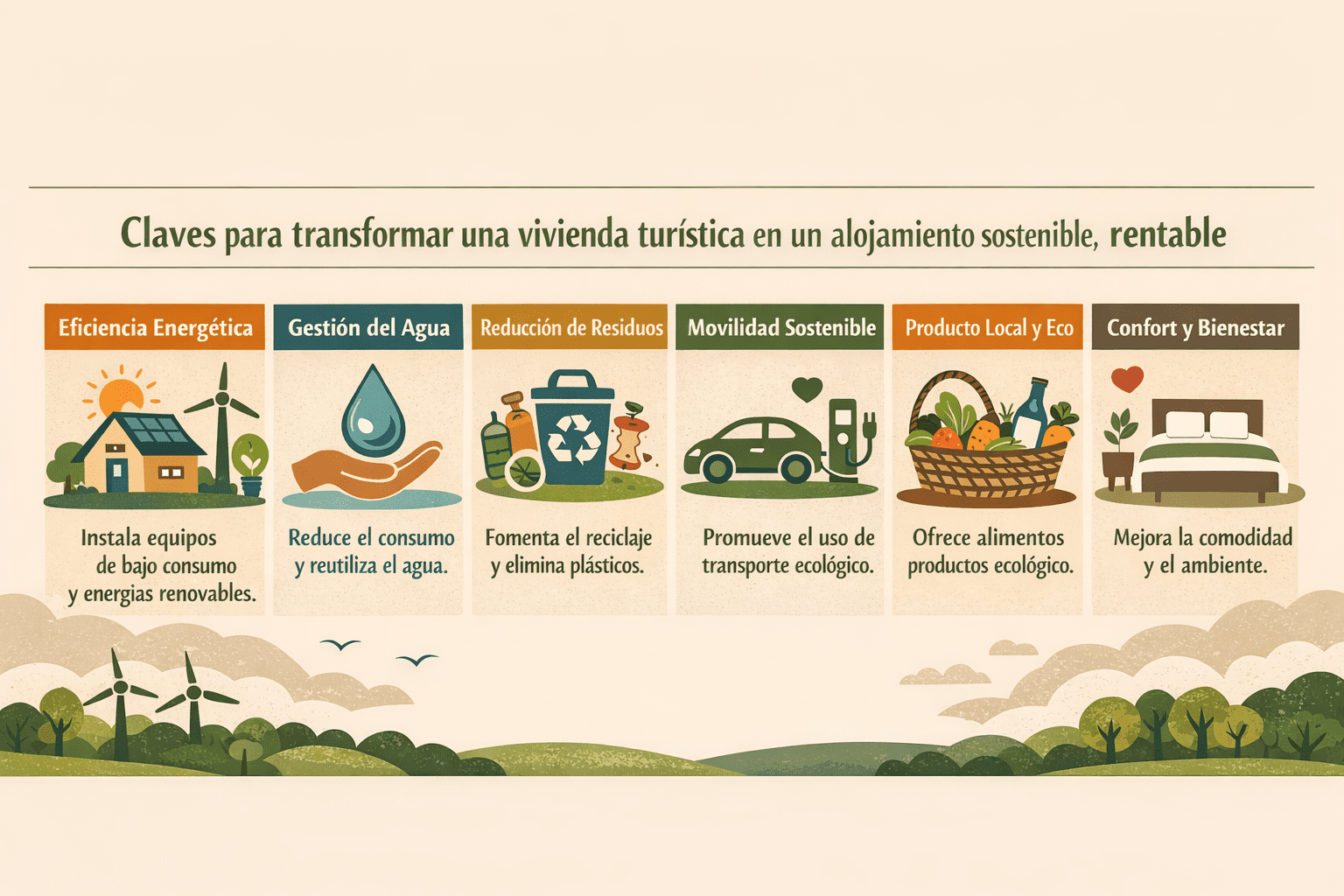
Energy efficiency: the clearest way to reduce costs without harming the experience
Energy is often one of the most significant variable costs of a tourist accommodation, especially in properties with air conditioning, electric heating, water heaters, dryers, or intensive use of lighting and appliances. Improving energy efficiency does not mean “limiting” the guest, but rather avoiding waste that does not provide value.
The best results often come from a combination of small, well-coordinated decisions: appropriate lighting, controlled climate, efficient equipment, preventive maintenance, and clear usage guidelines. In many cases, savings do not depend on major renovations, but rather on correcting habitual inefficiencies.
Efficient lighting
Replacing old bulbs with quality LEDs is one of the simplest and most effective measures. The choice should be made not only for consumption, but also for durability, color temperature, and visual quality.
When well implemented, this measure can lead to very appreciable reductions in consumption compared to less efficient lighting systems.
Smart thermostats and temperature control
They allow for limiting reasonable temperature ranges, avoiding unnecessary operation, shutting down during absence, or scheduling the equipment before arrival. They are especially useful when the accommodation does not have continuous in-person supervision.
In many accommodations, smarter control of climate allows for containing consumption without deteriorating comfort.
Opening sensors on windows and doors
They are very useful to prevent the air conditioning or heating from continuing to operate while the guest ventilates or leaves a window open. In coastal tourist homes, those with high solar exposure, or those with intensive use of air conditioning, this measure can have a significant operational impact.
Efficient appliances
Choosing efficient equipment not only reduces consumption; it also usually translates to less wear, a lower likelihood of breakdowns, and a more stable user experience. In a tourist home, it is advisable to prioritize the refrigerator, washing machine, dishwasher, and climate control. When comparing, look at the EU energy label: since March 2021 for refrigerators, washing machines, dishwashers, and displays, and since September 2021 for light bulbs, it uses a rescaled A to G scale with no “A+++” classes, so a current class C can correspond to a very efficient appliance.
It is not always necessary to replace everything at once. A sensible strategy is to renew based on age, intensity of use, and operating cost.
Properly sized climate control
An undersized unit works harder and consumes more to reach the desired temperature. An oversized unit can create inefficient cycles and ongoing waste. Before replacing units, it is advisable to check if the installed capacity, orientation of the home, insulation, and actual use are well-aligned.
Professional approach
Energy efficiency should not be approached as a collection of gadgets, but rather as a coherent system. First, it is important to identify where excessive spending occurs, then prioritize interventions with the most impact, and finally, communicate reasonable and friendly usage guidelines to the guest.
Water savings: silent efficiency with great operational impact
Water is one of the resources where improvements can easily be made without negatively affecting the guest. In fact, a well-prepared home can significantly reduce consumption while maintaining a comfortable and natural feeling of use. The key is to install efficient fixtures, check for leaks, and select equipment designed for intensive use.
In accommodations with high turnover, small losses or poorly controlled uses can have a significant cumulative effect. Therefore, water management should be treated as part of strategic maintenance, not as a minor aspect.
Aerators in taps and showers
They reduce flow without necessarily causing the user to perceive a loss of comfort, provided the product is of high quality and well chosen. They are one of the simplest measures to consistently contain water consumption.
Dual flush toilets
They allow adjusting actual use to the need and prevent excessive consumption at one of the usual points of expense. In tourist homes, their installation is usually advisable when not already incorporated.
Periodic inspections and leak detection
A dripping faucet, a tank that doesn't close properly, or a small invisible leak can increase the bill more than it seems. Establishing a quarterly check of faucets, hoses, tanks, and water pressure helps to avoid hidden consumption and major damage.
Efficient washing machines and dishwashers
Choosing quick and efficient programs, adjusting loads, and selecting equipment suitable for the actual volume of accommodation can reduce water, electricity, and operating time. In many cases, a well-used dishwasher proves to be more efficient than intensive manual washing.
Responsible Waste Management: Order, Clarity, and Ease for Guests
A poorly designed waste system generates confusion, dirt, bad smells, and a sense of disorder. On the contrary, when the accommodation incorporates clear and practical management, guests tend to cooperate better, and maintenance becomes simpler. Sustainability here does not rely solely on having several bins, but on ensuring that the entire system is intuitive.
The operational key is to simplify. If recycling or separating waste feels inconvenient, guests are less likely to do it. Therefore, it is advisable to design a realistic solution adapted to the space, the traveler's profile, and the cleaning operation.
Clear and Accessible Recycling
Reduction of Single-Use Plastics
One of the most visible changes for guests is the replacement of single-use formats with more durable, hygienic, and consistent solutions. It is also a regulatory matter: Ley 7/2022 bans placing on the market single-use plastic cutlery, plates, straws, stirrers, and cotton buds, expanded polystyrene cups and food containers, and any oxo-degradable plastic product, and Regulation (EU) 2025/40 will ban, from 1 January 2030, single-use miniatures of shower gel, shampoo, and other toiletries in the accommodation sector. Refillable dispensers let you get ahead of it.
Sustainable Welcome Kit
The welcome can also convey responsibility and quality without losing attractiveness. The important thing is to avoid excess and choose products that are consistent with the type of accommodation.
Materials, Equipment, and Decoration: Sustainability That Also Enhances Durability
In a tourist accommodation, sustainability does not mean decorating with "eco" aesthetics, but rather selecting materials and objects that last longer, generate fewer replacements, age better, and convey superior quality. Often, the most sustainable option is not the cheapest at purchase, but what withstands real use of the accommodation better.
The choice of furniture, textiles, paints, and decorative elements influences not only environmental impact but also cleanliness, maintenance, health, and the guest's final perception.
Quality Furniture and Durability Criteria
It is advisable to avoid very inexpensive furniture meant for occasional use when the accommodation will have continuous turnover. Choosing sturdy, repairable pieces with durable finishes is often more cost-effective in the medium term than constant replacements.
Natural or Better-Performing Textiles
Cotton, linen, or well-selected blends can offer better touch, breathability, and a more polished appearance. In tourist use, it is advisable to balance sustainability, ease of washing, durability, and a professional look after many cycles.
Paints and Finishes with Better Indoor Performance
Paints with lower odor load or more careful formulations can improve the sense of cleanliness in the accommodation, especially after maintenance or repainting between seasons.
Responsible and Functional Decoration
Sustainable decoration is not about filling the home with “green” elements, but about reducing the superfluous, selecting pieces that provide real value, and avoiding fragile objects that are difficult to clean or collect dust. Fewer pieces, but better ones, tend to be a more sustainable and elegant strategy.
Key Purchasing Criteria
Before incorporating any material or equipment, it’s essential to ask: Will it last? Is it easy to clean? Can it withstand tourist use? Does it provide real comfort? Does it facilitate maintenance? Does it prevent constant replacements? This practical perspective often leads to much more sustainable decisions.
Sustainable Practices Focused on Guests: How to Engage Without Annoying
A significant part of the outcome depends on the guest's behavior during their stay. However, this aspect must be managed delicately. Sustainable communication cannot sound like a reprimand, limitation, or transfer of responsibilities. It should integrate as a friendly guide to responsible use within a quality experience.
When travelers understand that certain practices help maintain comfort, reduce waste, and care for the environment, they tend to cooperate more. The difference lies in how it is communicated and whether those guidelines are reasonable, clear, and consistent with the level of accommodation.
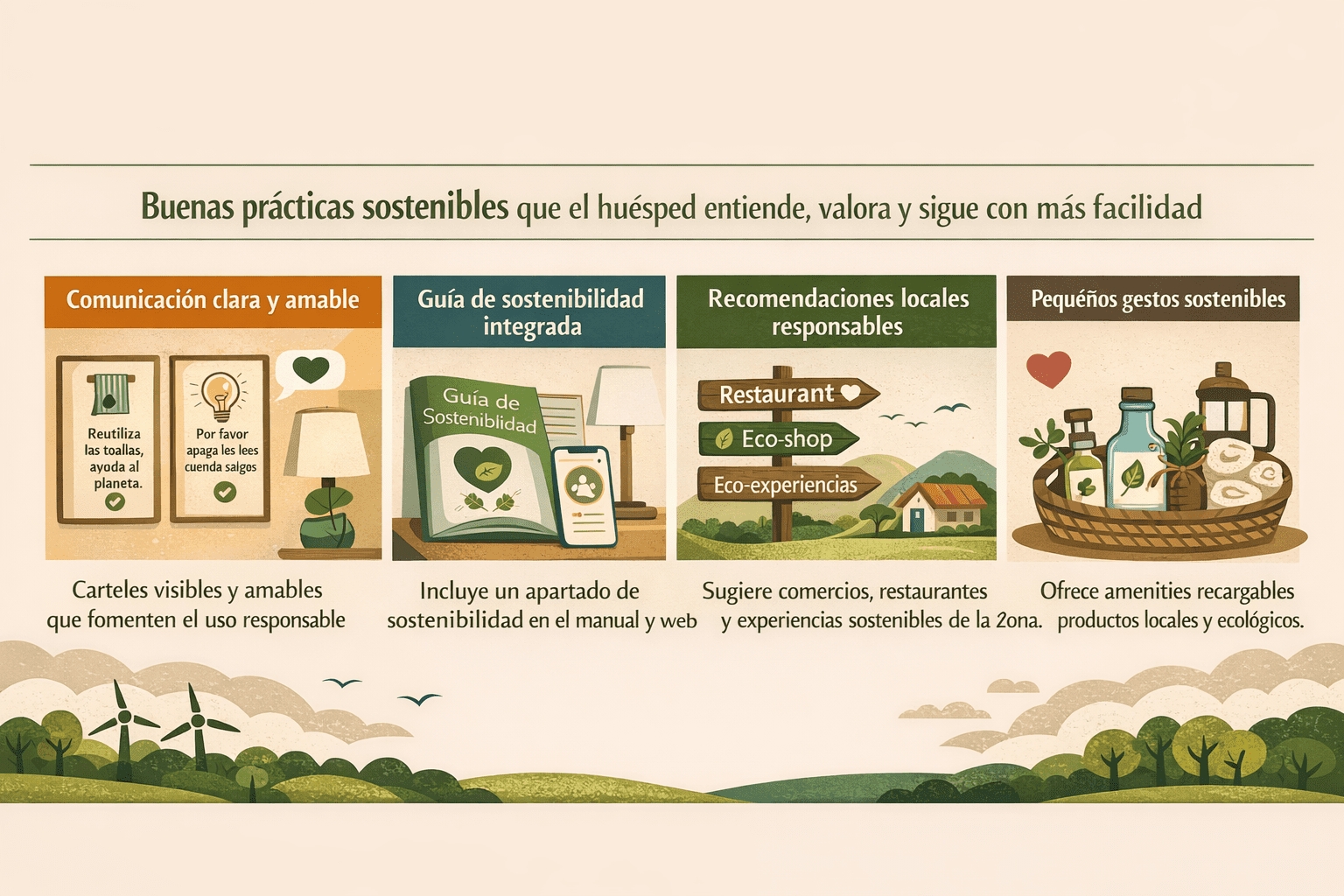
Clear and Kind Communication
Visible messages can encourage turning off unnecessary lights, using climate control sensibly, or separating waste, but always in an elegant tone. It is better to speak of shared care, comfort, and responsible use than to focus on prohibitions or excessive warnings.
Accommodation Manual with Sustainability Guide
Including a small section on sustainability within the welcome manual helps provide context. It can explain how to recycle, how the climate control works, where the bins are located, or why certain amenities and savings systems have been chosen.
Responsible Local Recommendations
Suggesting local shops, local producers, restaurants with local products, or activities that are less harmful to the environment strengthens the positioning of the accommodation and enhances the guest's experience with a more authentic perspective.
How to Implement Sustainability Without Turning It Into Unruly Spending
One of the most common mistakes is trying to apply sustainability through impulsive purchases or isolated decisions. A tourist accommodation needs a simple, realistic, and prioritized plan. Not all measures have the same impact, nor should they all be implemented at the same time.
The best strategy often consists of dividing actions into phases: quick savings, operational improvement, and smart replacement. This approach avoids spending without criteria and helps build a truly more sustainable model.
Before investing, also check which grants and incentives are still available. The personal income tax (IRPF) deductions for energy efficiency improvement works have been extended (Real Decreto-ley 7/2026) until 31 December 2026 for works on the home itself (20% and 40%), but in principle they only apply to a main residence or a home rented out as a dwelling, so they do not usually fit a tourist rental property; the 60% deduction for the energy renovation of predominantly residential buildings runs until 31 December 2027. Regional calls for applications funded by Next Generation EU have their own deadlines and requirements, and the Energy Savings Certificates system (Real Decreto 36/2023) allows you to transfer the savings generated by certain improvements to a third party in exchange for compensation. Consult your tax adviser and your region’s housing renovation office or energy agency before starting any works.
Phase 1: Quick Impact Measures
Switching to LED, aerators, checking for leaks, organizing recycling, clear signage, refillable dispensers, and optimizing cleaning and washing protocols.
Phase 2: Monitoring and Improving Consumption
Smart thermostats, opening sensors, checking climate control equipment, evaluating old appliances, and adjusting usage manuals for guests.
Phase 3: replenishment and consolidation
Progressive renewal of furniture, textiles, and equipment with criteria of durability, efficiency, and maintenance. This is the phase where it is best to buy less, but better.
Certifications and badges: when they can add value and when they should not become an end
Some accommodations want to go a step further and support their commitment with a badge or certification. This can make sense when it is part of a global positioning strategy, when the customer profile values it, or when it helps to structure internal processes.
However, it is worth remembering that a certification never substitutes for the actual quality of the accommodation. If there is no operational coherence behind it, the badge loses strength. There must first be a solid foundation; then, if it fits, accreditation can be considered.
ISO 14001
International reference in environmental management, more common in business structures with formalized processes.
Biosphere Sustainable Tourism
A well-known badge in the tourism field, useful when looking to reinforce a sustainability narrative with external recognition.
Green Key or other sector accreditations
They can be interesting if the target audience recognizes them or if they help to structure internal improvements and differentiate the accommodation.
Energy efficiency certificate
It is not a voluntary label: Real Decreto 390/2021 requires a registered energy efficiency certificate in order to rent out the property, including as tourist accommodation (except in cases such as detached buildings with less than 50 m² of usable floor area), and its article 17.3 requires the energy rating to be included in every offer, promotion, and advertisement, including listings on portals and platforms. Advertising without it is a minor infringement, and advertising a rating without a valid certificate may be a more serious one. Beyond compliance, a good classification reinforces the perception of quality and efficiency if backed by a truly well-optimized property.
Prudent recommendation
Before seeking a certification, it is advisable to review whether the accommodation already consistently meets basic standards of efficiency, maintenance, waste, communication, and material selection. If the foundation is not solid, the priority should be to improve the actual operation.
Common mistakes when discussing sustainability in a holiday accommodation
Confusing sustainability with aesthetics
Incorporating “green” decorative elements or an environmental discourse is not enough if the accommodation still has uncontrolled consumption, constant replacements, or inefficient operations.
Overloading the guest with excessive messages
If the communication appears to be a list of obligations, the effect can be counterproductive. Sustainability should be integrated naturally within a pleasant experience.
Purchasing without prioritizing
Spending on “eco” products with little impact while maintaining leaks, inefficient appliances, or poor operational habits often represents a misallocation of the budget.
Not measuring or reviewing results
Without tracking invoices, incidents, replacements, or guest feedback, it is difficult to know which measures truly work and which only look good on paper.
Promise more than what the accommodation offers
Sustainability also demands honesty. It is better to communicate real and specific improvements rather than using grandiose language that the guest does not perceive in practice.
Professional Sustainability Checklist for Tourist Accommodation
Conclusion: Sustainability as a Competitive Advantage, Savings, and Quality Management
Sustainability in tourist accommodation should not be seen as a trend or merely an aesthetic obligation. When well applied, it is a management tool that helps consume less, maintain better, save more, and project a stronger and more professional image. It also helps build a lodging experience more aligned with what many travelers already expect to find.
Sustainable accommodation tends to last longer, experience less operational wear, generate better reviews, and attract an audience that values real quality, not just appearance. Furthermore, when these measures are implemented thoughtfully, sustainability ceases to be an added cost and becomes a profitable investment.
The true advantage lies in combining three dimensions:
Turning your tourist accommodation into a more sustainable space does not require doing everything at once, but it does require moving forward with a professional vision. Each well-thought-out improvement contributes to more responsible, more competitive lodging that is better prepared for the future.