
Safety, Regulations, and Risk Prevention in Tourist Accommodations
Safety in a tourist accommodation is not an accessory detail or a mere administrative requirement: it is one of the foundations on which the entire business rests. An accommodation may have a good location, attractive decoration, and a correct commercial strategy, but if it fails in safety, regulatory compliance, or risk prevention, the project is exposed to incidents, claims, penalties, reputational damage, and even more serious liabilities.
In this context, it is important to adopt a professional and broad perspective. It is not enough to think about fires or locks. Safety in tourist accommodations encompasses the physical safety of the property, the legal safety of the activity, the operational safety of day-to-day activities, the health safety of the space, technological protection, and the actual ability to react quickly and judiciously when a problem occurs. That combination allows for calm operations, conveys trust to the guest, and protects the value of the property in the long term.
Moreover, safety should not be viewed as a burden. When well managed, it is a clear competitive advantage. It reduces incidents, improves the guest experience, avoids conflicts with neighbors, facilitates the team's work, and contributes to obtaining better reviews. An accommodation that is well maintained, well signposted, well informed, and well protocolized tends to generate less friction, less improvisation, and more of a sense of professionalism.
General Framework: Safety, Compliance, and Responsibility of the Manager
Although the specific regulations may vary depending on the autonomous community and the type of property, there is a common idea that should be kept in mind: the owner or manager of the accommodation is not only marketing a stay but is also providing the guest with a space that must be habitable, safe, functional, and compliant with applicable regulations. Therefore, professional management requires reviewing both the tourist regulations and other areas that indirectly affect the activity: consumer protection, data protection, neighborhood coexistence, installations, maintenance, insurance, and risk prevention.
A common mistake is to focus solely on obtaining the registration or tourist license while neglecting everything else. However, true compliance does not end when the accommodation is registered: it begins there. From that moment on, operations must be sustained with procedures, evidence, and a continuous review logic. An apparently correct accommodation can generate problems if it has an expired fire extinguisher, lacks clear instructions, does not have an organized response plan for emergencies, or if the guest cannot find visible information about the basic functioning of the accommodation.
Safety is not a decorative layer of the operation but a structural part of the product. A well-protected and well-protocolized accommodation tends to be more profitable because it operates with fewer disturbances, fewer compensations, fewer negative reviews, and less internal wear and tear.
It is advisable to work with a simple logic: review, document, correct, and re-review. This cycle turns safety into a stable system and not an improvised reaction when a problem has already arisen.
Physical Security of the Property: What Must Never Fail
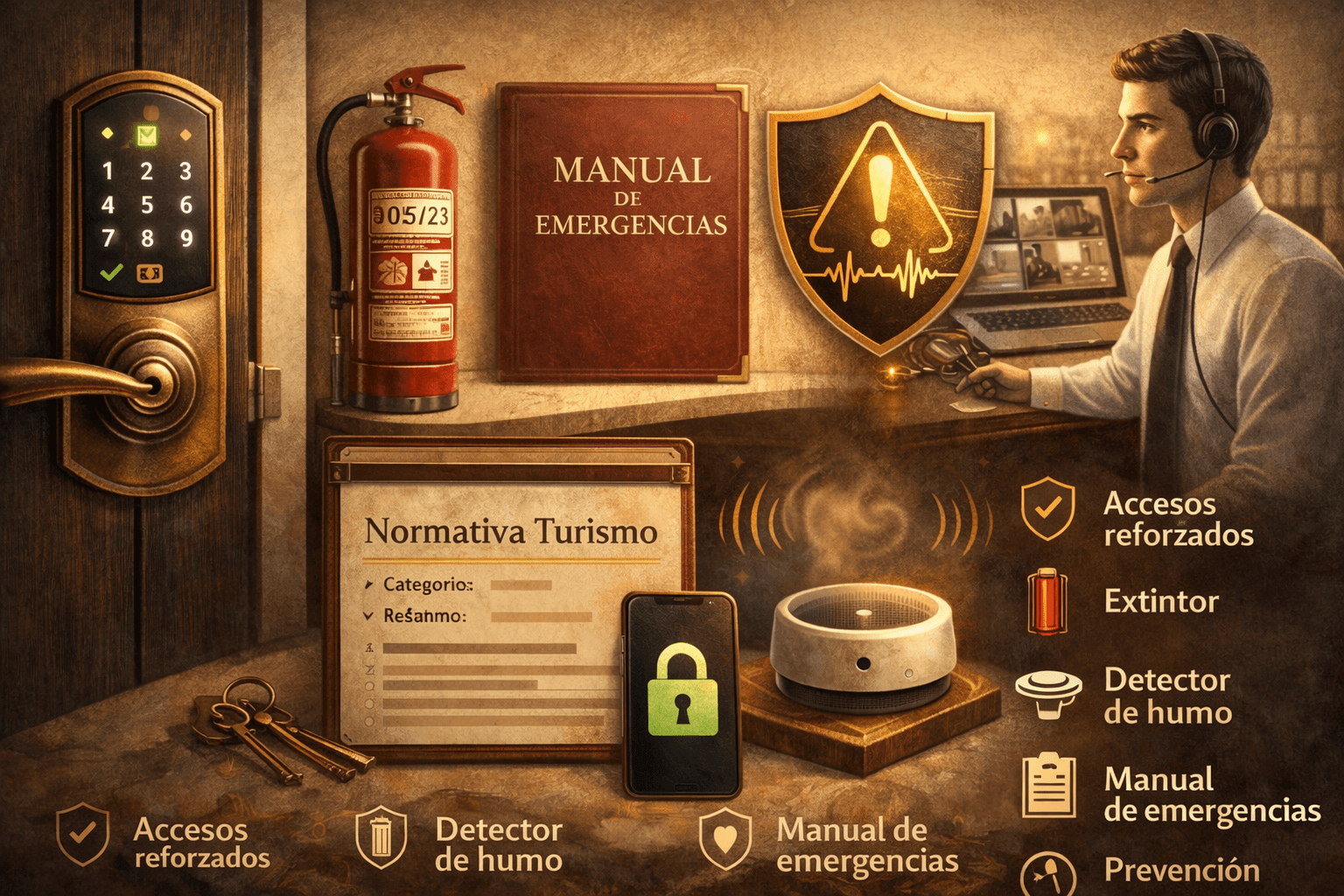
Physical security starts with the basics: ensuring that guests can enter, stay, and move around the property without exposing themselves to avoidable risks. This may seem obvious, but a significant portion of incidents stems from very fundamental issues: poorly marked steps, damaged sockets, insecure windows, unreliable locks, slippery rugs, and inadequate lighting in access areas or unstable furniture. When the accommodation is used intensively and by very different types of guests, these small flaws multiply.
Thus, a tourist rental should be considered almost like a product for rotational use. It is not evaluated in the same way as a private residence where occupants know the space and its particularities. Here, people enter who are unfamiliar with the layout, often arriving tired, sometimes at night, with luggage, children, in a hurry, or with high expectations. Everything that is intuitive, robust, visible, and stable reduces risk.
The main door, lock, entrance, exterior lighting, and arrival route must convey real security and not just appearance. An uncomfortable or unclear access point generates anxiety, emergency calls, and a bad first impression.
Falls are one of the most frequent and at the same time most preventable risks. Every transit point must be stable, visible, and comfortable.
In tourist accommodations, it is not enough for "everything to work." It must function stably, safely, and understandably for someone who has never used that space. This is especially crucial for electrical installations, hot water, boilers, gas, heating, and ventilation.
Well-identified circuit board, functional breakers, sturdy sockets, sufficient lighting, and absence of makeshift repairs. Electricity is one of the main sources of incidents when maintenance is neglected.
Up-to-date inspections, correct functioning, absence of strange odors, adequate ventilation, and ease of locating the shut-off valve. In combustion systems, it is advisable to take extra precautions with detectors and thorough inspections.
Conduct a physical review of the property as if you were a guest arriving for the first time, at night and in a hurry. Walk through the access, open doors, use lights, test sockets, check closures, observe floors, and analyze whether a newcomer would easily understand the space. This exercise uncovers flaws that often go unnoticed by the owner.
Fire Prevention and Emergencies: Minimum Requirements and Recommended Best Practices
When discussing safety, fire prevention must take a priority place. Although not all tourist accommodations are subjected to the same material requirements, there are certain elements that are practically essential from a professional perspective. Moreover, several autonomous communities already require them expressly: in Andalusia, Decree 28/2016 (as worded by Decree 31/2024) requires a first-aid kit, a smoke detector near the kitchen, a fire extinguisher and an evacuation plan on the door of the property; in the Community of Madrid, Decree 27/2026, which amends Decree 79/2014, requires a hand-held fire extinguisher inside, basic emergency signage, a visible evacuation plan and a sign with the emergency telephone numbers in at least Spanish and English, with a three-year adaptation period for properties already in operation. Always check the regulations in force in your autonomous community. The goal should not just be to meet the "minimum" requirements, but to genuinely reduce risk and improve the reaction capacity of both guests and managers.
The key point here is that a fire or small outbreak leaves no room for improvisation. If the fire extinguisher is not accessible, if the detector isn't functioning, if the guest doesn't know where the exit is, or if they do not have clear instructions, the problem escalates very quickly. That's why prevention has two inseparable components: material means and effective communication.
Health Safety and Habitability Conditions
A safe tourist accommodation must also be healthy. Health safety goes beyond visual cleanliness: it includes air quality, moisture control, absence of pests, textile hygiene, inspections of bathrooms and kitchens, sufficient ventilation, and a general feeling of salubrity. Many negative reviews that seem to be about “cleanliness” are actually problems related to habitability or poorly resolved maintenance issues.
At this point, professional criteria demand moving from reactive cleaning to protocolized cleaning. It is not enough to leave the property "seemingly good." One must work with checklists, recurring tasks, and a preventive look: filters, joints, odors, siphons, extraction, mattresses, fabrics, corners of the kitchen, appliances, and low-visibility areas.
Clear protocols, visual and functional inspections, odor control, sanitized textiles, and uniform standards between bookings.
Inspection of enclosures, control of food scraps, preventive treatment in sensitive areas, and immediate follow-up of any signs.
Effective extraction, sealing of joints, monitoring of condensation, and prompt responses before the problem becomes a recurring complaint.
A persistent smell, a blackened joint, a stain on the ceiling or wall, a bathroom that doesn't ventilate well, a damp mattress, an air conditioning unit with neglected filters, or a kitchen with debris in hidden areas are small alerts that signal larger problems ahead. The sooner they are addressed, the lower the cost and the less impact they'll have on the guest's perception.
In a vacation rental, the hygiene standard should seem obvious to the customer. When a guest notices these details, it's usually because something has already led to distrust.
Legal and regulatory safety: what is visible, what is mandatory, and what is prudent
Legal safety means operating in a way that not only ensures the property runs well but also reduces exposure to inspections, claims, or violations. Practically, this involves taking care of the visible aspects of regulations, the basic documentation of operations, and the relationship between the property, the guest, and the authorities.
Here, it is important to act with professional prudence. Some matters depend on the autonomous community, the municipality, or even the specific characteristics of the property. Therefore, the correct approach is not to invent requirements or copy models from others, but to clearly identify what is mandatory in your case, what is highly recommended, and what should be established as an internal standard even if it's not always expressly required.
The appropriate policy should not be analyzed only from the perspective of "just in case," but as part of the operational protection of the property. A liability insurance and coverage coherent with tourist use can make the difference between a manageable incident and an expensive problem. What matters is not just having any policy, but reviewing what it covers, what it excludes, and how it fits with the actual activities carried out in the property.
It is also advisable to know clearly what documentation the insurer would request in the event of an incident. Having invoices, reports, photographs, records, and logs simplifies any subsequent management.
Technological security and data protection
Technology has greatly improved the operation of vacation rentals, but it has also introduced new risks. Smart locks, sensors, outdoor cameras, digital check-ins, identification forms, automation, and shared WiFi networks can bring efficiency, but only when used within legal and operational guidelines. The key is to remember that not all useful technology is automatically correct, nor should everything that can be installed be installed.
In this environment, one of the most important principles is guest privacy. The accommodation must feel secure, not monitored. Any tool affecting personal data, image recording, or remote control should be carefully analyzed. Guest trust is easily destroyed if they perceive an invasion of privacy or unclear handling of their information.
Smart locks, temporary access, noise sensors without audio recording, QR codes with manuals, and communication automation can provide real security if they are properly configured and transparently explained.
The goal should be to improve operational control without undermining guest privacy or unnecessarily complicating the experience.
A stable and secure network is no longer an extra, but a basic expectation. Guests need it for work, navigation, entertainment, and communication. Moreover, from a management perspective, a well-resolved network prevents incidents with smart locks, automations, or property devices.
It is advisable to use strong passwords, avoid improvised configurations, and separate environments when the vacation rental network coexists with other uses of the property or the owner's. Connectivity should be convenient for the guest and sensible for the operation.
Noise prevention, coexistence, and conflicts with neighbors
In many vacation rentals, the real operational risk does not arise within the dwelling but in its relationship with the building and its surroundings. Noise, intensive use of common areas, nighttime entries, luggage at odd hours, non-compliance with rules, or the manager's poor reaction to a complaint can turn a profitable activity into a constant source of tension. Prevention here is worth much more than reaction.
The most effective way to reduce conflicts is to combine guest selection, clear information, well-placed reminders, and rapid intervention capability. It's not just about putting rules in writing, but about making them understandable, visible, and coherent with the type of property. The more urban, sensitive, or conflict-prone the location, the more important it will be to professionalize this aspect.
In small communities, very residential buildings, or environments with a history of conflict, it is advisable to heighten prevention: very clear communication, control of profiles, quick responses, and zero tolerance for serious breaches.
Minimizing the first neighbor complaint or responding late. Many chronic tensions solidify because the environment perceives passivity, lack of control, or little professionalism from the manager.
Emergency manual and useful communication for the guest
A well-designed emergency manual is one of the most undervalued tools in the vacation rental. It should not be long or technical, but clear, visible, and actionable. Its purpose is not to impress, but to resolve. In case of a leak, an electrical failure, a fire outbreak, or a medical incident, the guest needs to find basic and understandable information within seconds.
The quality of the manual also influences the overall feel of the accommodation. When the guest sees that the property is well organized, with clear instructions and defined contacts, they perceive more control and professionalism. This reduces anxiety, unnecessary calls, and wrong decisions in response to minor incidents.
Write the manual as if it needs to be understood by a nervous, foreign person with no technical knowledge. Short sentences, clear commands, direct language, and a clean design. The simpler and more visual it is, the more useful it will be in a real situation.
Incident Response Protocol: From Chaos to Professional Response
The true level of professionalism of a manager is demonstrated not when everything is going well, but when an incident occurs and they know how to respond in an organized manner. Having a protocol means avoiding improvisations, assigning priorities, communicating calmly, and documenting what happened. It doesn't require building a complex system, but one that is useful and repeatable.
Most incidents in holiday rentals can be grouped into a few categories: electrical failures, water leaks, access problems, climate control issues, conflicts with neighbors, cleanliness failures detected upon arrival, domestic accidents, or noise complaints. For each of these, it's advisable to have a basic sequence: assess, contain, assist, communicate, resolve, and document.
First, ensure safety. Assess if there is an immediate risk, instruct the guest on how to act safely, coordinate technical assistance, and quickly decide whether the problem allows for the continuation of the stay or requires an alternative solution.
Shut off water, contain the incident, assist, and document. It's important to minimize damage, guide the guest, mobilize a technician or insurance, and quickly decide if the experience remains viable or requires compensation or relocation.
There should always be an alternative: secondary code, remote support, backup system, or intervention person. Access is one of the incidents that causes the most strain if not resolved very well.
Intervention should be prompt, clarify the rules, assess reputational risk, and act firmly if the behavior compromises coexistence or the continuity of the activity.
Common mistakes that put tourist housing at risk
Practical recommendations for operating with more safety and less exposure
A well-conducted quarterly review detects risks sooner than months of reactive management. Check access points, facilities, bathrooms, kitchens, lighting, detectors, signage, manuals, and general condition.
What relies on memory tends to fail. Checklists for cleaning, maintenance, preparation, and checkout greatly reduce the margin for error.
The clearer the access, rules, use of the property, and emergencies are, the less friction there will be during the stay and the lower the likelihood of avoidable errors.
Electricians, plumbers, locksmiths, insurance, and cleaning support should be able to respond quickly. The network of suppliers is a direct part of the accommodation's security system.
Final Security Checklist for Tourist Accommodations
Conclusion
Safety, regulations, and risk prevention should not be seen as a set of isolated obligations, but as a system that protects the guest, the owner, the building, and the business. A safe tourist accommodation instills trust, operates with less friction, defends better against incidents, and generates a much stronger perception of professionalism.
In practice, this means working in an orderly manner: reviewing installations, documenting actions, communicating well, preventing problems before they arise, and acting quickly when an incident occurs. There's no need to make management bureaucratic, but it should be serious and stable. That difference is what separates a merely published accommodation from one that is truly well managed.
Well-understood safety does not detract from profitability: it protects it. It reduces damage, conflicts, complaints, and wear and tear. It enhances the guest experience. It strengthens the accommodation's reputation. And, above all, it allows for building a more robust and sustainable operation over time.