Risk Management, Guarantees, and Conflict Prevention
In this chapter
How to protect your property, avoid incidents, anticipate problems, and manage conflicts professionally to reduce damage, preserve your reputation, and maintain the profitability of your rental.
Introduction
The risks in tourist accommodations are a natural part of vacation rental management. Property damage, conflicts with guests, coexistence issues, technical problems, or financial claims can arise even in well-managed accommodations. The difference between amateur operations and professional management lies not in the absence of problems, but in the ability to anticipate, reduce, and resolve them in an organized manner.
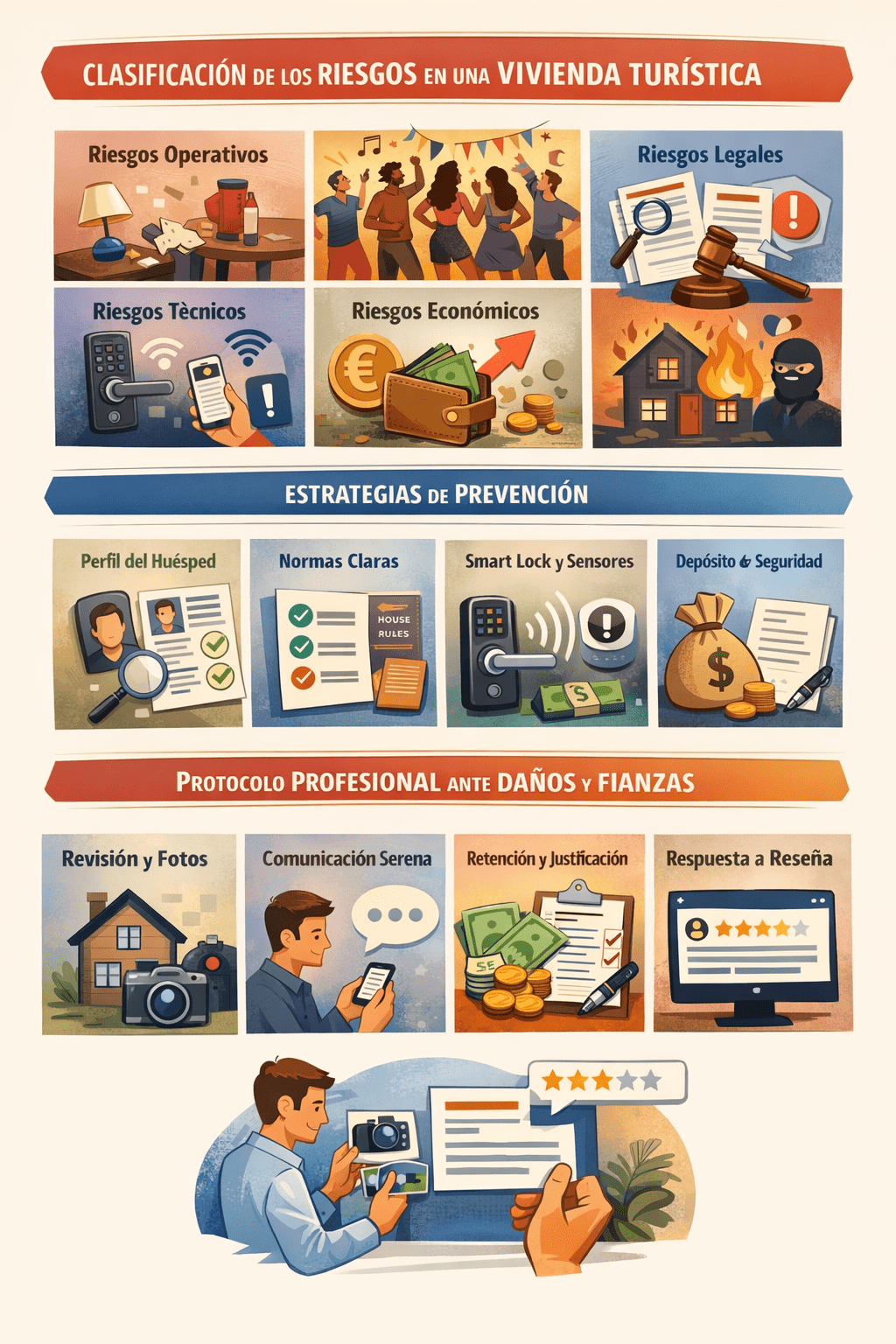
Managing a tourist accommodation involves accepting real risks that must be identified, classified, and addressed with a clear system. Among the most common risks are property damage, noise and neighbor conflicts, non-compliance with rules, troublesome guests, material damages, fraud, cancellations, access issues, or, in more delicate cases, scenarios of occupation, theft, fire, or serious breakdowns.
The good news is that almost all risks can be prevented, controlled, or neutralized if the accommodation has protocols, clear rules, appropriate technology, economic guarantees, and the capacity to react. In practice, prevention not only avoids losses: it also enhances the guest experience, reduces operational tension, and protects the business’s reputation.
In this chapter, you will learn how to classify the risks of a tourist accommodation, what preventive systems are advisable to implement, how to act in the face of damage, noise, conflicts, or unfair reviews, and what tools allow the owner to work with more security, control, and peace of mind.
Classification of Risks in a Tourist Accommodation
To effectively manage a risk, it must first be identified. Not all problems have the same origin, impact, or require the same response. Therefore, it is advisable to group them into categories that allow the owner to understand where their vulnerabilities lie and what preventive measures should be reinforced.
Important: a professional accommodation does not wait for the problem to arise. Classify the risks, review their likelihood, assess their impact, and prepare preventive measures before the incident turns into an economic or reputational loss.
Risk Prevention Systems
Prevention is always more effective and cost-efficient than reaction. A well-protected tourist accommodation does not rely on improvisation when an incident occurs, but rather on establishing filters, rules, technology, coverage, and procedures that minimize issues from the first contact with the guest.
1. Intelligent Guest Profiling
The first line of protection is not in the lock or insurance, but in selecting the guest. Properly evaluating a reservation significantly reduces a considerable part of human, economic, and reputational risks.
What to Evaluate
Warning Signs
The goal is not to discriminate but to reduce exposure. When a reservation does not fit the accommodation's profile or presents risk signs, it is advisable to be particularly cautious or to decline it outright.
2. Clear and Visible Rules
Rules reduce conflicts as they set the framework before a problem arises. They should be specific, concise, easy to understand, and communicated both via message and within the accommodation. In tourist accommodations, the absence of clear rules tends to generate more conflicts than having strict but well-written rules.
3. Smart Lock, Sensors, and Control Technology
The right technology allows for incidents to be detected before they escalate. It does not replace human management but makes it faster, more objective, and safer. In particular, access systems and monitoring significantly reduce the risk of parties, unauthorized entries, lost keys, and check-in problems.
Recommended System
- Professional smart lock with temporary codes and access logging.
- Noise sensor that measures decibels without recording conversations (on Airbnb it must be disclosed in the listing and cannot be placed in bedrooms or bathrooms; indoor cameras are prohibited).
- Occupancy or opening sensor at entrances when useful.
- Manual alternative procedures for technical failure cases.
This combination allows for the detection of parties, warns if more people enter than expected, reacts before a neighbor calls, and avoids unnecessary dependencies on the physical key.
4. Security Deposit and Economic Guarantees
The security deposit is a useful tool, especially for direct bookings, guests without a history, large groups, or long stays. Properly framed, it should not be seen as a punishment, but as a reasonable guarantee against damages, breaches, or losses.
When it is particularly advisable
- Bookings outside of Airbnb.
- Large groups.
- Guests without reviews.
- Long stays or those with greater exposure to damages.
How it can be managed
- Through the PMS.
- Via Stripe or an equivalent payment gateway (an online card pre-authorization usually expires after 7 days, so it is best to place it close to arrival).
- With prior authorization and clearly communicated conditions.
- Always linked to a policy of objective review.
5. Contracts, Inventory, and Documentation
In many incidents, prior documentation marks the difference between effectively resolving a conflict or lacking sufficient proof. For long stays or bookings outside of platforms, it is advisable to strengthen the documentation framework with contracts, inventory, and explicit acceptance of rules.
- For stays longer than 30 days, a temporary contract adapted to the corresponding use is highly advisable.
- The contract may include rules, inventory, liability clauses, penalties for noise, and resolution conditions.
- The inventory is particularly helpful with delicate elements, textiles, remotes, keys, accessories, and children's equipment.
- The documentation should be archived in an orderly and accessible manner in case of a claim.
6. Professional Insurance and Minimum Coverage
A basic home insurance policy is usually not sufficient for a tourist accommodation. The activity requires coverage adapted to the actual use of the property, with protection against incidents, claims, and possible damages caused by third parties.
Some policies also include coverage for lost profits or income loss after certain incidents. Reviewing exclusions, limits, and deductibles is as important as the price of the premium.
Prevention of Parties and Noise
Parties not only cause damages; they also generate legal conflicts, neighborhood complaints, and a rapid deterioration of the accommodation's reputation. In many cases, the problem is not so much the party itself as the lack of early reaction.
Example of preventive message: “Please remember that parties are prohibited and that rest hours from 22:00 to 08:00 must be respected. The accommodation is located in a residential area and we especially appreciate your cooperation.”
Prevention of illegal occupations
Illegal occupation is one of the most common fears among owners, although in practice most risky situations can be significantly reduced with proper management. The goal is to minimize any loss of control over access, occupancy, and documentation of the stay.
How to reduce the risk
- Always use a rental system clearly defined by time and conditions.
- Formalize a contract when the stay requires it.
- Utilize smart locks with temporary codes.
- Avoid handing over physical keys without control.
- Schedule periodic reviews, cleans, or checks.
- Control accesses and doors with appropriate technology.
Warning signs
- Guest asking to pay in cash or outside the usual circuit.
- Resistance to signing or identifying themselves.
- Local long-term reservation without a clear explanation.
- Request for multiple sets of keys.
- Suspicious requests about occupancy or access.
Management of damages and defects
Damages are part of the operation of tourist rentals. What is important is to have an agile review system that allows for the detection of incidents before the next check-in and documents them properly. Without review, there is no control; without proof, there is no solid claim.
Minimum protocol after each check-out
- Photos of the general condition of the accommodation.
- Quick inventory by areas.
- Review of appliances and climate control.
- Control of textiles, keys, remotes, and accessories.
- Incident report within approximately 20 to 30 minutes.
| Booking Channel | How the claim is usually managed |
|---|---|
| Airbnb | Reimbursement request through the Resolution Center within 14 days of check-out (AirCover damage protection), with photos, explanation, and documentation of the cost. |
| Booking | Damage payment request through Booking within 14 days of check-out; Booking passes it on to the guest, but payment is not guaranteed. It is advisable to reinforce the deposit and your own documentation. |
| Direct Booking | Prior deposit, clear contracting conditions, and justified charges with documentary support. |
Conflict Management as a Professional
In an incident, the way to react is as important as the incident itself. An impulsive message can turn a small problem into a long dispute and a bad review. The professional principle is simple: calmness, speed, documentation, and the right tone.
Conflicts with Guests
- Thank the message or information received.
- Validate their perception without automatically assuming responsibility.
- Offer an immediate solution or review when appropriate.
- Document what happened.
- Confirm in writing the resolution or the position adopted.
Conflicts with Neighbors or Noise
- Apology and quick response.
- Immediate contact with the guest.
- Follow-up until the disturbance ceases.
- Call or visit if the non-compliance continues.
- Cancellation or firm action if severity demands it.
Deposits, Damages, and Conflicting Reviews: How to Act with Professional Judgement
One of the most delicate moments in managing a vacation rental occurs when, after the guest's departure, damages occur, items are missing from the accommodation, or a conflict arises concerning the return of the deposit. In these situations, many hosts react late, communicate poorly, or make improvised decisions that end up generating a claim, a negative review, or even unnecessary financial harm.
Professional action requires a clear protocol: review, document, communicate calmly, justify any retention with evidence, and always separate the financial management from the emotional tone of the conflict. A bad experience should not turn into a reputational crisis if the host knows how to act with order, caution, and firmness.
What Should a Professional Deposit Policy Cover
The deposit should not be presented as a penalty, but rather as a guarantee mechanism to cover damages, losses, non-compliance, or improper use of the accommodation. For it to be truly useful, it must be clearly outlined in the booking conditions, be known to the guest prior to check-in, and be linked to reasonable, demonstrable, and proportionate scenarios.
Important: poorly communicated deposits create distrust. A well-explained deposit, associated with clear rules and objective reviews, conveys professionalism and reduces conflicts from the outset.
Protocol for action when damage occurs or an item is missing
The most common mistake is to immediately accuse the guest or report the issue without first gathering sufficient evidence. The correct order is to inspect, document, and communicate. Only then should the withholding of part of the deposit or an additional claim be considered.
What evidence to always keep
Photographs of the condition of the accommodation, inventory, usage rules, booking conditions, and deposit policy.
Photographs of the damage, screenshots of messages, invoice or replacement estimate, and internal note with review date.
Complete timeline, claimed amounts, response sent, and any elements that support proportionality.
How to communicate an incident to the guest without exacerbating the conflict
The key is to describe the facts, not to make judgments. The guest may react defensively if they interpret the message as a direct accusation. Therefore, it is advisable to avoid aggressive expressions, threats, or personal assessments. Communication should be brief, specific, and professional.
Correct approach: “After the review made following your departure, we have detected that one of the items in the accommodation is not in the condition it was delivered. We are writing to inform you about this and clarify it before proceeding with the return or adjustment of the deposit.”
Incorrect approach: “You broke this, you don't want to acknowledge it, and we are going to deduct it from the deposit.”
Tone recommendations
When the guest responds with a negative review
Not every negative review should be interpreted as a serious reputational issue. In many cases, the real mistake is not receiving criticism, but responding impulsively. If the review arises after communicating damage, claiming a replacement, or applying a deposit hold, it is advisable to analyze it coldly and assess whether it is a subjective opinion or inappropriate content.
| Situation | Recommended action |
|---|---|
| Subjective criticism about tastes or expectations | Respond courteously, without debating or refuting point by point. |
| Review linked to an economic claim | Respond neutrally and keep evidence in case it is necessary to report it. |
| False, insulting, or inappropriate content | Request a review from the platform providing context and evidence. |
| Prior threat of a review to avoid paying for damages | Save screenshots and inform the platform that there is retaliation or undue pressure. |
Professional criteria: an unjust review is not combated with anger, but with documentation. The better the incident is documented, the more options there will be to uphold a claim or defend the host's actions to third parties.
How to publicly respond to an unfair review
The public response is not intended to convince the guest, but to convey calmness and professionalism to future clients. It should be brief, elegant, and focused on the facts. In general, it is not advisable to expose all the details of the conflict or adopt a defensive tone.
Example of an appropriate approach
We regret that your final experience was not satisfactory. After your stay, a specific incident related to one of the elements of the accommodation was detected, which was communicated privately and with due respect. As always, we manage these situations with objective criteria, documentation, and a willingness to maintain a professional relationship with all our guests.
Particularly delicate situations to anticipate
Games, remotes, loose parts, or accessories tend to deteriorate or go missing easily. They require inventory, quick visual checks, and especially careful communication.
Not everything should be charged to the guest. It is essential to differentiate between damage, negligent use, and ordinary wear to avoid unfounded claims.
Some guests respond to a financial claim with public criticism. Therefore, the way and timing of the message are as important as the content.
Recommended internal protocol for the professional host
In professional practice, conflicts regarding deposits are not resolved well by intuition but by procedure. The clearer the internal system of the accommodation, the less room there will be for improvisation, tension, and reputational loss of control. A serious host does not argue: they document, communicate, and act proportionally.
Emergency protocols
Every manager should have clear protocols for emergency situations. It is not enough to know them informally: they must be documented, accessible, and, as much as possible, integrated into the accommodation's internal management manual.
An effective protocol should indicate what to check first, whom to contact, what message to send to the guest, what immediate measures to take, and how to document what happened. The difference between a controlled incident and a crisis often lies in having that process prepared in advance.
Risk Prevention Checklist
Conclusion
The best way to manage risk is to anticipate it before it happens. With the right tools, a tourist property can significantly reduce parties, over-occupancy, damages, operational incidents, and conflicts with guests or neighbors.
Prevention not only protects the property. It also protects the accommodation's reputation, the host's peace of mind, the relationship with the environment, and the profitability of the business. A clear system of rules, guarantees, documentation, technology, and protocols turns a vulnerable activity into a much more solid and professional operation.
In tourist rentals, managing risk isn't negative thinking: it is working intelligently. The better prepared the owner is, the less they will rely on luck and the more they can focus on providing a safe, orderly, and quality experience.