Advanced Revenue Management
How to Optimize Prices, Maximize Income and Turn Your Holiday Rental into a High-Performance Business
Revenue management is one of the most decisive areas in the actual profitability of a holiday rental. While many owners reduce it to “raising or lowering the price,” in reality, it is a much broader discipline: analyzing demand, anticipating market behavior, protecting valuable dates, avoiding unproductive gaps, and selling each night at the most convenient price according to the context.
In a holiday rental, each unsold night is lost forever. It cannot be recovered or stored for later. Thus, managing the calendar and pricing is not a secondary task, but a strategic function of the business. The same property can yield very different results depending on how its pricing policy is structured, its stay restrictions, its advance opening, and its ability to react to changes in demand.
Managers who professionally apply revenue management not only increase revenue. They also improve occupancy, reduce gaps between bookings, make better use of weekends and peak demand dates, and make decisions based on economic reasoning rather than acting on intuition or habit.
This chapter provides you with a practical and advanced view of revenue management applied to holiday rentals in Spain. The goal is not to complicate management, but to help you understand which variables to observe, how to make decisions more accurately, and how to transform price into a strategic tool for profitability, positioning, and business control.
What Good Revenue Management Allows You to Achieve
✓ Better average price per night
✓ Fewer unproductive gaps
✓ Better occupancy in low season
✓ Greater utilization of premium nights
✓ More control over the calendar
✓ Data-driven decisions instead of intuition
Why Pricing Cannot Be Managed Statistically
One of the most common mistakes in holiday rentals is working with almost fixed rates for weeks or even months. This approach often arises from the desire to simplify operations, but in practice, it leads to silent losses. When the market is strong, the accommodation sells too cheaply. When the market cools, the price becomes uncompetitive and calendar gaps appear that could have been avoided.
Tourist demand is not linear. It changes by season, day of the week, events, flights, destination behavior, listing reputation, stay restrictions, and competitor activity. Managing price as a static figure in such a changing environment reduces the accommodation's ability to capture value.
Revenue management is based precisely on this idea: the price must adapt to the context. It is not about changing rates indiscriminately, but structuring a clear, coherent, and revisable commercial logic that allows for optimizing income without compromising positioning or the guest experience.
Static Management
Often provides a false sense of order but reacts late to the market, misses demand peaks, and leaves too many nights vulnerable to poorly adjusted rates.
Dynamic Management
Allows adapting the price to the calendar reality, protecting strong dates, reacting to weak windows, and making decisions with greater economic logic.
Basic Indicators You Should Master Before Optimizing
You do not need to manage complex financial models to work effectively with revenue, but it is beneficial to master some indicators that help interpret the accommodation's performance with greater accuracy. These concepts are the foundation upon which more advanced decisions are built.
1. ADR (Average Daily Rate)
This is the average price per night sold. It indicates how much you are actually charging when there is a booking. If your ADR is low on dates when the market could support more, you're likely leaving money on the table.
2. Occupancy
This measures the percentage of nights booked compared to the total available. It is an important metric, but it should not be analyzed in isolation: a very high occupancy rate can hide a rate that is too low.
3. RevPAR
This relates price and occupancy to show how much revenue is generated per available night. It is one of the most useful indicators because it helps see if the balance between rate and occupancy is really efficient.
4. LOS (Length of Stay)
This is the average length of stay. It affects the calendar, the number of cleanings, operations, and net profitability. It is not always beneficial to maximize short stays if they impair the efficiency of the accommodation.
5. Pick-up
This measures the speed at which new bookings come in over a specific time window. It helps to detect whether the calendar is capturing demand normally or if an important date is lagging behind.
6. Lead time
This is the average lead time guests have when booking. Understanding this data allows you to know when a date can still be sold at a high price and when it becomes necessary to adjust strategy to avoid being too late.
Professional reading of these indicators
✓ High ADR with low occupancy may indicate excessive pricing
✓ High occupancy with low ADR may indicate undervaluation
✓ RevPAR helps see the real performance
✓ Lead time guides when to act
✓ Pick-up alerts about weak dates
✓ LOS affects profitability more than it seems
Practical reference formula
If an accommodation has an ADR of €120 and an occupancy of 75%, its RevPAR would be €90. In a month of 30 nights, this would equate to €2,700 in theoretical gross revenue. This straightforward reading helps compare expectations with what was actually achieved.
What variables should really influence the price
The optimal price for a holiday rental should never come from an arbitrary figure or a simple superficial comparison with other listings. It should respond to a more comprehensive reading of the context. The better you understand these variables, the less you will rely on intuition and the more capacity you will have to set coherent rates.
Furthermore, it is worth remembering that the price does not depend solely on the market. It also depends on the product. A well-equipped, well-photographed, well-reviewed, and well-managed accommodation can sustain higher pricing levels compared to other similar assets in the same location but with poorer perception and experience.
Seasonality
Summer, Easter, long weekends, Christmas, and school holidays modify the intensity of demand and should be clearly reflected in the pricing policy.
Local events
Fairs, congresses, festivals, concerts, sports events, or local holidays can radically alter the market during specific days.
Lead time
A booking made with two months’ notice does not behave the same as a last-minute booking. The available time conditions strategy.
Actual competition
Not all listings are comparable. Useful competition should resemble your property in terms of neighborhood, capacity, quality, positioning, type of guest, and reputation. Poor comparisons lead to poor pricing.
Internal value of the property
Design, air conditioning, beds, cleanliness, Wi-Fi, ease of access, good photos, and good reviews enhance perceived value. Revenue management cannot be separated from product quality.
How to Build a Professional Pricing Strategy
A well-defined revenue strategy is not about adjusting prices randomly every time a reservation comes in or doesn't come in. It is advisable to work with a base structure and then apply adjustments according to the evolution of the calendar. This logic helps maintain consistency and avoids impulsive reactions.
Practically speaking, it is often useful to start with a reasonable base price and modulate it according to the season, day of the week, events, future occupancy level, length of stay restrictions, and proximity to the check-in date.
1. Define a Consistent Base Price
It should reflect the average value of the accommodation under normal conditions. If the base price is set too low, the entire strategy will be dragged down.
2. Differentiate Between Low, Medium, High Seasons, and Extraordinary Peaks
Not all phases of the year merit the same pricing logic. It is advisable to recognize structurally weak periods and moments of maximum monetization capacity.
3. Adjust Weekend and Off-Peak Days
Fridays and Saturdays often bear better prices. Sundays, certain Tuesdays, or mid-week gaps may require more flexible strategies.
4. React According to the Booking Rhythm
If a date is selling very quickly, it may indicate underpricing. If it remains vacant for longer than normal, it’s time to review the price, minimum nights, visibility, or competitiveness of the listing.
5. Protect High-Value Dates
It is not advisable to sell strategic nights like holidays, long weekends, or local events under high demand pressure too early and too cheaply.
6. Maintain Reasonable Limits
Dynamic revenue does not mean accepting any variation. It is advisable to define minimums and maximums to maintain the commercial coherence of the accommodation.
Key Idea
The goal is not to achieve the highest price per night or the highest occupancy at any cost. The goal is to maximize overall income for the period with a sustainable and operationally sound logic.
Minimum Stays, Calendar Gaps, and Smart Restrictions
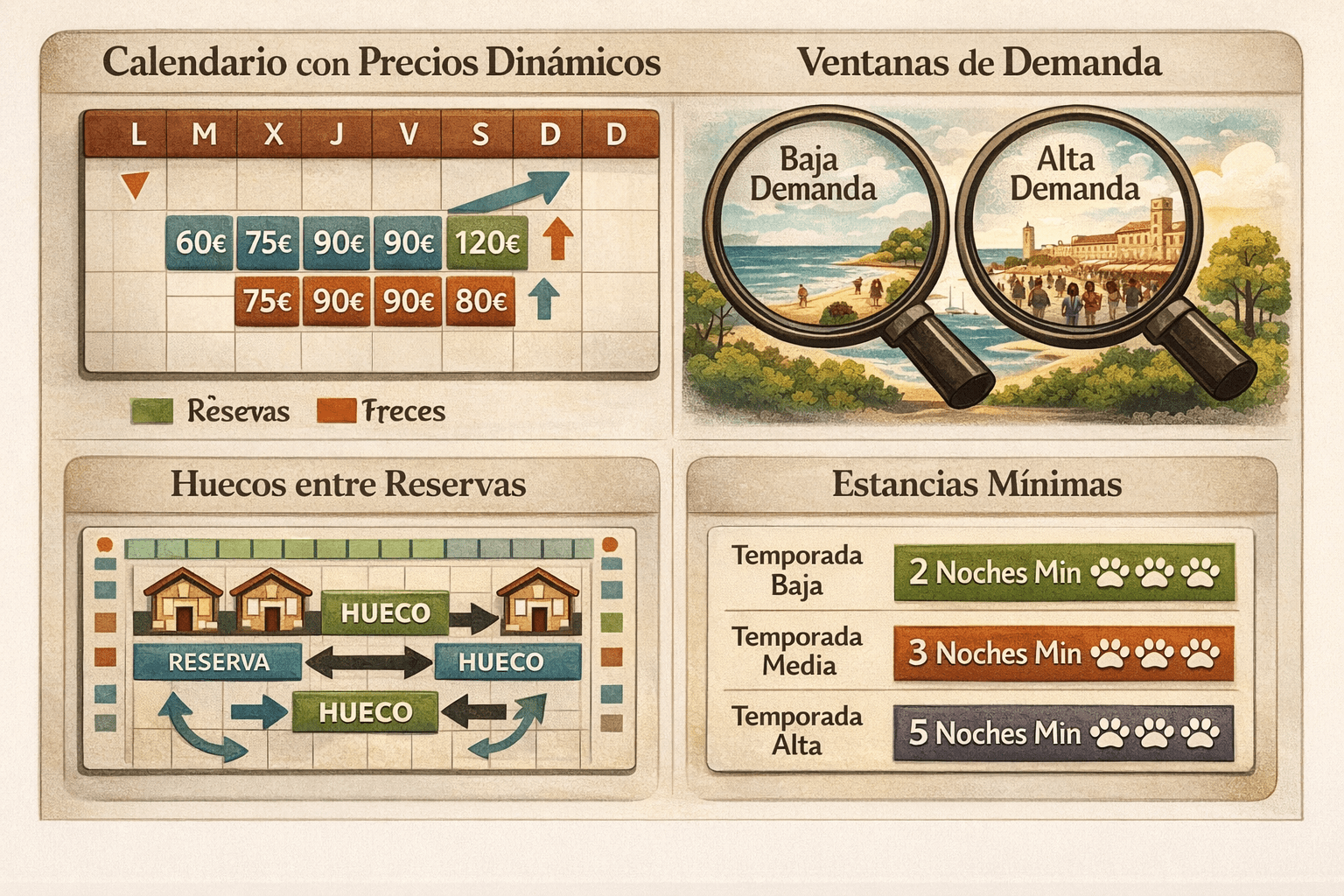
In revenue management, price matters a lot, but it is not everything. Calendar setup can greatly enhance or diminish the performance of the accommodation. A poor minimum stay or opening policy can leave unsold single nights, force unnecessary cleanings, or prevent valuable bookings.
Therefore, restrictions should be considered commercial tools. They are not applied to complicate the booking but to better organize inventory and protect the profitability of specific dates.
Smart Minimum Stay
During long weekends, summer, or major events, it may be advisable to require more nights to consolidate income and reduce operational friction. In low season, greater flexibility is usually beneficial.
Short Gaps
Gaps of one or two nights between bookings require a lot of attention. It is often preferable to adjust the price or restriction rather than leave completely lost nights.
Open or Close with Criteria
There are dates that should be opened well in advance at a high rate and others that require a review closer to the entry date for more precise adjustments.
Do Not Block Valuable Reservations Due to Excess Rigidity
Restricting too much on check-in or check-out days can organize operations, but it can also drive away very profitable demand if applied without commercial judgment.
Think about net profitability, not just gross rate
A very short stay with a high rate may seem interesting, but it does not always compensate if it multiplies operating costs and disrupts the calendar.
Last minute, early booking, and decision-making timeframes
One of the most interesting aspects of revenue management is that the same future date can require very different decisions depending on the point in the calendar you are in. A night that is coming up in ninety days is not managed the same way as a night that is coming up in three days.
Therefore, it is advisable to think in terms of decision timeframes. Each one allows for a different strategy and reduces the risk of acting too early or too late.
Early booking
If a strong date is far away, it is often advisable to start with high rates and leave room to observe the market response. It is always possible to lower rates; raising them late is not always feasible.
Intermediate window
This is the time to analyze pickup, future occupancy, competitor behavior, and nearby events to refine pricing more accurately.
Last minute
As the date approaches and remains empty, it may be necessary to relax minimum night stays, review pricing, increase competitiveness, or facilitate conversion. The important thing is to act with judgment, not panic.
Professional judgment
Not all weak dates should be discounted. Before lowering prices, it's advisable to check whether the real issue lies in the rate, in restrictions, in lack of visibility, in the quality of the listing, or in a poor understanding of the usual lead time for the destination.
Pricing policies that can reinforce your strategy
Beyond the published price, the conditions accompanying the booking are also part of revenue. Flexibility, cancellation, long stay discounts, special conditions, and the way the rate is presented directly influence conversion and the type of guest attracted.
There is no perfect combination for all accommodations, but it is important to understand what role each policy can play within a broader strategy.
Flexible rate
It can facilitate conversion in highly competitive or uncertain markets, though it increases exposure to cancellations and requires calendar monitoring.
Non-refundable rate
If used correctly, it helps consolidate income and reduce last-minute cancellations. It is advisable to apply it with reasonable discounts and not as an automatic formula in any context.
Long stay discounts
These can be useful for reducing turnover and improving operational efficiency, but they must be calculated carefully so as not to accidentally give up high-value nights.
Promotional offers
They make sense when responding to a specific situation in the calendar. Applying them by habit can spoil the market and erode the perceived value of the accommodation.
Tools and automation: when they truly help
As the number of properties grows or business demands increase, automation begins to add significant value. Dynamic pricing tools allow you to work with rules, limits, market signals, and daily adjustments without relying solely on constant manual revisions.
However, it is important to understand their role correctly. A tool can speed up analysis and facilitate reaction, but it does not replace the manager's judgment. Local events, the actual quality of the product, operational incidents, knowledge of the destination, and final oversight remain critical.
In other words: automating does not mean disengaging. It means gaining speed, consistency, and adjustment capability without losing strategic control.
Automated pricing · consumer-law limit in force in 2026: Article 20.1.c of the consolidated TRLGDCU requires clear communication of the final complete price and, where that price is personalised through automated decision-making in distance or off-premises contracts, clear and comprehensible information to the consumer. Personalisation may not cause increases in the final sale price when demand rises in situations of consumer urgency, risk or need linked to civil-protection emergencies. Revenue automation must therefore operate with legal as well as commercial limits.
Do not confuse the rule in force: former Article 20 ter, introduced by Royal Decree-Law 4/2026, ceased to have effect on 28 February 2026. Current revenue policies should refer to Article 20.1.c of the TRLGDCU.
Official source — BOE · consolidated TRLGDCU, Article 20
What a good pricing solution should provide you
✓ Quick review of peak and low dates
✓ Dynamic adjustments with defined limits
✓ Rapid reading of future occupancy
✓ Ability to act in time windows
✓ Reasonable integration with your operations
✓ Manual correction options when necessary
When it makes sense to automate
When you manage multiple properties, work with a lot of future inventory, need to react to multiple changes, or want to stop relying on disorganized manual reviews.
What mistake to avoid
Completely delegating pricing to a tool without strategic oversight. Automation improves execution but does not replace understanding of the business.
Common mistakes that destroy profitability
Much of the revenue loss does not occur due to a single massive failure, but rather from small poorly made decisions that repeat over months. Correcting these mistakes often has an immediate effect on the profit and loss statement.
Keeping fixed prices for too long
Makes accommodation perform poorly during various moments in the market and reduces the ability to capture value when strong demand appears.
Confusing high occupancy with good management
Filling up does not always mean earning well. Very high occupancy can hide insufficient pricing and poor monetization of valuable nights.
Not monitoring local events and demand spikes
Reacting late to fairs, conferences, or parties means losing a significant part of the calendar's potential.
Comparing yourself to listings that are not real competition
Misinterpreting the market leads to copying inconsistent rates and making decisions based on unhelpful references.
Forgetting the impact of restrictions
A correct price can still fail if the minimum stay, check-in days, or calendar configuration are blocking conversions.
Discounting reflexively for every empty date
Lowering the price does not always solve the problem. Sometimes the cause lies in lead time, visibility, the listing, minimum duration, or the product itself.
Not measuring results
Without reviewing ADR, occupancy, RevPAR, pick-up, or net profit per booking, it is impossible to know if the strategy is truly improving.
Practical recommendations for owners and managers
Review the calendar with discipline
There is no need to change prices every hour, but frequent reviews are necessary to detect early signals and take timely action.
Think in time windows
Do not make the same decisions at 90 days out as you would at 7 days before check-in. The available time completely changes the business logic.
Protect high-value nights
Bridges, holidays, and events deserve special attention. These are moments where a pricing error is much more noticeable in lost revenue.
Analyze what repeats
If certain days sell out easily while others are always stuck, the calendar is providing information. Revenue management is precisely about knowing how to read it.
Look at profit, not just gross
A very aggressive pricing or turnover strategy may generate bookings, but it can worsen net profitability due to excessive operations or poor calendar quality.
Integrate pricing and product
There is no strong revenue management without competitive accommodation. Photos, cleanliness, comfort, and online reputation directly influence the price the market accepts.
Final revenue management checklist
✓ Well-defined base price
✓ Differentiated seasons with criteria
✓ Reviewed weekends and low days
✓ Controlled local events
✓ Real competition identified
✓ Stay restrictions reviewed
✓ Calendar gaps monitored
✓ Lead time analyzed
✓ Pick-up observed by windows
✓ Results measured with ADR, occupancy, and RevPAR
Conclusion
Revenue management marks one of the clearest distinctions between amateur management and professional management of tourist accommodations. Not because it converts the lodging into a cold or automated system, but because it provides method, context reading, and the ability to make better decisions regarding each available night.
When price ceases to be a fixed number and becomes a strategic tool, the accommodation gains profitability, coherence, and stability. Repeating errors are reduced, high demand dates are better exploited, and there is more economic control over the calendar.
In an increasingly competitive market, optimizing revenue does not depend solely on advertising on platforms or having good photos. It also relies on understanding how demand behaves, how inventory is protected, and how each stay is sold with criteria. That is where revenue management ceases to be a complementary technique and becomes a true tool for performance, sustainability, and professional positioning.