Providers, Local Collaborations, and Strategic Alliances
Surrounding yourself with good providers is not a secondary detail in a holiday rental: it is one of the foundations of the business. Cleaning, maintenance, laundry, emergency assistance, product replenishment, photography, tax management, or local collaborations determine the actual quality of operations much more than many owners initially imagine.
A property can be well decorated, well located, and well advertised, but if there is not a reliable network of professionals behind it, sooner or later delays, failures, improvisations, and a sense of disorder will arise, ultimately affecting the guest's experience, reviews, and profitability. In contrast, when there is a solid structure around the accommodation, management gains consistency, responsiveness, and the ability to grow without losing control.
Owners and managers who work professionally do not just "have contacts." They build an operational network with criteria, protocols, priorities, response times, and clear standards. They know whom to call, under what conditions, with what expectations, and to what level of demand. Furthermore, they understand that well-established local alliances can enhance guest service, strengthen the reputation of the accommodation, and open new opportunities for positioning and growth.
The quality of a holiday rental does not solely depend on the property: it depends on the quality of the network that supports it.
Why the provider network defines the real quality of the accommodation
In holiday rentals, almost everything affects the guest's perception. If the apartment is spotless, check-in works, bed linen conveys cleanliness, the air conditioning responds, the Wi-Fi is good, and any incidents are resolved quickly, the guest interprets that they are in a well-managed accommodation. Conversely, if cleaning fails, consumables are lacking, a breakdown lingers, or an emergency is handled slowly, the entire experience deteriorates even if the property itself is good.
This means that providers are part of the final product. They are not an external element that the guest does not perceive. The traveler does not mentally separate what the owner has done from what a cleaner, a laundry service, or a maintenance technician has done. Everything integrates into a single evaluation: that of your accommodation and your management.
Therefore, in professional operations, providers should not be considered "occasional supports," but rather parts of the system. The more professional the property or the greater the volume of managed properties, the more crucial it will be to have a well-organized, stable, and evaluated external network.
When you choose your providers well, you are not just buying a service. You are buying time, stability, reputation, responsiveness, and less mental wear. In many cases, the right provider is more cost-effective than the cheapest one, as they prevent errors, delays, compensation, and negative reviews.
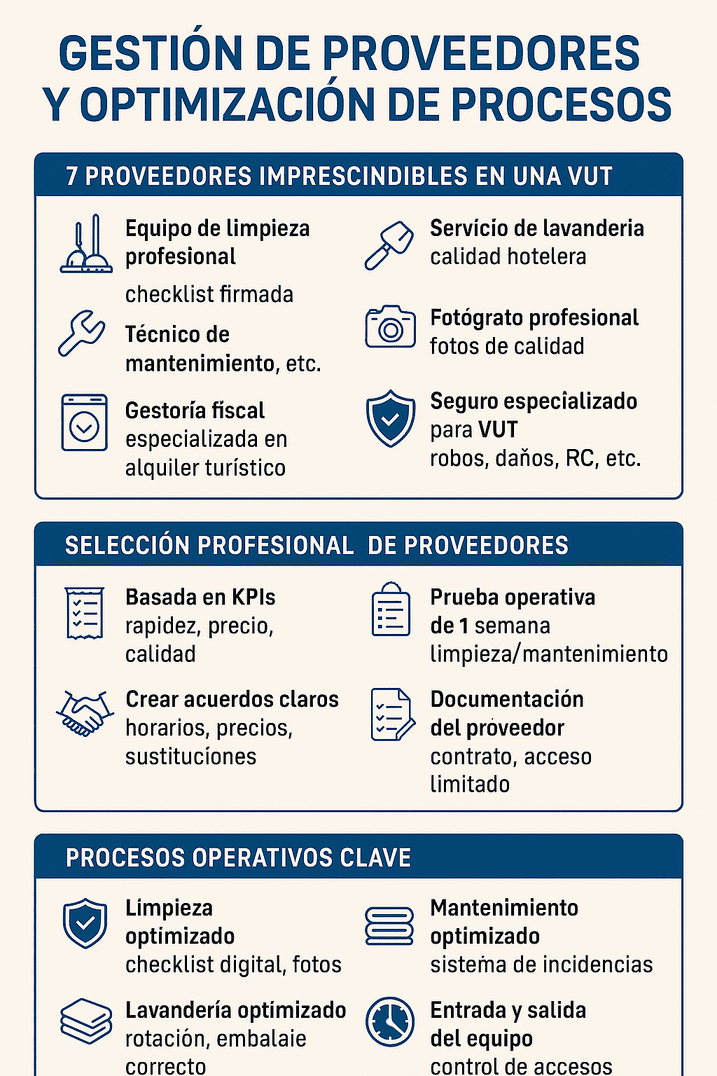
Key Providers for a Professional Holiday Rental
Not all accommodations require exactly the same structure, but there is a base of providers that should be identified and well-developed from the start. Some will be critical from day one. Others will become essential as the quality of the product, occupancy, or number of managed properties increases.
Without a doubt, this is one of the most important providers in the business. Cleaning affects the first impression, the sense of care, the perceived hygiene, the level of trust, and the possibility of receiving good reviews. Moreover, in many accommodations, cleaning functions that go beyond just cleaning: it detects damage, alerts about stock shortages, verifies that everything is correct after a departure, and prepares the property for the next check-in.
When occupancy is high or multiple properties are managed, laundry ceases to be a logistical detail and becomes a strategic issue. Consistency in sheets, towels, table linens, or auxiliary textiles directly influences the property's image. Good laundry services provide hygiene, predictability, textile stock control, and less internal operational wear and tear.
Every accommodation requires maintenance, even if the property is new. Bulbs, faucets, blinds, appliances, locks, cisterns, sockets, painting, silicone, dampness, or small breakdowns will eventually appear with use. A good technician prevents cancellations, compensations, and progressive deterioration of the property.
Locksmith services are one of the most sensitive providers in vacation rentals, especially when there is high turnover, use of key boxes, or smart locks. A lost key, a guest locked out, or a malfunctioning lock can turn a normal stay into a critical incident if there is no agile response.
It won't always be a frequently used provider, but it’s wise to have one identified and tested. Dampness, damage, tiling, flooring, deep painting, partial renovations, or aesthetic improvements require reliable contacts, especially if you want to keep the property competitive over time.
Many owners do not consider it an operational provider, but it is from a commercial perspective. Good photographs improve the visual positioning of the listing, increase click-through rates, convey quality, and help justify a better rate. Additionally, a good session can serve for platforms, the owner’s website, social media, marketing materials, and future campaigns.
Shampoo, gel, coffee, tea, courtesy water, kitchen kits, eco products, welcome details, cleaning products, toilet paper, or pet items can make a difference in the guest's experience. Having a clear supplier for these items improves stock control, homogeneity, and perceived quality.
When a property includes smart locks, sensors, climate control, routers, WiFi repeaters, approved outdoor cameras, automation systems, or integrations with PMS, it is advisable to have real technical support. Poorly installed or maintained technology creates more problems than it solves.
The taxation of a vacation rental can have relevant nuances depending on the operating model, services provided, the profile of the owner, country of residence, or business structure. Having advisory services that truly understand the sector reduces errors, avoids improvisations, and improves decision-making.
Not all these providers hold the same importance across all accommodations, but it is advisable to think of the property as a small service business. The clearer you are about which functions you need to cover and at what level of demand, the easier it will be to professionalize operations and avoid dangerous dependencies.

How to select providers professionally
One of the most common mistakes in tourist housing is choosing providers based on intuition, urgency, or price. This approach may work on occasion, but it rarely builds a stable operation. A suitable provider for this sector must understand that they work within a service highly sensitive to time, quality, and online reputation.
Selecting well means valuing availability, actual capacity, communication, method, attitude, administrative professionalism, and adaptation to your standards. A competitive price can be interesting, but it should never be the sole criterion.
The provider must be able to meet the pace of the business, especially on weekends, guest changes, public holidays, or high season. It is not enough for them to “normally respond”; they must offer availability consistent with the operations you need.
They must understand that arriving late or delivering mediocre work does not only affect a specific task: it affects a guest, a check-in, a possible review, and the overall perception of the accommodation.
A professional provider must accept checklists, defined times, clear instructions, verification photos, finishing criteria, and follow-up on incidents. If they reject any type of system, it is likely they will be difficult to integrate into a serious operation.
Response speed matters. A provider who takes too long to reply creates uncertainty even before a serious incident arises. Ideally, they should respond clearly, confirm tasks, notify of problems, and not require constant follow-ups.
Working with invoices, clear budgets, and defined conditions brings security and seriousness. In a business aiming to grow, sustained informality often leads to chaos, misunderstandings, or dependence on unprofessional relationships.
Before consolidating a relationship, it is advisable to ask for references, observe their work, conduct a preliminary test, and evaluate the result without rushing into broader commitments. In tourist housing, the trial phase saves many future problems.
How to evaluate a provider once they start working
Choosing well is important, but evaluating afterward is even more so. Many managers spend time looking for providers and, once they start working with them, stop measuring their performance objectively. This generates a false sense of stability, even when the real quality has dropped.
It is advisable to periodically review each provider's performance, not from a logic of distrust but from a logic of professional control. What is not reviewed tends to deteriorate over time.
Is the work really well done? Are there repeated mistakes? Are there details that the guest might notice? Quality should not be measured by intuition, but by comparing with your expected standard.
It's not enough for the work to be done "more or less." In holiday rentals, doing it on time is an essential part of the service. Repeated delays erode the entire operation.
A valuable provider informs, alerts, and helps anticipate issues. They don't wait for you to discover the problem. They communicate incidents, propose solutions, and respond quickly.
Do they respond well when there are last-minute changes, an emergency, or an extraordinary need? Reasonable flexibility is very valuable in this sector.
The cheapest provider is not always the most profitable. Evaluate whether the cost corresponds with the peace of mind, quality, and stability they provide.
Contracts, agreements, and conditions that should be clearly defined
Not all providers will necessarily need a long and complex contract, but it is important to clarify the essential working conditions. When the agreement is vague, misunderstandings, incompatible expectations, and operational conflicts arise at the least opportune moments.
In holiday rentals, where speed and availability are crucial, a clear agreement saves a lot of problems. Even when the relationship is good, it is advisable to formalize the essentials in writing.
Although the relationship with the provider may be close and trusting, professionalizing the collaboration protects both parties. The clearer the relationship, the less everything will depend on interpretations, urgent calls, or misunderstandings.
How to organize operations with providers so that it really works
It is not enough to have good providers. They need to be well integrated into your system. When everyone works "their way" and coordination depends on improvised messages, operations suffer. The most professional approach is to design a simple, clear, and repeatable structure.
This involves defining what each provider does, when they intervene, how they are activated, what they need to check, what information they must report, and how incidents or completed tasks are recorded.
Cleaning, post check-out review, restocking, breakdowns, emergencies, photography, deliveries, or preventive maintenance should have their own logic. The clearer the protocol, the less you will depend on repeated explanations.
A brief and clear list, accompanied by photos when useful, reduces omissions and improves control without making operations cumbersome.
Cleaning, locksmithing, urgent maintenance, or laundry cannot rely on a single person without alternatives. A single bottleneck can paralyze the guest experience.
Contacts, schedules, conditions, costs, observations, previous incidents, access, and important notes must be organized. The business should not rely on lost messages or informal memory.
Local collaborations to add value for the guest
A professional holiday rental should not only provide accommodation but can also make the stay more comfortable, enjoyable, and memorable. This is where local collaborations come into play. When well-planned, they enhance the guest experience, strengthen your image as a host or manager, and can differentiate you from similar accommodations that merely offer a bed and basic instructions.
The key is that these partnerships provide real value. It’s not about filling the property with local advertising or recommending businesses out of obligation. It's about selecting collaborators that fit your guest profile, the quality of your accommodation, and the experience you want to create.
They can offer symbolic discounts, preferential treatment, personalized recommendations, or simply become part of your curated selection for the guest. You don’t need to recommend many; you need to recommend well.
Taxis, airport transfers, private drivers, car rentals, bicycles, or similar services can be very helpful in certain destinations or customer profiles, especially for international guests or groups.
Guided tours, routes, culinary experiences, sports, wellness, nature, family activities, or premium offerings can significantly enhance the perceived value of the accommodation if well recommended.
In some accommodations, it’s very useful to collaborate with businesses that allow welcome baskets, pre-purchase, local products, or special restocking for groups, families, or long stays.
Massages, yoga, aesthetics, personal trainers, home chefs, or private experiences can be an interesting way to elevate the offering in higher-end accommodations or specific destinations.
A good local collaboration is not the one that promises the highest commission, but the one that truly fits your guest and enhances their stay. If you recommend something, it must be because you know it, consider it reliable, and believe it adds to the overall experience.

How to create a local network like a professional
Building a useful local network is not about handing out cards or asking for discounts. It involves presenting yourself professionally, explaining what you do, conveying seriousness, and proposing balanced collaborations. When a local business perceives that you manage accommodations with care and can generate satisfied clients, it’s much easier for them to want to collaborate with you.
Having a brief presentation of your brand, the type of accommodation you manage, the profile of your guests, and the potential volume you can generate conveys seriousness. You don’t need a large dossier, but a well-prepared presentation is essential.
The best alliances are born when both parties win. You can provide visibility, clients, or qualified recommendations. The collaborator can offer service, special attention, or specific advantages for the guest.
It’s better to recommend three or four really good partners than to fill your guest guide with mediocre proposals. Curating recommendations is part of your value as a manager.
You can do this through a digital guide, a QR code, a section of the accommodation manual, or messages before arrival. The important thing is that the recommendation is clear, elegant, and useful, not intrusive.
Sharing feedback, thanking referrals, discussing results, or reviewing the collaboration over time helps to consolidate a stable local network, beyond a one-time agreement.
Alliances between managers: an underutilized opportunity
Many managers view other managers solely as competition, but in practice, there may be room for very useful collaborations. In local or regional environments, a healthy relationship with other professionals can help you manage incidents, share resources, learn faster, and reduce operational fragility.
These alliances do not have to imply blind trust or sharing sensitive information. They can be limited to specific, clear, and practical agreements that bring value to both parties.
These relationships should be built with prudence, professionalism, and practicality. Not every manager will be a good ally, but having two or three solid contacts in your area can provide you with much greater operational resilience.
Common mistakes when working with suppliers and collaborators
In many accommodations, problems with suppliers do not arise because options are lacking, but because the relationship is poorly established from the beginning. Here are some of the most common and costly mistakes in the medium term.
Practical recommendations to strengthen your position as a local manager
Whether you manage a single property or aspire to grow, it is beneficial for your image with suppliers and collaborators to be that of a serious, organized professional with a long-term vision. This improves the treatment you receive, the priority you are given, and the overall quality of the relationships you build.
Good suppliers value working with clients who know how to ask for things, provide context, and maintain some operational order.
Professionalism also comes from your side. If you want priority and commitment, it’s wise to be a serious and predictable client.
It’s not just about pointing out mistakes. It’s also important to acknowledge when something has been done well and share specific observations that help improve.
The sum of reliable suppliers, useful local collaborators, and other managers you can count on creates a much stronger and less vulnerable position.
Final Closing
In holiday rentals, good management is not built in isolation. It is built with method, criterion, and a network of people and companies capable of sustaining the level of service you promise to the guest. The better that network is, the more stable, profitable, and professional your business will be.
A good supplier does not just perform a task. They save you time, prevent incidents, improve the traveler's experience, and allow you to focus on more strategic decisions. Good local collaboration does not just decorate your proposal: it enriches it. And a well-planned professional alliance can provide you with a much stronger foundation for growth.
That is why one of the smartest investments a property owner or manager can make is not always to buy more furniture, add more decoration, or look for new channels. Often, it is about building a reliable, well-maintained, and professional network around each property.
The quality of your business depends, to a large extent, on the quality of your alliances. When your external network works well, your accommodation conveys control, trust, and professionalism. And that makes a difference in every stay in the holiday rental market.