
Real Cases, Common Scenarios, and Professional Solutions
Managing a vacation rental with professional criteria is not just about achieving bookings, maintaining good occupancy, or taking care of the presentation of the accommodation. The real difference between amateur management and solid management emerges when an issue arises. It doesn't matter if the property is well-equipped, if the guest received a flawless check-in, or if the listing is optimized: sooner or later, unforeseen events, minor frictions, technical failures, operational errors, or problematic behaviors will test your working system.
In vacation rentals, problems are not an unusual exception but a natural part of operations. What completely changes the outcome is not so much the incident itself, but the speed of reaction, the clarity of the protocol, the quality of communication, and the ability to resolve calmly, firmly, and practically. In many cases, guests accept that something goes wrong; what they cannot forgive is feeling ignored, uninformed, or neglected.
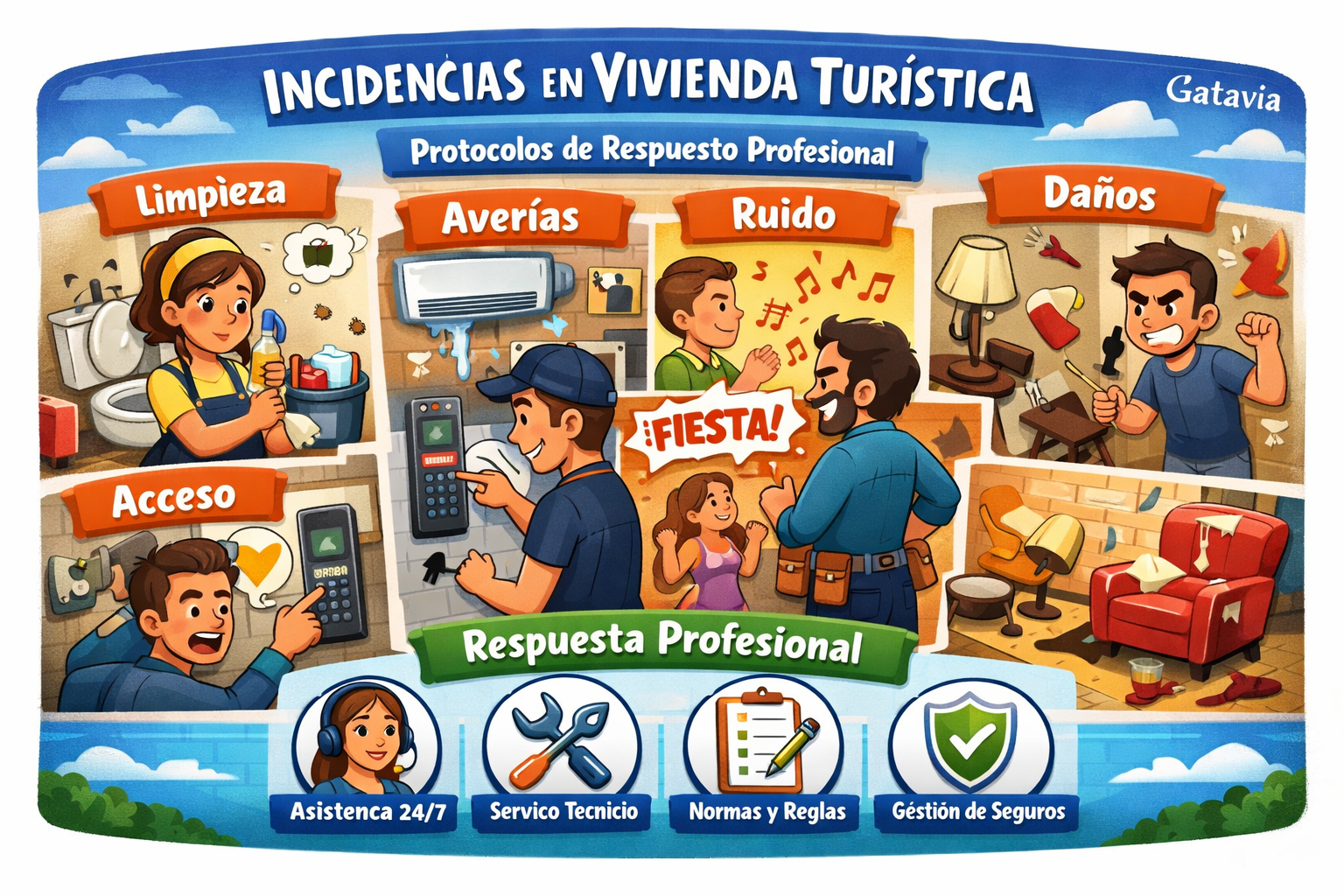
This chapter is designed to help you act professionally in real and frequent scenarios in vacation rentals: cleaning issues, breakdowns, access incidents, noise complaints, rule violations, damages, delays in check-out, or more delicate situations such as attempted squatting, theft, or emergencies. It's not about promising perfect operations, but about building a robust management system that can respond well even when things don't go as planned.
The Real Objective of This Chapter
The goal is not to make you believe that you can eliminate all problems. That would not be realistic. The aim is far more useful: to know how to act quickly, how to reduce the impact of each incident, how to protect your reputation, and how to turn a potentially negative situation into a reasonably satisfactory experience for the guest. In practical terms, good incident management seeks to contain damages, regain control, and prevent the issue from turning into a bad review, an unreasonable complaint, or unnecessary losses of time and money.
Key Idea: a large part of the bad reviews do not stem from the problem itself, but from the feeling of neglect, slowness, lack of empathy, or absence of a solution. A guest may tolerate a specific failure; what they rarely tolerate is poor management of that failure.
Professional Framework for Responding to Any Incident
Before diving into specific scenarios, it's important to establish a mental response structure. Professional operations depend not just on the case but on the method. When a problem arises, your actions should always rely on five steps: detect, verify, communicate, resolve, and close. Detect means to know about the incident as soon as possible; verify involves understanding what is actually happening and its scope; communicate consists of responding quickly and with the appropriate tone; resolve means to activate the most reasonable solution; and close implies confirming with the guest that the incident has been addressed and documenting the occurrence internally.
This approach avoids two very common mistakes: responding without fully understanding the problem and, conversely, delaying the response too long in an attempt to have everything resolved before replying. The right approach is often to acknowledge receipt quickly, show empathy, explain that it is being managed, and provide a first realistic expectation.
Cleaning Problems: First Impressions That Can Affect the Entire Stay
Scenario 1 — The Guest Arrives and Perceives That the Property Is Not Clean Enough
This is one of the most delicate incidents because it affects the initial impact and generates immediate distrust. Sometimes it’s something minor, like dust on a table, poorly cleaned cutlery, or a bathroom that could be improved; other times the situation is more serious, with residues from the previous stay or a clearly incomplete cleaning. The issue is not just hygienic: the guest interprets that if something so basic has failed, perhaps everything else will too.
- Visible dust on furniture or surfaces.
- Cutlery, glasses, or dishware that is poorly washed.
- Bathroom lacking a sense of complete cleanliness.
- Remnants or residues from previous guests.
The guest loses trust in the property from the first minute and begins the stay predisposed to look for more faults or to document everything with the intent to complain or leave a negative review.
Recommended Professional Solution
Apologize clearly and straightforwardly. Do not downplay the issue or engage in debate. Activate a quick and specific correction. If you have cleaning staff nearby, the ideal is to offer an intervention within the next 30 to 60 minutes. Once resolved, confirm with the guest that everything has been properly addressed. In some cases, a small gesture of courtesy can help relieve tension, but it should never be used as a substitute for a real solution.
The message should convey three things: acknowledgment of the problem, solution activated, and commitment to follow-up.
“We are very sorry for the inconvenience. Our cleaning team is already on the way and will fix the issue as soon as possible. Everything should be properly taken care of within the next hour.”
Scenario 2 — Missing Towels, Bed Linens, or Basic Amenities
Although it may seem like a minor issue, the lack of bed linens, towels, or basic items conveys a sense of disorganization. Moreover, it directly impacts the guest's comfort and generates immediate annoyance, especially when arriving late, with children, or after a long journey. Here, the margin for overly explaining is very small: what is expected is speed.
The correct response is to send what is missing as soon as possible, sincerely thank the guest for reporting it, and then internally review why the error was not detected before check-in. These types of incidents almost always reveal weaknesses in the cleaning checklist, restocking, or final verification.
Technical Problems: Breakdowns That Require Judgment, Speed, and Constant Communication
Scenario 3 — The Air Conditioning Is Not Working
At certain times of the year, a failure of the air conditioning is not perceived as a mere inconvenience, but rather as a serious issue that can compromise the habitability of the accommodation. Before concluding that there is a real breakdown, it’s advisable to check if the problem is due to incorrect settings, improper use of the remote, open doors or windows, or pending equipment restarts.
If a clear and brief guide does not resolve the issue, technical support should be activated. In the meantime, offering a temporary solution, such as additional fans, helps the guest perceive effort and attention. If the repair will take time and the heat is significant, it may be reasonable to consider a proportional compensation or, in serious cases, a partial or total relocation depending on the duration and context of the reservation.
Protocol: guided check, technician if unresolved, immediate temporary solution, and follow-up until closure.
Scenario 4 — Hot Water Failure
The lack of hot water directly impacts the minimum quality of the stay and requires a high priority. In some properties, the cause is relatively simple, such as an electric heater that needs maintenance or a reset. In others, especially if there is a boiler, the technical intervention may be more urgent and less predictable.
What’s important is not to treat the issue as a minor incident. The guest needs clear instructions, a sense of support, and an honest forecast. If there is a reasonable temporary alternative, it can be communicated cautiously, but without presenting makeshift solutions as equivalent to having the service restored. If the problem significantly affects the stay, compensation or adjustment should be evaluated judiciously.
Operational Key: update the guest frequently. In these types of incidents, silence is interpreted as a lack of control.
Scenario 5 — Power Outage in the Building or Area
Although it is not the host’s responsibility, the guest experiences the power outage as a problem with their stay and expects a helpful response. The first task is to confirm whether the incident affects only the property, the building, or a broader area. The second, to communicate it immediately with empathy and without conveying indifference due to the external cause.
Informing that the company has already been contacted, providing regular updates, and anticipating support solutions — such as portable lights, flashlights, or basic contingency items — helps reduce anxiety. In family stays, overnight stays, or with especially sensitive individuals, the way to manage this incident matters almost as much as the incident itself.
Good Practice: update every 15 to 30 minutes when the outage is prolonged, even if there are no relevant updates. It maintains the sense of support and control.
Access Problems: When Check-In Becomes Complicated at the Worst Moment
Scenario 6 — Guest Cannot Enter Due to Code Error or Smart Lock Failure
Access issues are particularly sensitive because they often occur after travel, with exhaustion, haste, and often with companions or children waiting. The guest does not interpret this incident as a technical detail, but as a direct barrier to starting their stay. Therefore, calmness and precision are essential.
The correct response involves offering a step-by-step guide, ideally with prior prepared visual support, checking if the code is correct, activating an alternative code if the system allows, and remotely unlocking if technology permits. It is always advisable to have a physical backup plan, such as a lockbox or access through nearby personnel. An intelligent entry system without a backup is not a robust solution, but an operational risk.
Professional Solution: immediate guidance, alternative code, remote unlocking, and physical emergency resource if the system fails.
Scenario 7 — Guest Loses Physical Keys
Losing keys involves several levels of issues: immediate access, property security, and possible replacement or locksmith costs. The first step is to determine whether a nearby copy exists or if it can be resolved without compromising security. If it is not possible, a locksmith or an authorized person will need to intervene for access.
When the loss is attributable to the guest and is outlined in the rules or conditions of stay, the cost can be passed on, but always with documentation, an appropriate tone, and without dramatizing. Beyond the specific incident, this situation reinforces a clear operational lesson: the more dependent your property is on physical keys without an alternative system, the greater your exposure to preventable incidents.
Preventive Approach: smart lock, controlled copy, alternative access protocol, and clear conditions regarding key loss.
Noise, Neighbors, and Parties: Protecting Coexistence is Part of Professional Management
Scenario 8 — Neighbor Complaint About Noise
A poorly managed neighbor complaint can not only generate a bad experience but also create lasting tensions with the community, warnings, internal sanctions, and even reputational damage for the accommodation. Therefore, in response to the first complaint, the reaction must be quick, firm, and respectful.
The reasonable protocol consists of sending an immediate message to the guest, calling if they do not respond, and if the problem persists, escalating the intervention according to your operational model. In repeated or severe cases, cancellation of the stay should not be ruled out if the contractual conditions and the platform allow it. The priority is not to avoid inconveniencing the problematic guest, but to protect coexistence, the asset, and the continuity of the business.
Guiding Principle: acting early prevents a controllable annoyance from turning into a crisis with neighbors.
Scenario 9 — Possible party detected or highly probable
Parties are one of the highest risk scenarios because they can lead to noise, damage, extraordinary mess, unauthorized entries, conflicts with neighbors, and security issues. Noise sensors, access control, and monitoring unusual patterns in bookings help detect these situations before they escalate.
If the system detects abnormal levels or if there are solid indications, an immediate and documented warning must be issued. If not corrected, monitoring should be close and, if necessary, in person or through the responsible person on-site. It is always advisable to document messages, records, and any reasonable evidence, especially if it later becomes necessary to justify a cancellation, a damage claim, or a firmer action.
Important warning: tolerating a party to avoid confrontation often ends up being much more costly than intervening in time.
Problematic guests: firmness, evidence, and emotional control
Scenario 10 — Aggressive, disrespectful, or clearly confrontational guest
Some guests not only generate operational incidents but also personal tension situations. This may include aggressive messages, veiled threats, disrespect, disproportionate demands, or intimidating attitudes. In these cases, the priority is not to win the argument, but to maintain safety, protect evidence, and avoid communication errors that could harm you later.
The general recommendation is to remain calm, not respond in the same tone, move the conversation to written and documentable channels whenever possible, and avoid unnecessary in-person encounters if the situation escalates. When behavior is serious, especially if there is intimidation or risk, police intervention or support from the respective platform should be considered. Professionalism here is not about tolerating everything, but about acting with control and documented support.
Practical rule: never argue heatedly with an aggressive guest. Respond briefly, correctly, documentably, and focused on facts.
Scenario 11 — Violation of house rules
Smoking where it's prohibited, bringing unregistered people, housing unauthorized pets, or clearly using the property against the rules are relatively frequent behaviors. Here, the common mistake of the host is to react too late or to formulate ambiguous messages that leave room for interpretation.
The correct response should be polite in form but firm in substance. It is advisable to remind the violated rule, request immediate correction, and warn of consequences if appropriate. If there is a scheduled penalty that is applicable, it should be communicated with criteria and documented support. In more serious or repeated cases, cancellation or eviction, always within the applicable legal and contractual framework, may be necessary. Poorly considered leniency often conveys to the guest that the rules are negotiable.
Infrastructure and maintenance incidents: protecting the asset and the guest experience
Scenario 12 — Leaks, drips, or infiltrations
Leaks and infiltrations require quick action not only for the guest but also for the risk of greater damage to the property itself, neighbors, or structural elements. The first step is to contain it, for example by turning off the water if applicable, and activating technical assistance. At the same time, the guest should be kept informed and it should be evaluated whether the incident allows for a reasonable continuation of the stay or if relocation is needed.
If the problem is serious, documenting from the first moment is essential for both insurance and any subsequent claims. The lack of documentation, even when actions have been taken properly, significantly weakens the ability to recover financially and operationally.
Order of action: contain, communicate, intervene, evaluate habitability, and document.
Scenario 13 — Essential appliance malfunction
Not all breakdowns have the same severity. A failure in a small appliance may be a secondary inconvenience, while a malfunction in the refrigerator, washing machine during long stays, or an essential cooking item can significantly affect the guest experience. Professional management requires distinguishing between the accessory and the truly critical.
If the appliance affects basic needs, it is advisable to act as a priority, send technicians if applicable, and when the repair is not immediate, provide a reasonable temporary solution. In the case of a broken refrigerator, for example, the guest needs not only a technician; they need to know what to do with their food and if they will have a provisional alternative.
Professional vision: technical incidents are not resolved solely by fixing the device, but by protecting the stay while the repair is done.
Check-out, damages, and closing the stay: where a large part of economic control is decided
Scenario 14 — The guest does not leave at the agreed time
A delay in check-out may seem like a minor friction, but it disrupts cleaning, subsequent check-ins, and daily organization. Prevention is important: sending automatic reminders and clear messages avoids many situations. If, nonetheless, the guest does not leave the property on time, the appropriate action is to contact them kindly, reminding them that cleaning is scheduled and requesting immediate departure.
When the delay is significant and your conditions foresee it, a penalty may be considered, but it is always advisable to act in a proportional, reasonable, and documented manner. The goal is not to punish for punishment's sake but to protect operations and make it clear that schedules are not just suggestions.
Effective prevention: message the night before and additional reminder a few hours before check-out.
Scenario 15 — Damages found after departure
Finding damages after a stay requires acting methodically rather than in anger. The strength of a claim lies in the quality of the evidence, the promptness of registration, and the ability to objectively explain what occurred. Clear photographs, reasonable inventory, brief and coherent description, and keeping communications are basic elements.
If the booking was channeled through a platform, it is advisable to review their procedures and deadlines for claims (on Airbnb and Booking, 14 days from check-out). In direct bookings, the deposit and prior conditions are particularly important. The essential thing is to avoid improvised or poorly founded claims, as they weaken your position and increase conflict.
Correct approach: visual evidence, brief report, objective communication, and claim within the appropriate channel and timeframe.
Extreme situations: infrequent, but too important to improvise
Scenario 16 — Attempted occupation or refusal to leave the property
Although it is not the most common, it is a scenario that every professional manager must consider. Certain prior signals can alert: unusual extensions, resistance to check-out, unauthorized changes in access, unplanned repeated visits, or attitudes clearly aimed at buying time and controlling the property.
The reaction must be immediate and cautious. It is not advisable to face these situations from a personal confrontation or take impulsive actions that may exacerbate the problem. The correct approach is to document, alert the competent authorities when appropriate, inform the property owner, and follow supported action. Do not change the lock, cut off utilities or remove belongings on your own: if the person entered with a booking, they may have an apparent title, and such measures could be considered coercion (coacciones). The appropriate route (criminal, with fast-track trial for trespass and unlawful occupation since Organic Law 1/2025, or civil) depends on the case; it is advisable to consult a lawyer. The longer the seriousness of the scenario is disregarded, the more room is given for the situation to complicate.
Essential criterion: do not improvise or confront alone. Document and activate a formal response as soon as possible.
Scenario 17 — Theft within the property
When a guest reports a theft, in addition to the material incident, there is an evident emotional dimension. They feel vulnerable and seek support. Although it is not always possible to determine responsibilities immediately, the manager's attitude should be one of serious support, without promising more than can be fulfilled or downplaying what has happened.
Helping to document the incident, guiding on filing a report if appropriate, reviewing insurance coverage, and keeping a written record of what occurred are reasonable steps. In parallel, it is advisable to review access, locks, entry history, and any points of vulnerability in the accommodation.
What the guest values most in this case: feeling real support, order and seriousness, not premature excuses.
Scenario 18 — Fire or medical emergency
In real emergencies, the absolute priority is the safety of individuals. Any other consideration takes a back seat. Therefore, every tourist accommodation should have clear instructions, basic emergency information, and simple communication on what to do and whom to call. In Spain, 112 serves as the general reference for emergencies, but the guest may not always be in the right frame of mind to react quickly and accurately.
After immediate intervention, the phase of documentation, communication with the insurer, support to the guest, and reviewing what happened will follow. Emergencies cannot be improvised; they require prior preparation, understandable protocols, and functional and visible safety elements within the accommodation.
Recommended minimum basis: visible emergency information, fire extinguishers or means required when applicable, first-aid kit, and a clear internal protocol.
What differentiates a professional manager from an improvised one
In practice, guests and platforms do not only evaluate whether or not there were incidents. They assess how those incidents were managed. An improvised manager responds late, changes their story, blames the guest before understanding the problem, promises what they cannot deliver, or disappears while trying to find a solution. A professional manager, on the other hand, may not have the complete solution in the first minute, but they convey control, presence, traceability, and genuine commitment.
That difference is crucial because it protects reputation, enhances brand perception, facilitates resolution, and reduces the emotional impact of conflict. Many times, the guest ends up positively rating a stay with an incident because they felt their problem was taken seriously and handled responsibly.
Professional Incident Management Checklist
Common Mistakes in Managing Incidents in Holiday Rentals
Practical Recommendations to Reduce Incidents Before They Occur
Many incidents cannot be completely eliminated, but they can be reduced with smart preparation. A good pre-arrival system, a well-reviewed property, a reasonable inventory, clear rules, well-designed automated messages, reliable suppliers, and documented operations drastically reduce the number of problems and, above all, their severity.
It’s advisable to periodically review which problems occur repeatedly and why. If cleaning issues reappear, the failure likely isn’t in the reaction, but rather in the prior control. If access generates stress, perhaps check-in isn’t sufficiently guided. If there are conflicts with rules, it’s likely they aren’t being communicated clearly or enforced consistently.
Professional management matures when it stops putting out one fire at a time and starts learning from each incident to build a stronger system. That is the true difference between managing bookings and running accommodation with a business focus.
Conclusion
The key to good management is not in claiming that nothing ever goes wrong, but in demonstrating that when something occurs, you know how to respond quickly, clearly, empathetically, and effectively. This combination builds trust and protects your reputation far more than any sales pitch. The guest does not need absolute perfection; they need to feel that they are in capable hands.
In vacation rentals, each incident is a silent test of your professional level. It can turn into a negative review, strain relations with neighbors, result in financial loss, or become an issue that is resolved competently, even enhancing the perception of the accommodation. The difference is rarely defined by the problem; it is almost always defined by the management.
A professional manager does not just put out operational fires: they transform conflicts, unforeseen events, and friction into a more controlled, safer, and more satisfying experience for both the guest and the business itself.