
Host Personal Brand and Professional Positioning
The host's personal brand has become a key element in the vacation rental sector. Building a solid professional identity, generating trust, and offering a consistent experience allows one to differentiate the accommodation and improve its positioning in the tourist market. In an increasingly competitive environment, personal branding is no longer an ancillary detail but a real part of the value proposition of both the accommodation and the professional behind its management.
Personal branding is not a logo, a name, or a corporate color. It is the perception that guests, owners, and collaborators have of you. It is built through the way you communicate, the quality of service, the ability to resolve incidents, the coherence between what you promise and what you deliver, and the overall experience that others associate with your way of working.
A well-constructed personal brand helps you stop competing solely on price, avoids conveying a sense of improvisation, and allows you to position yourself as a reference host or manager in your area. This chapter develops how to build that identity in a professional, practical, and realistic way, so that it becomes a competitive advantage, a source of trust, and a solid foundation for growth.
Why Personal Branding is Already a Strategic Criterion for a Professional Host
Many hosts still think that personal branding is something only applicable to highly visible profiles on social media or large corporate structures. In reality, in tourist housing, personal branding has a much more practical and direct focus: conveying trust, organizing the perception of service, and making clear what guests or owners can expect from the person managing the accommodation.
When this identity is well developed, it improves the perception of the accommodation, reinforces professionalism, facilitates the acquisition of homes, stabilizes bookings, and helps justify better rates. It is not enough to appear serious: you must actually be serious, demonstrate it, and maintain it over time through actions, processes, and consistency.
Generates Trust
A clear professional presence reduces doubts, improves the first impression, and makes it easier for both guests and owners to perceive security and reliability from the first contact.
Attracts Owners
Owners seek managers who inspire order, criteria, transparency, and operational capacity. Personal branding precisely reinforces that professional perception.
Loyalizes Guests
When the experience has a recognizable style, the treatment is consistent, and the management conveys quality, the guest remembers who was behind it, making repeat visits more likely.
Increases Reservations and Perceived Value
A professional brand helps enhance the perceived quality of the accommodation and reduce reliance on price as the sole selling argument.
What a Well-Developed Professional Personal Brand Allows
What the Host's Personal Brand Really Is
Reputation
What others think and expect from your service after interacting with you. It is not entirely controllable, but it can be cultivated through the actual quality of management.
Communication Style
The tone of your messages, the clarity of your explanations, the courtesy, the ability to anticipate questions, and the overall quality of interaction are central to your brand.
Incident Resolution Approach
Professionalism becomes especially apparent when a problem arises. This confirms whether the accommodation is managed seriously, prepared, and responsibly.
Operational Consistency
The brand also relies on the consistency of service: well-executed cleanings, clear rules, organized check-in, well-maintained materials, and a stable experience over time.
Overall Perception
Overall, personal branding is how others perceive you. It’s not about pretending to be professional but being professional and consistently showing it.
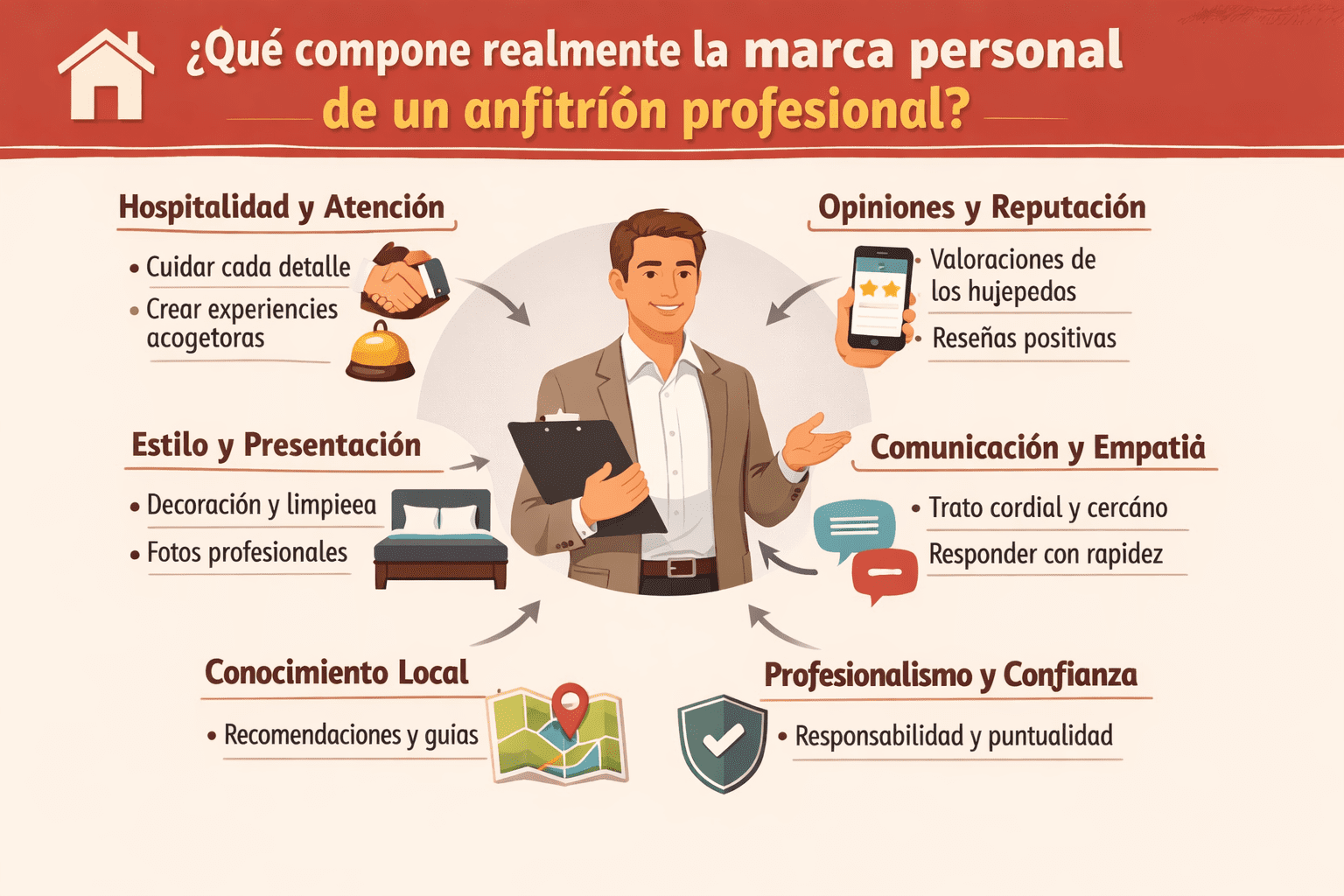
The Six Pillars of a Solid Personal Brand
A strong personal brand does not arise from a single decision, but from the combination of several well-aligned layers. When one fails, the whole structure loses strength. That’s why it’s important to understand it as a structure where each pillar reinforces the next.
These six pillars help build a recognizable, trustworthy, and useful professional identity for both the guest and the owner.
Real Professionalism
It is the foundation of everything else. Without well-executed work, no image can sustain the reputation for long.
Consistent Visual Image
The image does not replace the service, but it does organize perception and reinforce professionalism when there is a real foundation behind it.
Excellent Communication
How you speak and write also builds your brand. Careless communication can undermine good operations.
Trust
Trust grows with reviews, testimonials, transparency, results, and consistency between the commercial promise and the actual experience. Without it, positioning does not solidify.
Differentiation
A strong personal brand must clearly answer two questions: why should a guest choose you and why should a property owner trust you with their home? If that answer is unclear, the proposal dilutes.
Visibility
The best brand in the world is of little use if no one sees it. Visibility allows reputation to circulate and turn into real opportunities.
How to Build Your Personal Brand Step by Step
Building a personal brand does not require a large structure or a big budget, but it does require criteria. The important thing is not to do many things, but to do the right ones well, in the right order, and with a recognizable proposal behind it. The goal is not to "sound like a brand," but to convey a clear, credible, and useful professional identity.
Below is a practical guide to developing a strong personal brand within vacation rentals without falling into gimmicks or superficial solutions.
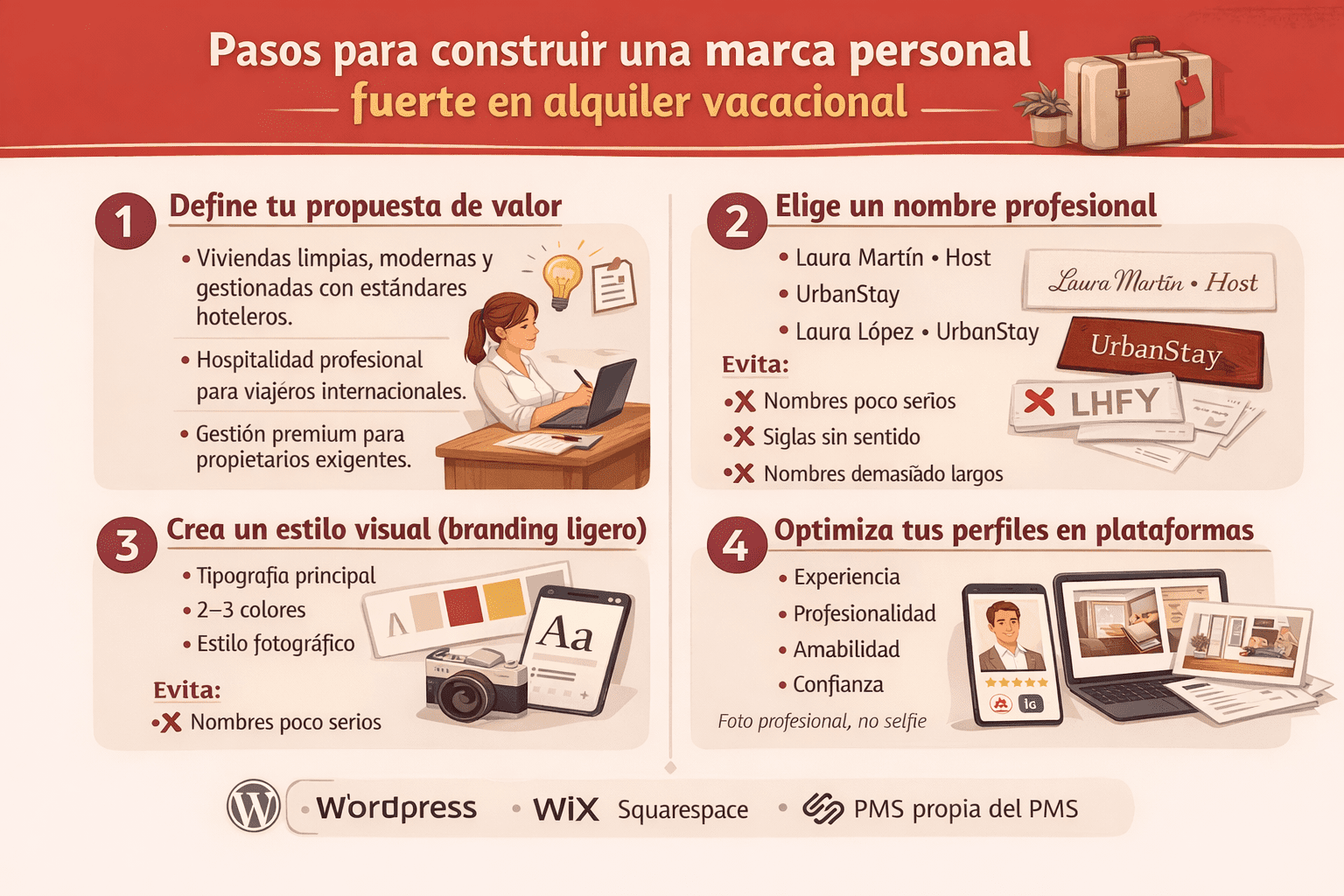
1. Define Your Value Proposition
Your value proposition summarizes what you do, for whom you do it, and why someone should choose you. It should be clear, concrete, and professional. It should not be an empty slogan, but a useful synthesis of your work approach.
2. Choose a Professional Name
The name has a significant impact on the first impression. It should sound serious, be easy to remember, and fit the type of positioning you are seeking.
It’s best to avoid unserious names, meaningless acronyms, excessively long formulas, or combinations that are difficult to memorize.
3. Create a Light Branding Visual Style
You don't need a large corporate manual, but a basic visual consistency that helps convey a sense of order and professionalism is essential.
4. Optimize your profiles on platforms
Your profile on Airbnb, Booking, or any direct channel also conveys your brand. It should project experience, clarity, friendliness, and trust.
5. Design a presentation for property owners
This material is key if you want to scale. It should help you clearly explain your proposal and demonstrate that your service has method and value.
6. Create a simple yet professional website
It isn’t always essential at the beginning, but it is highly recommended when you want to position yourself as a serious professional and attract property owners or direct bookings.
It can be developed on WordPress, Wix, Squarespace, or through the PMS's own infrastructure if the presentation is sufficiently professional. If what you need is a direct booking channel, Gatavia sets up the owner's booking website free of charge, with no commission (only Stripe's fee applies) and with the calendar synchronised with Airbnb and Booking.
Positioning as a local expert: how to become a reference in your area
A strong personal brand is not only built internally; it also needs local projection. Becoming a recognized authority in your area strengthens credibility, multiplies recommendations, and positions you better with property owners, businesses, and potential collaborators. In many markets, being "the professional that gets mentioned" holds more value than continuously investing in capturing attention without structure behind it.
This local positioning does not depend on appearing more significant, but on demonstrating knowledge of the destination, the market, the traveler's experience, and the operational reality of the area. When this is well communicated, reputation stops being abstract and becomes a real presence.
Becoming a local authority allows you to
Publish tips on social media or your own channels
There's no need for complex production. The important thing is to share real, useful, and professional content that demonstrates expertise: destination recommendations, best practices, tips for owners, or operational details that add value.
Collaborate with local businesses
Restaurants, experience companies, shops, laundries, photographers, technicians, or complementary services can reinforce your local presence and turn your name into a reference associated with quality and trust.
Offer profitability studies or property analyses
When you help the owner better understand the potential of their property, you are no longer seen merely as a manager but as someone with strategic insight and market knowledge.
Create a neighborhood or destination guide
Demonstrate knowledge of the surroundings, enhance the guest experience, and reinforce the idea that you are not only managing a property but are also well-acquainted with the place where you work.
Attend real estate or tourism events
Being present in the local professional ecosystem helps build credibility, relationships, and visibility. It may not always yield immediate results, but it does solidify positioning over time.
How a strong personal brand makes money
A strong personal brand not only improves the image: it also has economic impact. In many cases, the difference between a host who simply "operates" and one that truly positions themselves lies in the ability to turn reputation into income, opportunities, and sustainable growth. A well-built brand reduces commercial friction and increases the perceived value of the service.
This economic impact can manifest in various ways and is not limited to charging more per night. It also influences who chooses you, how many opportunities come your way, and what types of business you can develop in the medium term.
Higher prices
Guests are more likely to pay higher rates when they perceive professionalism, trust, quality, and consistency. The brand helps to better justify that positioning and maintain it without seeming arbitrary.
Property acquisition
Property owners look for managers with reputation, organization, method, and a clear professional perception. A well-crafted personal brand shortens the distance between doubt and trust.
Business expansion
When your name begins to be associated with quality and reliability, you can expand your activities beyond a single property or very basic management.
Difference between a host with a personal brand and one without
Trust
Without a personal brand: trust is usually low or fragile and depends too much on price or the platform. With a personal brand: trust is higher and is supported by a consistent professional perception.
Bookings
Without a personal brand: bookings tend to be more unstable. With a personal brand: they are usually more consistent and sustainable over time.
Average Price
Without a personal brand: there tends to be more pressure to lower prices. With a personal brand: it is easier to maintain higher prices or a superior perception of value.
Reviews
Without a personal brand: the experience can be more variable and the ratings more inconsistent. With a personal brand: reviews tend to be more consistent because the service is also consistent.
Owners and Visibility
Without a personal brand: it is harder to attract owners, and visibility is minimal. With a personal brand: referrals, reputation, and local presence increase significantly.
Perceived Professionalism
Without a personal brand: the perception can be basic or poorly defined. With a personal brand: professionalism is perceived as high and more structured.
Common Mistakes When Building a Personal Brand
Not Having a Clear Visual Style
A disorganized identity conveys improvisation. It's not necessary to complicate the design, but it's important to maintain recognizable criteria.
Continuously Changing Tone or Positioning
Inconsistency weakens the brand. You can't project a premium profile today and communicate as if there were no criteria behind it tomorrow.
Responding Unprofessionally
A poor tone, frequent errors, confusing messages, or impulsive responses quickly destroy trust.
Not Asking for or Utilizing Testimonials
Social proof is one of the most powerful drivers of credibility. If you don't gather it or present it well, you waste an important part of your reputation.
Not Showing Results or Caring About First Impressions
Profiles without photos, poor presentations, careless ads, or unclear materials make the market perceive you below the actual level you could convey.
Professional Personal Branding Checklist for Hosts and Managers
Conclusion: Personal Branding as a Strategic Business Asset
The host's personal brand is much more than an issue of image. It is a strategic tool that positions the professional, improves guest perception, and opens doors for growth as a manager or local reference. When well crafted, it helps to inspire trust, differentiate oneself, foster loyalty, and generate new income opportunities.
A good personal brand is not built on empty promises, but on coherence, real professionalism, careful communication, and sustained results over time. Therefore, one of the biggest mistakes is to treat it as something superficial. In reality, it is a visible layer of the operational quality that lies beneath.
Its value can be summed up in five practical effects:
In an increasingly competitive sector, building a clear and consistent professional identity is not a luxury, but one of the most valuable assets of the business. When the guest, the owner, and the local environment know what to expect from you and associate it with quality, your brand ceases to be an abstract concept and becomes a true competitive advantage.