
Professional operational management, cleaning, suppliers, and service standardization
Operational management is the silent but decisive foundation of any tourist accommodation. A property can have an excellent location, attractive photographs, and a well-adjusted price, but if the cleaning fails, access causes issues, consumables are missing, the guest doesn’t understand how the property works, or each supplier acts differently, the final result translates into stress, worse reviews, more incidents, and much more fragile profitability.
The difference between an amateur accommodation and a professional operation lies not only in decoration or technology but in the ability to consistently deliver quality service time after time, regardless of who performs each task and whether the owner is present or not. This consistency is what protects the business's reputation, reduces operational errors, and allows for growth without losing control.
In this chapter, you will see how to build a realistic and professional operational system for your tourist accommodation: standardized processes, controlled cleaning, reliable suppliers, solid checklists, entry and exit protocols, quality control, well-defined amenities, and a work structure designed to enhance the guest experience and facilitate scalable management.
Why operations determine the actual quality of the accommodation
Operations transform a booking into a satisfying experience. It is also what turns a property into a manageable business. When the operation is well-designed, the guest perceives order, cleanliness, clarity, quick responses, and a sense of control. When it is poorly designed, any small failure multiplies: a missing towel, a lock that doesn’t respond, a dirty coffee maker, or ambiguous instructions can ruin a stay that, on paper, seemed perfect.
Additionally, operations have a direct impact on the income statement. A disorganized property generates more urgencies, unnecessary trips, uncontrolled replenishments, more coordination time, more undetected damages, and greater dependence on the owner. This increases management costs even when it might seem like savings at first glance.
Therefore, effective management is not about reacting quickly to problems but about designing a system that prevents most of them before they arise.
Standardization of processes: the foundation of professional management
Standardizing means that each important task has a clear way of being executed, a responsible person, a moment, and a defined minimum level of quality. It does not imply absurd rigidity but operational consistency. The goal is for the service not to depend on the mood of the day, the memory of a specific person, or improvisations that only work sometimes.
Without standardized processes, there is no real control. And without real control, it is very difficult to maintain quality, delegate with confidence, or scale the business.
The processes that should be standardized from the beginning are, at a minimum, the following: cleaning, bed preparation, laundry, restocking of consumables, inventory check, maintenance issues, access management, check-in and check-out messages, post-departure review, and final quality control. All of this should be supported by clear and verifiable lists, not by generic instructions such as 'leave everything tidy.'
The more specific the standard, the less room there will be for interpretations that deteriorate the service.
How to design a simple, clear, and repeatable operating system
Work by operational moments: before arrival, during the stay, guest departure, preparation for the next check-in, and periodic property control. This division prevents mixing tasks and helps assign responsibilities in an orderly manner.
Each task should have a main responsible person, even if there is support or supervision. When everyone is responsible, in reality, no one is. Clear assignment avoids gray areas and reduces the need to chase everyone to find out what was done.
It's not enough to say what task needs to be done; you also need to explain how it should look. A 'made' bed can have many levels. A 'clean' kitchen can also. Document the correct outcome with instructions and, if possible, with internal reference photographs.
A process does not truly exist until it is verified. The most useful combination is usually a checklist, photographic evidence, and random or periodic reviews. It is not necessary to bureaucratize management, but it is essential to avoid basing the system solely on verbal trust.
Professional cleaning checklist: what really needs to be checked
Cleaning is by far one of the factors that most influence guest satisfaction and the accommodation's reputation. Moreover, it is one of the aspects that most quickly destroys trust when it fails. A guest may tolerate a small aesthetic defect, but rarely forgives dirt, bad odors, questionable textiles, or remnants of previous use.
For this reason, professional cleaning should not be understood solely as sanitization, but as a comprehensive preparation of the accommodation. It should include presentation, restocking, visual inspection, and basic functional checking.
Check-out checklist: one of the most cost-effective operational tools
The check-out review should not be limited to 'seeing if everything is more or less fine.' It is a critical phase to detect damages, deficiencies, misuse, technical incidents, and replenishment needs before the next booking arrives. It is also a fundamental piece to document the property's condition and avoid subsequent conflicts.
The sooner it is carried out and the better it is documented, the easier it is to act with criteria, and the less likely a problem is to carry over to the next stay.
Selection and management of suppliers: how to build a reliable network
Suppliers are not a secondary support: they are a direct part of the guest experience. Mediocre cleaning, irregular laundry, or slow maintenance affect service just as much as a bad host. Therefore, choosing suppliers solely based on price tends to be costly in the medium term.
The important thing is to build a reliable, fast operational network aligned with your accommodation's standard. The right supplier understands that they do not just provide a technical service, but also help protect an online reputation and a profit and loss account.
Must provide punctuality, responsiveness, visual criteria, order, and communication. It is advisable to work with professionals who accept checklists, understand the importance of photographic control, and can adapt to intense rotations without degrading quality.
Laundry impacts hygiene, presentation, turnaround times, and textile durability. Common options include external professional laundry, self-service with in-house management, or internal washing with strict protocols. The choice depends on volume, accommodation positioning, and the real time you can dedicate to the process.
Every tourist accommodation needs a minimum response network: electricity, plumbing, locksmithing, painting, air conditioning, and appliance assistance. The key is not just the price per intervention, but the speed, seriousness, documentation, and the ability to act within 24-48 hours when an incident affects a reservation.
Access management, keys, and operational security
The guest's entry is one of the most sensitive moments of the entire experience. A poorly resolved access generates immediate stress, urgent calls, poor service perception, and, at times, negative reviews even if the rest of the stay goes well. Therefore, access management must be designed with criteria of reliability, simplicity, and backup.
The best operation is the one that offers autonomy to the guest without losing control on the part of the manager.
It is usually the most efficient option when well implemented. It allows for autonomous check-in, reduces key losses, improves access traceability, and facilitates code changes between reservations. However, it is advisable for the system to have reasonable support, clear instructions for the guest, and a contingency plan in case connectivity fails or the battery runs out.
They are still valid in many accommodations, but they require more control. If you opt for them, you need backup copies, a clear protocol for delivery and return, precise instructions, and a system to avoid unnecessary trips or losses that are difficult to trace.
It can be a good backup solution, especially if you use a smart lock or need a second access route in case of an incident. The important thing is that it does not replace a poor main operation, but acts as a well-controlled safety net.
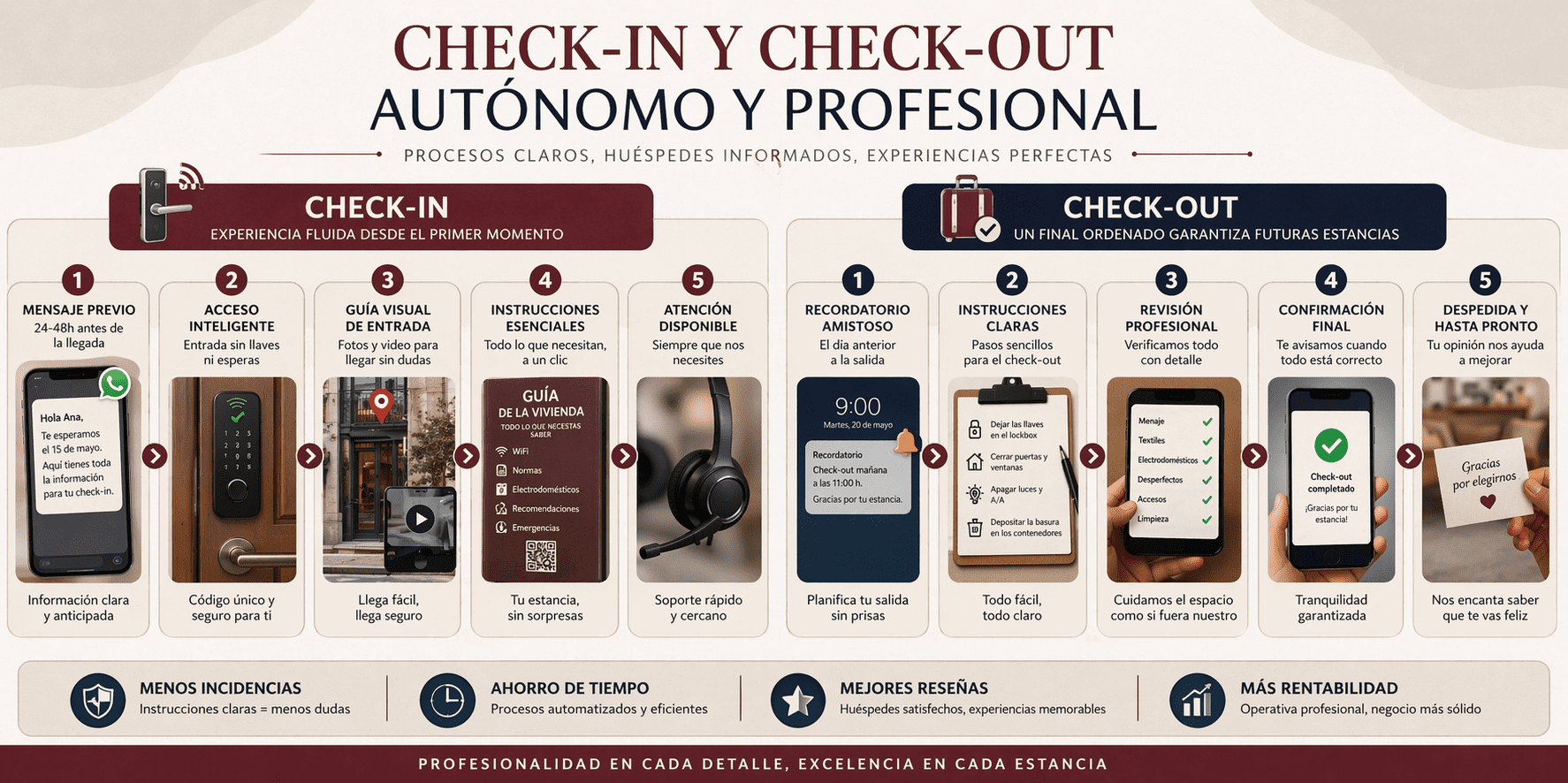
Check-in and check-out operation: clarity, speed, and control
The entrance and exit of the guest are two key moments for the overall perception of the service. They must be designed to minimize doubts, errors, and friction. A good check-in operation conveys professionalism from the first minute; a good check-out operation reduces damage, facilitates cleaning, and leaves a better predisposition to request a review.
In both cases, the goal is the same: simple instructions, sufficient information, and a sense of support without the need to be physically present unless the accommodation model requires it.
Housing manual: an operational tool that reduces incidents
The housing manual is not a decorative detail or a bureaucratic document. When well designed, it acts as a prevention tool. It reduces repetitive questions, avoids misunderstandings, enhances guest autonomy, and helps the stay flow with less friction. Additionally, it conveys order, foresight, and seriousness.
It is recommended to have a digital version accessible via QR code and a brief, clean physical version within the accommodation. The content should be clear, useful, and truly consultable, not a dense block that no one wants to read.
Amenities and replenishment: small details, great impact on the experience
Amenities and consumables are part of the service promise. It's not about filling the home with products, but about offering the essentials with coherence, cleanliness, and careful presentation. When this aspect is standardized, the guest perceives attention to detail; when it is improvised, it is immediately noticeable.
Moreover, replenishment should respond to a clear operational logic. If each shift freely decides what to leave and what not to, inconsistencies, overspending, and comments from guests comparing different stays will arise.
Inventory, textiles, and kitchenware: what deteriorates the most if not controlled
One of the most common mistakes in tourist housing is not having a minimal inventory logic. When it is not clear what there is, the condition it is in, and what safety stock exists, urgent replenishments, inconsistencies between stays, and the silent loss of quality begin.
This especially affects textiles and kitchenware, two categories that suffer continuous wear and tear, breakage, loss, or improvised substitutions that ultimately break the image of the accommodation.
Define how many complete sets you need per bed and per bathroom, what the acceptable level of wear is, when a piece is discarded, and how the clean stock is stored so that it does not get mixed or damaged.
Kitchenware should be sufficient, coherent, and easy to review. The more mixed, scattered, or heterogeneous it is, the harder it will be to detect shortages or breakages. It is advisable for each property to have a clear logic for quantities and location.
Having a small cushion of textiles, light bulbs, batteries, remotes, or basic pieces prevents expensive urgencies and unnecessary trips. Safety stock is not a luxury: it is a way to protect operations.
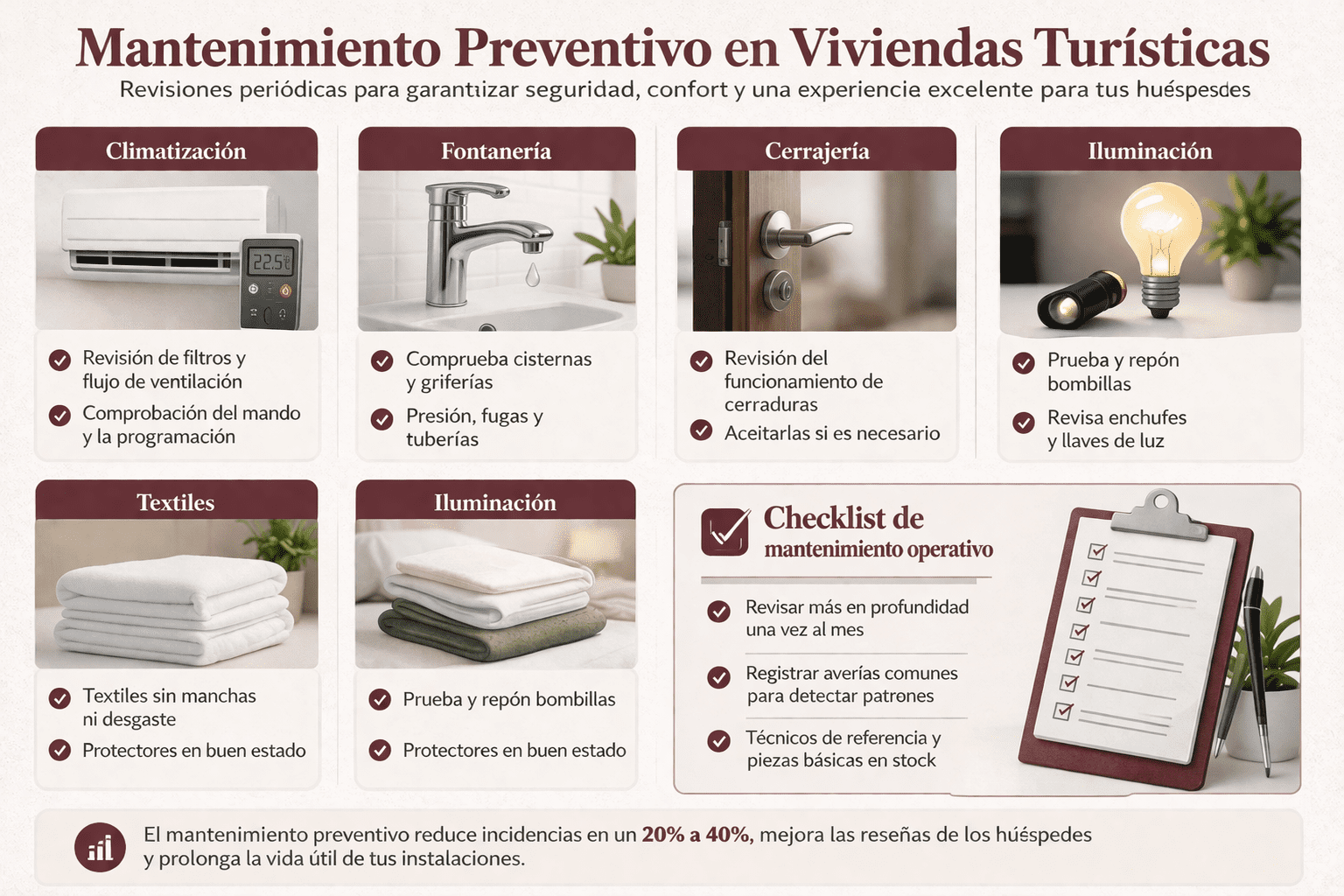
Preventive and corrective maintenance: how to avoid incidents pulling you down
An important part of bad experiences in tourist housing does not come from major breakdowns, but from small accumulated faults that no one reviewed on time: a slow tank, a stiff shutter, a burnt-out light bulb, a door that scrapes, an air conditioner poorly explained, or a coffee maker that starts to fail. When these details are ignored, they end up becoming issues during a paid stay.
That is why it is advisable to work with two layers of maintenance: corrective, to solve problems when they arise, and preventive, to detect them before they affect the guest.
Internal quality control: how to supervise without falling into chaos
It is not enough to assume that if there are no complaints, everything works well. Internal quality control serves to detect deviations before they reach the guest. It also helps measure whether standards are being truly met or only in theory.
This control can be simple, but it must be constant. A reasonable combination of spot inspections, reviewing photographs, monthly checks, and incident analysis is usually sufficient to keep the system healthy.
Frequent mistakes in the operational management of tourist housing
A single house also needs a system. In fact, many bad reviews arise precisely because it is managed with excessive informality.
Cheap often becomes expensive when it generates repetitions, failures, emergencies, and deterioration of the accommodation's reputation.
Without a clear standard, each person interprets tasks in their way and the quality changes from one stay to another.
Blindly trusting that "it will be fine" is one of the quickest ways to carry issues over to the next entry.
When each booking is managed with uncontrolled small variations, operations become heavy, fragile, and difficult to delegate.
Practical recommendations for owners and managers
Conclusion
Operations are the real heart of any tourist housing. It is what sustains quality when the guest arrives late, when there is high turnover, when staff changes, or when inevitable incidents arise. A well-designed operation protects reputation, saves time, reduces errors, and turns management into something much more professional and sustainable.
Working with clear standards, repeatable processes, reliable suppliers, and reasonable controls is not an obsession with order: it is a way to ensure that the accommodation operates well consistently, even in demanding contexts. That consistency is what allows for maintaining good reviews, avoiding unnecessary wear and tear, and making decisions with greater confidence.
If you manage a property, this chapter gives you a practical foundation to professionalize it. And if you manage several, it outlines the essential path to scale without losing quality. In both cases, the conclusion is the same: without a system, there is no solid operation, and without a solid operation, there is no stable business.