
Scaling, Expansion, and Growth Strategies
Most property owners and managers start in vacation rentals with a single unit, often as a natural extension of an investment, a second home, or an opportunity that arises almost by inertia. However, when that first property starts to perform well, a key question arises: Does it make sense to grow?
Scaling does not simply mean adding more properties. It does not mean accepting any opportunity, hiring hastily, or trying to improvise what has worked in a specific property. Scaling in vacation rentals means building a structure capable of replicating results with control, quality, and profitability, maintaining the guest experience and avoiding an overreliance on a single person.
But successful growth requires much more than enthusiasm. It requires processes, standards, financial control, reliable suppliers, appropriate technology, and a clear vision of the type of company you want to build. A small business can survive on improvisation; a growing business cannot.
This chapter provides you with a practical roadmap to transition from a single property to a scalable, profitable, and professional operation, avoiding the most common mistakes when trying to grow too quickly or without structure.
What Does It Really Mean to Scale in Vacation Rentals?
Scaling in vacation rentals means increasing the volume of activity without losing control of operations, without degrading the guest experience, and without destroying profitability along the way. In other words, it’s not about managing more for the sake of managing more, but about growing methodically.
There is a profound difference between having multiple properties and having a scaled business. You can manage three or four units in a handcrafted way and still rely completely on your time, physical presence, and personal capacity to put out fires. In contrast, a scaled business operates with standards, delegation, tools, indicators, and a structure capable of absorbing incidents without collapsing.
Therefore, growing doesn't always mean buying more. It can also mean acquiring third-party properties, expanding to new areas, professionalizing a management brand, or improving operational margins with processes and tools. The key is to choose a growth model consistent with your capital, your profile, and your risk tolerance.
When Are You Ready to Scale?
One of the most dangerous decisions in this sector is trying to grow before stabilizing the foundation. Sometimes the enthusiasm for adding properties obscures internal issues that are still unresolved: repeated incidents, poor coordination with cleaning, lack of financial control, poorly defined processes, or total dependence on the main manager.
Before growing, it makes sense to verify if your current operations are already functioning consistently. Scaling a weak foundation only multiplies errors, increases daily pressure, and worsens service quality just when you need reputation the most.
If you still have poorly coordinated arrivals, cleaning delays, frequent access issues, messages that are responded to late, or incidents that are resolved reactively, you are not prepared to grow. An unstable operation does not improve with more properties; it worsens.
The correct signal is different: reservations handled in order, controlled response times, consistent cleaning, smooth check-ins, and low dependence on daily "heroism".
A property can be sustained with informal supports or direct owner intervention. Multiple properties cannot. Beyond a certain volume, you need a robust and available external network.
What is not standardized cannot be delegated well. If each property is managed differently, if every message depends on the memory of the day, or if each incident is resolved "as seen," scaling will be chaotic.
Growing without mastering the platforms is opening more friction points. Before scaling, it is advisable to understand well how Airbnb, Booking, Vrbo, and the direct channel work, as well as the implications of using a PMS or a channel manager.
It’s not necessary to use all the tools on the market, but it is essential to understand the logic of calendars, messaging, pricing, availability, collections, restrictions, and synchronization between channels.
You should not scale an activity whose numbers are not yet clear. If you do not know precisely how much you earn, how much you spend, what margin each reservation leaves you, and what fixed costs each unit absorbs, growth can give a false sense of success while hurting your cash flow.
Growing with criteria requires knowing which properties are truly profitable, which areas perform better, which channels convert more, what operational costs you can bear, and what structure can sustain itself without relying on overly optimistic assumptions.
You are not ready to scale just because you "want" to grow, but because your current model already works consistently, is measured, is repeatable, and can absorb more volume without compromising quality. This difference separates solid growth from fragile growth.
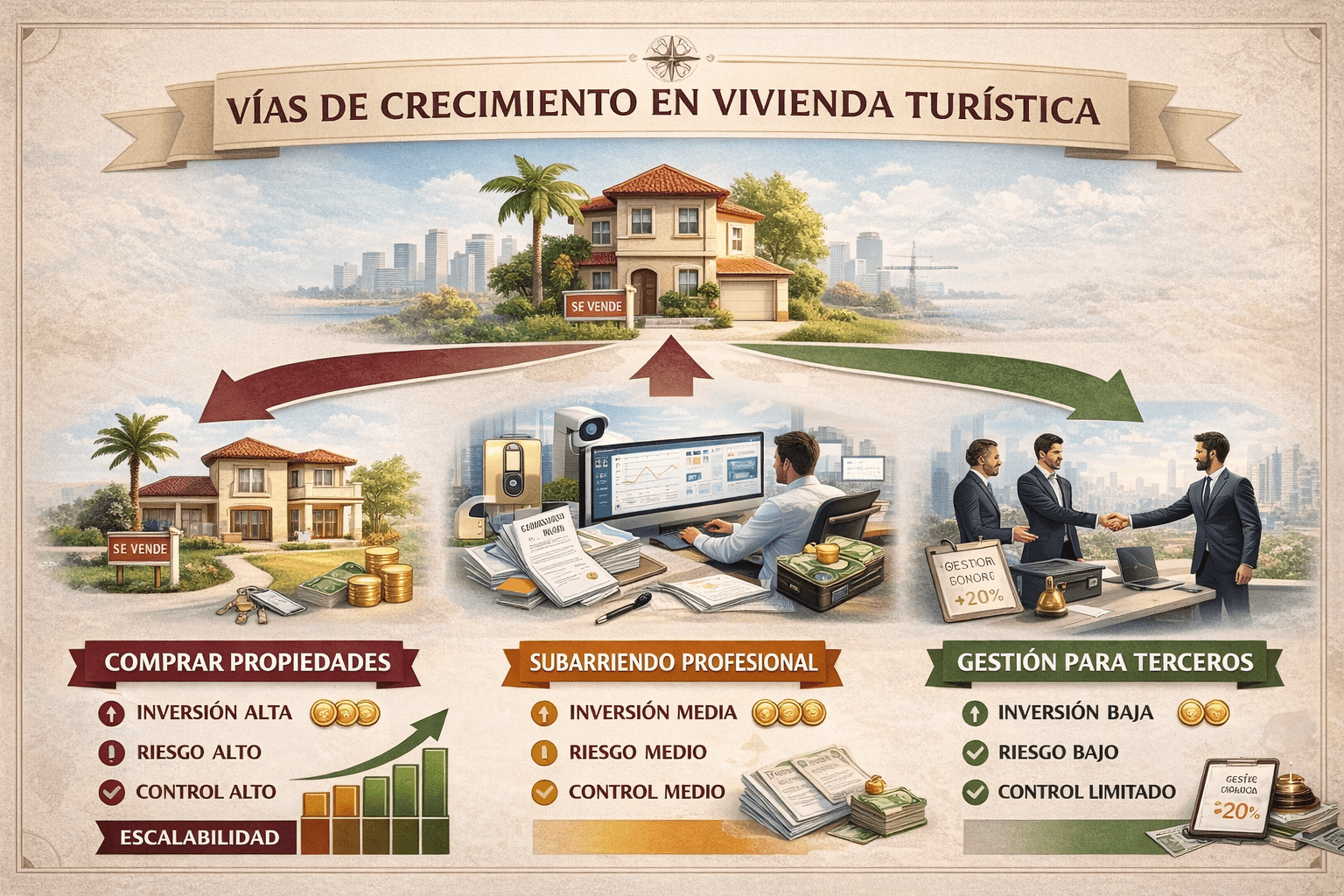
The 3 ways to scale a holiday rental business
There is no single way to grow in this sector. The common mistake is to assume that scaling necessarily means buying more properties, when in reality, there are several possible paths, each with very different implications in terms of capital, risk, structure, and expansion speed.
Choosing the right growth model is a strategic decision. Your profile as an investor, manager, or operator, as well as your financial capacity and level of risk tolerance, completely determine which of these paths makes the most sense for you.
This is the classic route of the asset investor. It allows building a personal portfolio, consolidating assets, and maintaining a high degree of control over the asset, operations, and long-term decisions.
This model, known in Anglo-Saxon markets as rental arbitrage, involves renting a property on a long-term basis and subsequently exploiting it for tourism or short stays, provided that applicable regulations, the contract, and the owner's authorization allow it.
This can be a relatively fast growth avenue because it reduces the entry barrier in terms of equity, but it is also a formula that requires special caution in Spain. It is not enough for it to "seem possible"; there must be contractual alignment, explicit authorization, and a thorough analysis of operational and market risk. Bear in mind that, if the contract is signed as a residential lease, the Urban Leases Law (Ley de Arrendamientos Urbanos) only allows the dwelling to be sublet partially and with the landlord's written consent (art. 8.2 LAU); that is why these arrangements are usually formalized as a lease for a use other than housing (art. 3 LAU), with express authorisation for tourist or seasonal use. In addition, the property must obtain its own regional tourist authorisation or registration and, if it is in a building under the horizontal property regime, since 3 April 2025 starting the tourist activity requires prior approval by the community of owners by a three-fifths majority (art. 17.12 of the Horizontal Property Law, Ley de Propiedad Horizontal).
In this model, it is advisable to exercise professional caution: it should not be assumed as an automatic or universal formula, because its viability depends on the applicable regulatory framework, the contract, the owner, the community, and the specific fiscal and operational structure.
This is the most accessible form and one of the most common for growing without locking up large amounts of capital. Here the operator does not need to be the owner of the property: they provide management, coordination, commercial optimization, and operational structure, while the asset owner participates in the profits in exchange for a commission or income sharing.
Step by Step to Scale Up to 5 Properties
The phase of one to five properties is probably the most delicate. Here, there is still much direct intervention from the manager, but needs for order, standardization, and coordination begin to emerge that a single unit did not require. It is the stage in which the “operating system” of the business is built.
If this phase is resolved well, the subsequent leap will be much more solid. If resolved poorly, later growth will rest on a fragile foundation. That is why the goal is not just to add four more properties, but to design a replicable method.
Before thinking about more properties, you need to document how your business works. An internal operating system is not bureaucracy; it is the foundation that allows you to repeat quality, train collaborators, and identify deviations.
Scaling without constant presence forces one to reduce reliance on physical intervention. It is not about filling the property with unnecessary technology, but about incorporating tools that save time, reduce errors, and allow for better supervision.
In practice, many operations grow or break down because of cleaning. It is the area with the most impact on reviews, incidents, turnover times, and final quality perception. That's why it's not enough to just "have someone who cleans." You need a system.
When managing multiple units and several channels, manually coordinating calendars becomes unreasonable. The most complex tool on the market isn't always required, but a solution that organizes calendars, automations, and overall visibility is necessary.
From three properties onwards, working without a centralized tool can become a source of unnecessary errors, mental overload, and the risk of overbooking.
Between one and five properties, how you are perceived by owners, collaborators, guests, and local agents becomes relevant. The brand is not just aesthetic: it is a layer of trust. The more you want to grow, the more you will need a recognizable and coherent identity.
Scaling from 5 to 15 properties
In this phase, an important change occurs: you stop being just an owner or operational manager and begin to behave like a small management company. Reacting is no longer enough. You need coordination, follow-up, supervision, and a clearer structure of responsibilities.
This is the stage where many businesses feel tension, as the volume is enough to create complexity, but there often isn’t yet a mature corporate structure. For this reason, it is advisable to professionalize before continuing to grow.
When there are multiple properties, it is no longer reasonable to manage everything by memory, scattered WhatsApp messages, or random calls. You need a system that allows you to record incidents, assign them, prioritize them, and verify that they have been resolved. Simple tools can be sufficient, as long as there is discipline in usage.
At this level, it is no longer sufficient to rely on the assumption that "everything will have been done correctly." It is advisable to introduce minimal evidences of execution, random sampling review, and visual controls or closed checklists. Cleaning ceases to be an isolated service and becomes a monitored process.
The more units you manage, the more costly it becomes to operate in a reactive mode. Preventive maintenance shifts from being a good practice to becoming a profitability tool: it reduces emergencies, protects reviews, avoids cancellations, and improves equipment lifespan.
From a certain volume, the bottleneck is usually the person who centralizes everything. To grow, you need to start distributing functions and reducing direct operational dependency.
At this scale, it is no longer enough to intuitively resolve problems. You need consistent criteria for delicate situations, as they impact reputation, margins, and operational security.
Scaling from 15 to 50 properties
From this volume, the business must be conceived as a consolidated company. At this point, improvisation ceases to be a nuisance and becomes a structural risk. Complexity increases, reputational exposure grows, and margins depend much more on operational efficiency and quality control.
At this level, it is advisable to adopt a mindset closer to that of a hotel operator or a professional manager: auditable processes, area accountability, a more mature financial vision, and a much more serious technological integration.
Management can no longer rest on a single central figure. It is necessary to start structuring areas and responsibilities, even if some functions are outsourced or shared.
With this dimension, it is advisable to review the corporate form, the contractual relationship with owners, insurance, liability coverage, billing organization, and the tax framework applicable to the activity in greater depth. Operational growth must be accompanied by a growth in structure and control.
At this level, technology is no longer a complement, but a central layer of the business. It is not just about having a PMS, but about better connecting operations, data, channels, incidents, and analysis.
A professional operation must be audited. It is not enough to look at isolated reviews or check monthly income. It is advisable to systematically review what is happening in each sensitive area.
How to Attract New Properties if You Are a Manager
For a professional manager, growth depends not only on operating well but also on knowing how to attract suitable properties. Acquisition should not be based on grandiose promises, but rather on credibility, commercial clarity, and demonstrable ability to provide order, performance, and peace of mind to the owner.
Owners value three things above almost anything else: trust, visibility, and a sense of control. They want to understand who will manage their asset, how it will be taken care of, what expectations are realistic, and why they should delegate to you rather than another operator or manage it themselves.
Your brand must convey reliability, not just aesthetics. A credible portfolio, real cases, clear presentation of services, and well-constructed materials help much more than exaggerated communication. The brand sells trust before selling management.
The owner wants to visualize results. There is no need to promise impossible numbers, but showing real improvements in presentation, positioning, processes, occupancy, guest experience, and operational order is essential. The clearer the before and after, the stronger the proposal.
Attracting properties is not about improvising a conversation. It is advisable to have a professional, clear, and adaptable commercial proposal for each property.
Offering a serious initial evaluation of the property's potential can be a great entry point. It is not about providing complex consulting for free, but about demonstrating judgment: analyzing the area, type of asset, expected demand, risks, product fit, and possible improvements before signing.
A significant portion of the best opportunities comes from recommendations or local visibility. Relationships with real estate agents, administrators, legal professionals, renovation companies, decorators, or local suppliers can become a stable source of acquisitions if your reputation is serious and consistent.

Risks When Scaling and How to Avoid Them
Growth can be a great opportunity, but it can also lead to quiet deterioration if not controlled. Many businesses increase volume while losing margin, worsening the guest experience, and overloading the team. Therefore, it is important to identify typical scaling risks from the beginning.
Strategic Solution: only scale what is already functioning stably. Before adding new properties, ensure that the current system can handle more load without degrading timelines, quality, or profitability.
Strategic Solution: professionalize selection, define standards, and do not rely on a single critical person. Real scalability requires minimal redundancy and clear performance criteria.
Strategic Solution: work with monthly dashboards, review margins per unit, differentiate cash from billing, and pay special attention to the growth of structural costs.
Strategic Solution: diversify thoughtfully, not by spreading too thin. It may be advisable to spread risk across neighborhoods, demand profiles, or even cities, as long as operations remain manageable.
Strategic Solution: use tools to organize and automate, but without losing human oversight. Technology improves the system; it does not independently correct poorly designed operations.
Strategic Solution: sell with professional caution. Mismanaged expectations generate property turnover, reputational wear, and avoidable conflicts. The best long-term acquisition is based on sustainable results, not inflated speeches.
Frequent mistakes that hinder growth
Practical recommendations for smart growth
Start by consolidating, not by accelerating. Speed does not compensate for a poor operational foundation. Slower yet well-structured growth often yields better accumulated results.
Incorporate properties that fit your system. Not all opportunities are good opportunities. Evaluate location, demand profile, operational difficulty, property condition, owner requirements and, above all, its legal situation: regional tourist authorization or registration, whether new registrations are possible in that municipality and, in buildings under the horizontal property regime, the community's authorization where required.
Measure each phase. Define simple yet useful indicators: response times, incidents per stay, average score, cleaning cost, net income per unit, and operational load per property.
Document before delegating. Delegating without clear instructions creates dependency, failures, and frustration. A well-written process saves time, it doesn’t take it away.
Care for profitability as much as occupancy. A highly occupied business that is poorly organized might work hard for little gain.
Don’t lose the experience standard. The larger you grow, the more important it is to maintain consistency in cleanliness, communication, presentation, response times, and incident resolution. Perceived quality must scale with you.
Conclusion
Scaling a vacation rental business is not a matter of luck, intuition, or simple volume. It is a process of progressive professionalization based on systems, standards, financial control, team, technology, and business acumen.
The true difference between growing and becoming disorganized lies in structure. You can move from a single property to a solid, profitable portfolio, but only if each phase of growth is supported by a sufficiently mature foundation. The opposite often results in more stress, more errors, and less margin.
The professional roadmap is clear: stabilize, standardize, measure, delegate, and only then expand. That is the most sensible path to turning a first property into a serious, scalable, and sustainable business over time.