
Home Automation and Automation in Tourist Accommodations
Home automation has become one of the great levers of professionalism within tourist accommodation. It is no longer just about offering modern or eye-catching lodging, but about building a more secure, efficient, and scalable operation. A well-automated property allows for the reduction of repetitive tasks, better control of what happens in the accommodation, a decrease in incidents, and provides guests with a more comfortable experience from the very first minute.
In the current context, where margins can be affected by rising energy costs, review pressure, the need for rapid responses, and regulatory complexity, technology ceases to be a luxury and becomes a strategic investment. Proper automation does not mean filling the house with devices; it means choosing reliable, useful tools that align with the actual operation of the accommodation.
A modern tourist accommodation can operate with smart access, remotely controlled climate, preventive sensors, automated messaging, digital cleaning coordination, and remote monitoring systems. All of this indirectly improves profitability: less time lost, fewer mistakes, fewer trips, less unnecessary consumption, and more control over the service.
This chapter explains how to integrate home automation and automation with a professional approach: what technology provides real value, which equipment should be prioritized, what risks you should avoid, how to deploy it in phases, and how to turn technology into a tangible operational advantage for owners and managers.
What home automation really brings to a tourist accommodation
Well-applied technology provides three fundamental benefits. The first is operational efficiency: fewer calls, fewer trips, less dependence on manual deliveries, and less improvisation. The second is control: knowing who accesses, when a stay ends, if there are unusual consumptions, or if an incident is occurring before a negative review appears. The third is the perception of professionalism: guests notice when they arrive at a well-thought-out accommodation, with easy access, clear information, good connectivity, and smooth operation.
Automation also allows for standardizing the experience. This is especially important when managing more than one property, when a support team is working, or when wanting to grow without each reservation depending on the availability or criteria of the owner at a specific time.
What to automate first and what not to oversize
One of the most common mistakes is installing too much technology without a clear operational logic. In tourist accommodations, it is advisable to prioritize those systems that have the most impact on day-to-day operations: access, connectivity, climate control, preventive security, and communication automation. These are the areas where the investment usually returns more real value.
On the other hand, more aesthetic or non-essential elements can wait. Automation should not generate extra complexity, dependence on unstable configurations, or a confusing experience for the guest. Every solution must be easy to use, simple to maintain, and have a backup plan if it fails.
Smart lock or professional access system, good WiFi with real coverage, message automation, basic climate control, and preventive sensors at critical points.
These are solutions that directly impact the guest experience and the operational load on the manager.
Advanced scenes, voice assistants, decorative automations, complex lighting, or sophisticated integrations that require too much maintenance.
They can add value in specific cases, but should not replace investment in essential elements.
Essential equipment to start with professional criteria
Not all properties require the same level of automation, but there is indeed a minimal recommended technological base when seeking professional management. This base should allow the property to be operated without constant physical presence, control access, optimize consumption, receive alerts for incidents, and maintain organized communication with the guest and support team.
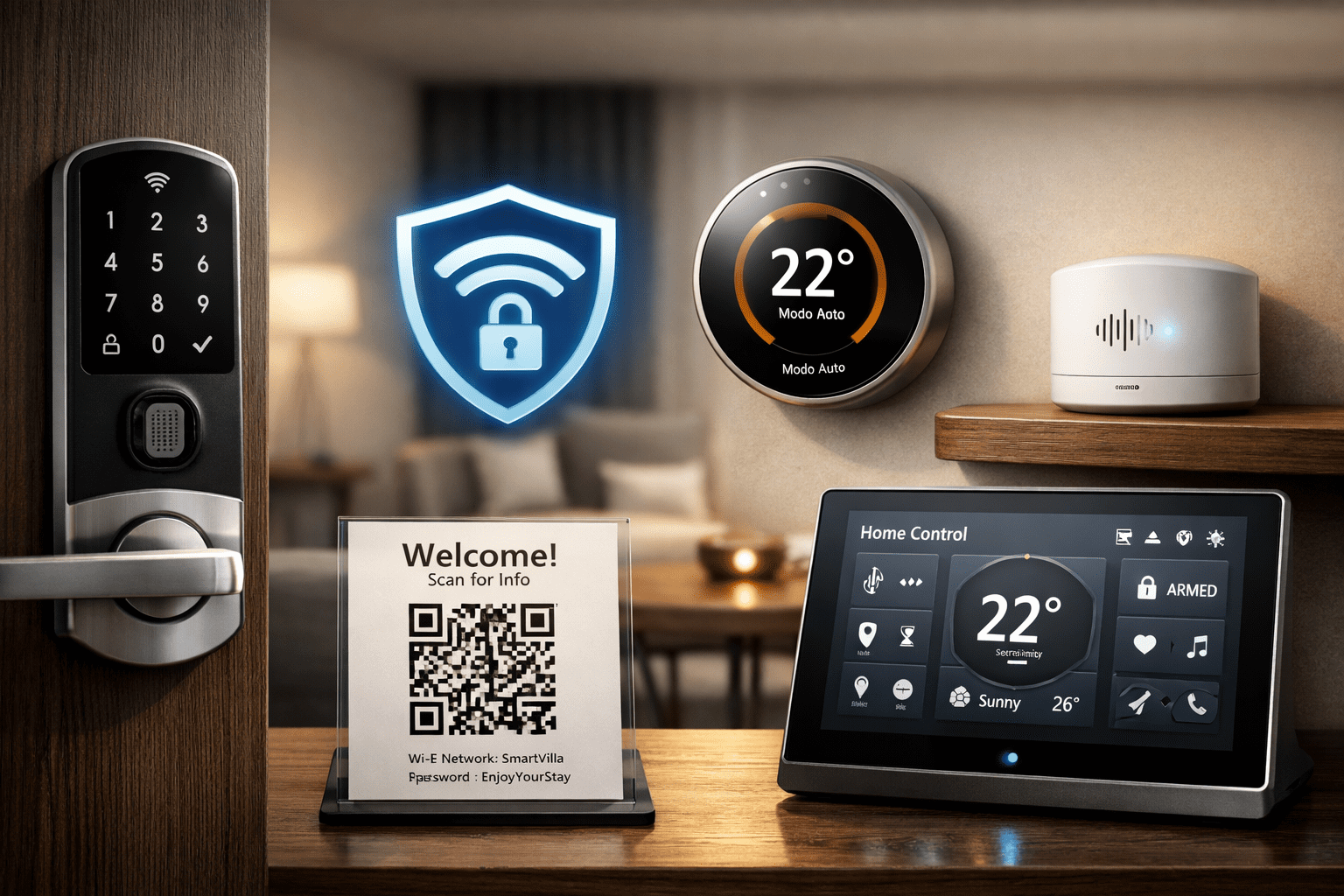
Smart access: the first major system that truly changes operations
Access management is probably the area where home automation provides the most immediate return. A well-chosen smart lock reduces trips, avoids issues with delivery or loss of keys, facilitates late arrivals, and allows differentiated access for guests, cleaning, maintenance, or trusted personnel. Moreover, it organizes the operation of entries and exits much better.
Not all solutions have the same level of professionalism. Some work well in residential use, but are not designed for frequent turnover, recurrent code generation, or integrations with PMS. Therefore, it is advisable to select systems that offer reliability, access history, temporary permissions, and a simple experience for the guest.
Temporary code: very practical for guests and easy to renew between bookings.
Mobile app: useful for the manager and certain user profiles, although it is advisable not to depend solely on it.
Outside keypad: a convenient solution that prevents the guest from having to install anything.
Backup system: safe box or alternative method in case of power failure, dead battery, or connectivity issue.
Generation of temporary or unique accesses.
History of entries and exits.
Stable and simple remote management.
Compatibility with existing door, cylinder, and type of installation.
Battery, maintenance alerts, and clear backup solution.
Known brands in the professional and semi-professional market include solutions like Nuki, Yale Linus, Tesa, TTLock, or Igloohome. The specific choice will depend on the door, the level of integration you need, the budget, and the available support. More important than the brand name is verifying real compatibility, user experience, system stability, and medium-term management ease.
Smart energy management: savings, control, and waste prevention
In many tourist homes, energy expenditure is one of the most volatile and difficult expenses to control. Guests do not always use the climate controls as they would in their own home, and this can lead to disproportionate consumption. Home automation helps limit excesses without deteriorating the experience, as long as it is implemented with common sense and without creating a sense of uncomfortable restriction.
The most useful systems in this area are smart thermostats, window or door opening sensors, smart plugs for certain devices, and, in some cases, automated lighting in passage areas. It is not about cutting comfort but preventing clearly inefficient uses: air conditioning running with open windows, heating at maximum with an empty home, or appliances running unnecessarily for hours.
Smart thermostats: allow limiting temperature ranges, scheduling times, and remotely monitoring the system.
Opening sensors: help reduce waste if coordinated with climate control or alerts to the manager.
Smart plugs: useful for controlling specific devices or for remote restarts when appropriate.
Automated lighting in passage areas: can make sense in entries, hallways, or specific common areas, although it is not always essential throughout the home.
It is common to read very appealing theoretical savings percentages, but one should be cautious. The real impact depends on the climate, the type of guest, the size of the home, and how the system is configured. Still, in many properties, simply monitoring and intelligently limiting consumption represents a significant improvement over completely manual management.
Define reasonable temperature limits.
Receive alerts for unusual consumption or usage.
Automate savings measures that do not create unnecessary friction for the guest.
Setting boundaries that are too strict that harm comfort and reviews.
Installing unstable automations that shut down systems when they shouldn't.
Not explaining to the guest in simple terms how the climate control works or what to expect from the system.
Noise sensors and incident prevention with neighbors
Preventive noise control is one of the most interesting uses of technology in tourist housing, especially in urban properties, sensitive communities, or accommodations where a party or misuse could generate a serious problem. These devices are not designed to monitor conversations but to detect high levels of noise, unusual occupancy, or patterns compatible with incidents.
Their value is not only in alerting; it’s in allowing early intervention. A timely alert can prevent a temporary disturbance from becoming a call from a neighbor, police intervention, or a poor reputation for the accommodation. Additionally, it helps support more serious management when it is communicated to the guest that the home has preventive systems respectful of privacy.
The device should be used to measure noise levels or patterns, not to record conversations or invade the guest’s privacy.
It is advisable to inform transparently in the house rules and stay documentation when this type of sensor exists.
It is also important to review the threshold settings to avoid constant alerts for normal usage of the home.
There are well-known brands oriented to the vacation rental sector, such as Minut, Roomonitor, or NoiseAware. The suitability of one or another depends on the environment, the type of alerts, the possibility of integrating with other systems, and the level of support. The essential thing is that the system is reliable, easy to manage, and consistent with the accommodation's coexistence policy.
WiFi and connectivity: a basic infrastructure, not a minor detail
In practice, a poor internet connection can generate more frustration than many other failures of the accommodation. The guest expects smooth connectivity to work, consume content, communicate, or manage their trip. Therefore, WiFi has become a critical infrastructure rather than an extra. Home automation also depends on that connectivity for other systems to function correctly.
It is not enough to contract a reasonable rate. One must ensure real coverage throughout the entire property, especially in large properties, with multiple floors, thick walls, or complex layouts. In many cases, a mesh solution is much more suitable than relying on a single poorly located router.
Check real coverage in bedrooms, living room, kitchen, and relevant outdoor areas if advertised as usable space.
Install a mesh network when the property requires it, instead of trying to solve it with makeshift repeaters.
Have remote access to the system for reboots or basic adjustments when possible.
Provide the guest with a simple connection, well signposted and without unnecessary steps.
Brands like TP-Link Deco, Google Nest WiFi, or Orbi often appear among the usual references for this type of solution. But again, the priority is not the brand itself, but the coverage, stability, ease of management, and compatibility with the size and layout of the property.
Message and task automation: less mental load and more consistency
Automation does not end with physical devices. A large part of operational improvement in tourist housing comes from automating communication with guests and certain internal workflows. When this part fails, the manager ends up repeating messages, forgetting notices, improvising instructions, and wasting time on low-value tasks.
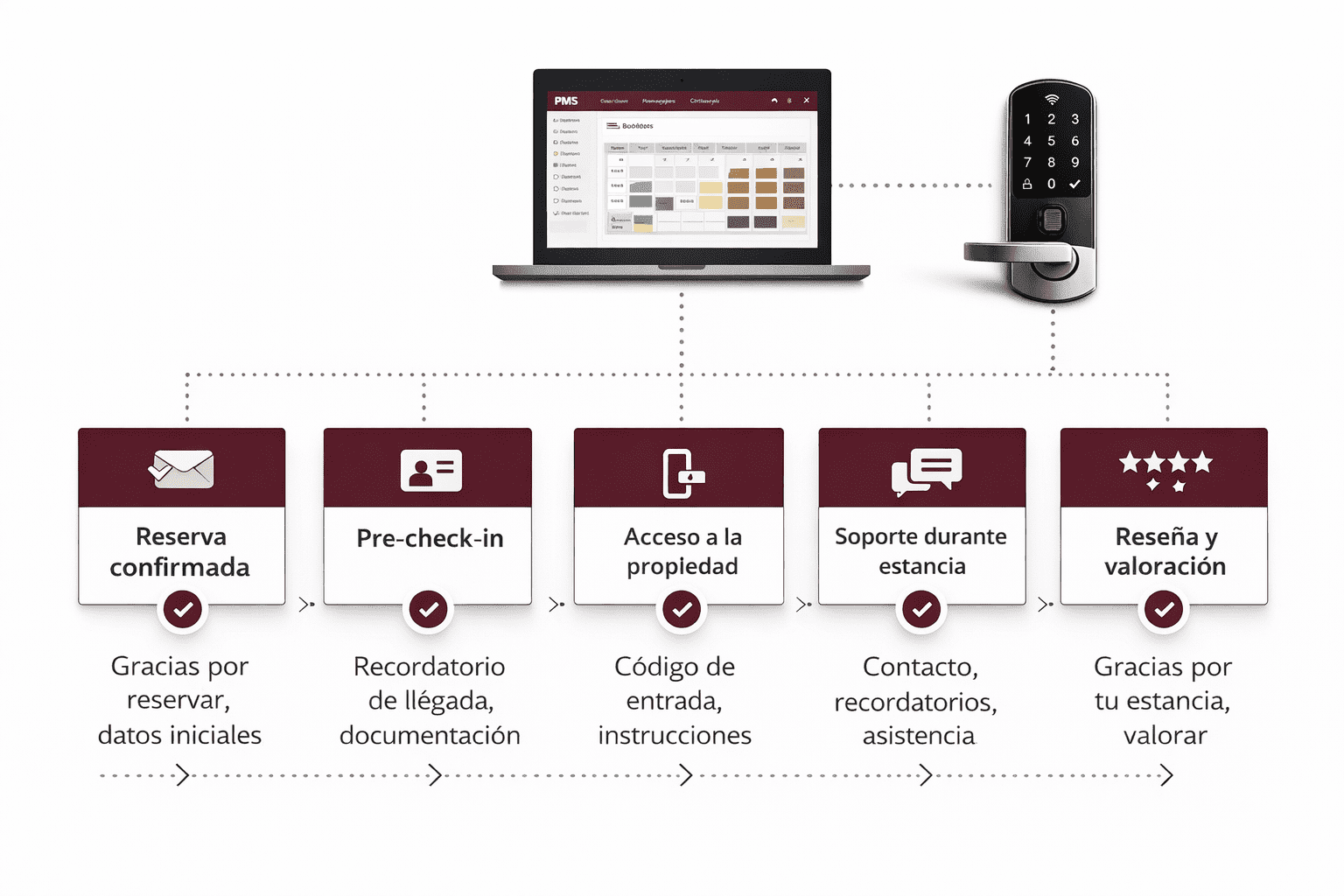
Automating messages does not mean dehumanizing attention. It means ensuring that critical points are always covered: reservation confirmation, documentation reminder, arrival instructions, access information, basic rules, support during the stay, checkout process, and request for reviews. From there, human attention can focus on real exceptions and value-added service.
Confirmation and thank you after booking.
Pre-check-in and prior documentation.
Arrival information and access details.
Usage rules and important reminders.
Follow-up message during the stay.
Checkout and subsequent request for evaluation.
PMS and channel manager with native automations.
Specific vacation management platforms.
Scheduled messaging in OTA when the channel allows it.
Integrations with locks, forms, digital guides, and internal tasks.
Platforms like Hostaway, Guesty, Smoobu, AvaiBook, Lodgify or certain specialized solutions can help with this automation. The choice will depend on the volume of properties, the main booking channel, the necessary integrations, and the budget. The important thing is that the system avoids duplications, is easy to maintain, and does not require manually reconstructing the same operations over and over again.
Technology applied to cleaning, maintenance, and internal coordination
A well-operated tourist accommodation not only needs to automate for the guest but also for the internal or external team that makes it function. Technology can greatly simplify coordination with cleaning, laundry, maintenance, and periodic reviews. This is especially useful when occupancy is high, when there is rapid turnover, or when working with several people and it is inconvenient to rely on impromptu calls or messages.
Well-planned automation allows knowing when the guest has left, generating temporary access for staff, automatically activating tasks after a completed booking, or keeping track of who has accessed and when. It also facilitates more preventive maintenance rather than reactive, which is key to maintaining the accommodation's standard.
Temporary access for cleaning: avoid physical keys and allow defining the entry time.
End-of-stay alerts: help trigger cleaning or review flows without having to confirm them manually.
Digitalized incidents: allow registering failures detected during cleaning or maintenance for subsequent resolution.
Control of replacements and reviews: reduces oversights and helps maintain the property consistency between stays.
When home automation is integrated with a clear cleaning operation, the result is much more solid: fewer errors, fewer oversights, fewer logistical blockers, and better capacity to scale management without losing quality.
Preventive safety: water, smoke, carbon monoxide, access, and exterior surveillance
Technology can also play a very important role in damage prevention and safety. In tourist housing, detecting a water leak in time, a smoke problem, or an access incident can prevent material damage, cancellations, conflicts with neighbors, or greater liabilities. These are systems that are not always visible, but which provide enormous operational peace of mind.
Water detectors are especially useful in bathrooms, under sinks, in washer or dishwasher areas, and in spots where a leak may go unnoticed for hours. Smoke or carbon monoxide detectors are particularly relevant in homes with certain combustion systems, although their recommendation goes further and fits within responsible and professional accommodation management.
Regarding cameras, the criteria must be extremely cautious. In tourist accommodation, interior surveillance is a line that should not be crossed. The possible installation of exterior cameras at access points or perimeters should only be addressed based on legal grounds, legitimate purpose, clear information, and absolute respect for the guest's privacy. This is an area that demands seriousness.
Water detectors in risk points.
Smoke detectors and, when applicable, carbon monoxide.
Alerts for access or abnormal use when the system allows it.
Use of cameras and video surveillance concerning privacy.
Processing of data associated with connected systems.
Need to inform, limit, and justify the use of certain technologies.
How to integrate home automation into the daily operations of the accommodation
Installing devices does not equate to having automated operations. For home automation to add real value, it must be integrated into the accommodation management processes. This means defining who receives alerts, what happens when an issue arises, how access is granted, how the end of a stay is recorded, how the cleaning team acts, and what information the guest receives.
The key is to connect technology with practical decisions. A noise sensor without an action protocol is barely useful. A smart lock without a backup system can create more problems than solutions. A connected thermostat that is poorly configured does not save energy; it only complicates things. Automation must serve the work method, not the other way around.
Who generates and supervises access for each reservation?
Who receives an alert about noise, leaks, or device failures?
What protocol is activated if a system fails to function at check-in time?
How is the guest's departure synchronized with the cleaning and inspection of the property?
What information is communicated to the guest so they can use the property properly and not feel lost with the technology?
When these answers are clear, technology becomes a layer of order. When they are not, home automation risks becoming a collection of loose tools with no real impact.
Phase implementation: the most sensible way to automate a tourist accommodation
The best strategy for implementing automation is usually progressive. This allows systems to be tested, costly errors avoided, and the investment adapted to the actual return being observed. Phase implementation also reduces the risk of reliance on a single brand or a technological ecosystem that later proves inflexible.
Smart access, good WiFi connectivity, automation of essential messages, and a clear digital manual for the guest.
Smart thermostat, opening sensors, selective plugs, noise alerts when necessary, and associated internal protocols.
Water, smoke, or CO detectors, more advanced automation with PMS, access for the team, digitized incidents, and more comprehensive remote monitoring.
This approach allows validation of whether the technology is truly improving time, costs, and satisfaction. Additionally, it facilitates correcting errors before extending systems to other properties or to an entire portfolio.
Recommended installation and deployment checklist
Indicative budget: how much it costs to automate wisely
The cost of automation will depend on the level of professionalism, the size of the home, whether there is a prior technological base, and the complexity of the system. Therefore, it is advisable to talk about indicative ranges rather than fixed figures. Additionally, there are differences between solutions designed for domestic use and more robust solutions for intense tourist operations.
In general terms, basic and reasonable automation can start with a relatively contained investment, while a more complete and professional implementation will require a larger budget. What matters is not to spend a lot, but to first invest in what truly reduces friction and improves control.
Common mistakes when implementing automation in a tourist home
Practical recommendations for owners and managers
If you manage a single home, automation can already provide you with a lot of value, especially in access, basic climate control, connectivity, and automated communication. If you manage several, its impact multiplies because it allows standardization, reduces dependency on specific people, and builds a much more scalable operation.
The professional recommendation is to start with a map of real needs: what takes your time, what incidents recur, what costs spike, what tasks depend too much on physical presence, and what moments generate more tension with the guest. From there, the technological choice becomes much more sensible and profitable.
Final closure
Home automation in tourist accommodations should not be understood as a collection of devices, but rather as a smarter way to operate an accommodation. When implemented thoughtfully, it enhances the guest experience, reduces manual labor, strengthens security, helps control costs, and allows for management with a more professional mindset.
The key is to choose useful, stable, and well-integrated technology. A reliable access system, a solid WiFi network, coherent automated communication, and a basic layer of prevention can completely transform the daily operations of a tourist home. From there, growth can continue in phases, always logically and without over-dimensioning.
In an increasingly competitive market, doing automation well not only saves time: it helps provide better service, protects profitability, and makes accommodation management a much more controllable, predictable, and scalable activity.