
Maintenance of tourist accommodation: repairs and professional decoration
Maintaining tourist accommodation in excellent condition is not just about repairing what breaks. Professional management requires anticipating wear and tear, methodical checks, informed investments, and taking care of the presentation of the accommodation as if it were a premium product on permanent display. In vacation rentals, guest perception depends on small details that, when accumulated, directly affect reviews, average nightly rates, ad conversion, and overall profitability.
A property can be legally registered, well-located, and correctly advertised, but if it conveys a sense of wear, improvisation, or lack of maintenance, its performance suffers. More incidents arise, more compensations are needed, operational wear increases, and a general sense of lower quality develops. Conversely, well-maintained accommodation that is visually coherent and functionally solid immediately conveys trust, reduces friction during the stay, and elevates the perceived positioning of the property.
Introduction
In a regular home, many small defects can be tolerated for weeks or even months. In a tourist property, they cannot. A worn-out joint, a stuck shutter, a wobbly chair, or poorly lit lamp can lead to complaints, negative reviews, or compensation. The guest does not evaluate the property as the owner does; rather, they see it as a customer who has paid for an orderly, comfortable, and visually appealing experience.
That is why maintenance and decoration must be managed with a professional mindset. It is not just about fixing breakdowns but implementing a system. A review system, a supplier system, an inventory system, a replenishment system, and a clear design criterion. Improvisation is often expensive. Prevention, on the other hand, is usually profitable.
This chapter develops a practical and realistic approach for owners and managers who want to operate at a high standard: preventing rather than repairing, intervening quickly when a problem arises, and presenting the property with a resilient, pleasant, and profitable aesthetic.
Profitable tourist accommodation is not just the one that looks good the day it is published, but the one that continues to function, impress, and photograph well after dozens of bookings. That is the true professional standard.
Preventive maintenance: the true secret to success
Preventive maintenance is what is done before visible incidents arise for the guest. It is the difference between a reactive operation and a mature operation. A property that is only attended to when something fails accumulates silent wear: small leaks, misaligned locks, deteriorating appliances, textiles wearing out unnoticed, scuffs that age the overall appearance, and details that gradually lower the accommodation's perception.
Applying preventive maintenance doesn’t mean overreacting or spending unnecessarily. It means reviewing with criteria. Some tasks should be done monthly, others quarterly, and others once or twice a year. The key is to make it a documented routine. When there is frequent guest turnover, a small periodic check saves emergencies, avoids cancellations, and preserves the property’s value.
Moreover, preventive maintenance has a very relevant commercial effect: when the property appears cared for, fresh, without obvious signs of deterioration, and all its elements are functioning properly, the guest perceives quality even before sleeping. This feeling translates into trust, better reviews, and a greater willingness to repeat or recommend.
Detect and correct minor wear before it leads to a breakdown, a poor experience, or an expensive intervention during a stay.
Keep the property looking impeccable, functional, and competitively attractive to continue defending price and reputation.
Monthly Maintenance
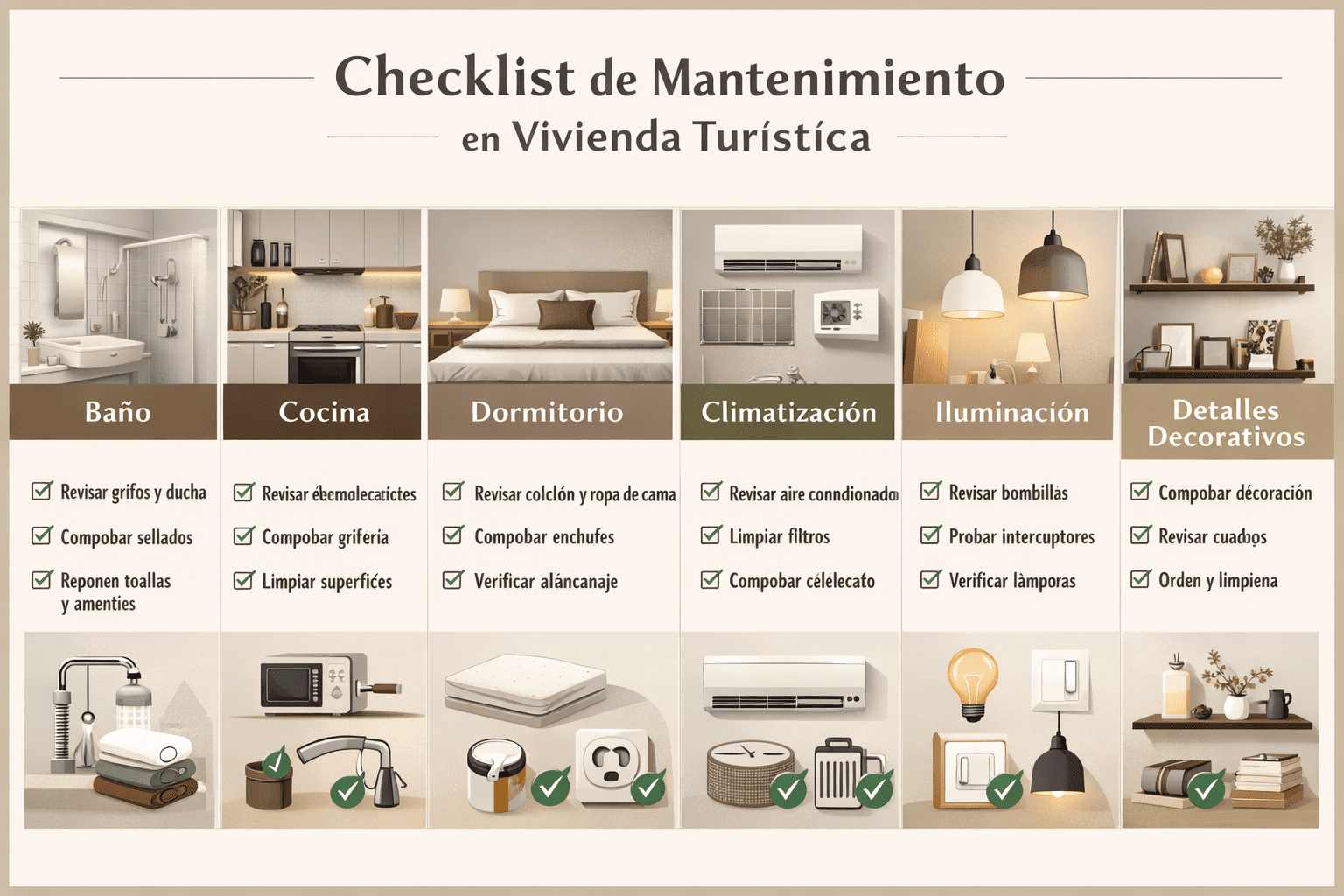
The monthly review should be brief, concrete, and repeatable. It is not a comprehensive audit, but rather a technical and visual round to ensure that the property continues to respond well to intensive use. Ideally, this review should be linked to the change of month or to a particularly convenient check-out reservation, allowing the team to access the property without the pressure of immediate check-in.
The important thing is not just to look, but to look with a checklist. When the process relies on memory, details are forgotten. When it relies on a defined routine, the standard is maintained.
The monthly review should not be limited to checking whether something "works." It should ask whether it works well, whether it conveys quality, and whether it remains aligned with the accommodation category. An outlet that works but is yellowed; a drawer that opens but scratches; a lamp that lights up but provides poor illumination are still operational and commercial issues.
Quarterly Maintenance
Every quarter, it is advisable to take a step further and review elements that do not require constant attention but do need professional follow-up. These are points where the real deterioration of the property tends to incubate: incipient dampness, worn joints, equipment losing performance, locks starting to misalign, or mattresses needing rotation and deeper disinfection.
This quarterly review is particularly useful for detecting the difference between normal wear and tear and wear that begins to compromise the guest experience. When managed well, it becomes a very effective barrier against costly breakdowns.
Annual Maintenance
The annual review is the time to lift your gaze from daily tasks and evaluate the property as a product. It is not enough for it to remain functional. It must continue to look competitive. Guests compare your accommodation with other properties, hotels, recently renovated apartments, and visually well-crafted listings. If the property begins to look aged, even if it still "holds up," it will lose commercial appeal.
Annual intervention does not always require major renovations. In many cases, selective painting, replacing textiles, professional deep cleaning, and replacing items that visually no longer meet the quality of the accommodation will suffice. The key is not to wait until wear and tear is too evident.
It is not advisable to stretch an item until it becomes clearly ugly or uncomfortable. In tourist accommodation, the right moment to replace something often comes sooner than in a private home. The goal is not to wear it out completely but to protect the overall perception of the space.
Hiring Technicians and Suppliers
Many incidents are not complicated by the breakdown itself, but by not knowing whom to call, by lacking clear priorities, or by relying on a supplier who takes too long. The tourist property needs a small technical network ready, not an urgent search every time a problem arises. Having tried-and-tested suppliers saves time, reduces operational anxiety, and limits the risk of cancellations or guests being unresolved for hours.
It is advisable to work with at least one primary supplier and one backup supplier in the most sensitive trades. It is also wise to have written agreements on schedules, access methods, typical response times, approximate rates, and criteria for urgency. The more organized this network is, the more agile the actual management will be.
Not all suppliers are equally suited for tourist accommodation. Besides being able to repair, they must understand that they are working on a commercial asset. This requires punctuality, cleanliness during interventions, good communication, and the ability to resolve issues without creating unnecessary disorder.
Incident Management
Every tourist accommodation needs a clear incident protocol. It's not enough to respond quickly; the response must be effective. The initial reaction must focus on managing the situation: understand the problem, assess its severity, decide whether it can be resolved with simple instructions or requires technical intervention, and communicate to the guest that action is being taken. Many complaints escalate not due to the malfunction itself, but because of a feeling of neglect or silence.
Documenting each incident is also crucial. If a problem recurs, it is no longer an anecdote, but a symptom of poor prevention. Keeping a small historical record enables the identification of patterns: remotes that frequently go missing, doors that always malfunction, appliances that generate recurring complaints, or pieces of kitchenware that need to be replaced with more durable models.
In professional operations, the distinction is not only defined by speed but also by structure. An incident managed methodically protects the guest's experience and helps prevent a singular issue from becoming a permanent negative review.
Lack of water, power outage, access problem, smart lock not responding, major leak, gas smell, active leak, or any situation that compromises safety or habitability.
Boiler, irregular hot water, air conditioning, essential appliances, blinds rendering the bedroom unusable, or issues that seriously affect guest comfort.
Burnt out bulb, lost remote, small paint scuffs, replacement of kitchenware, or details that do not impede the stay but should be documented and resolved methodically.
Professional Inventory
A professional inventory is not just a list for guest check-in or check-out. It is a tool for cost control, prevention of duplicate purchases, and maintenance of standards. When there is no real inventory, the accommodation loses consistency: items are missing, useless pieces are overabundant, urgent purchases appear, replacements are made with different models, and the property loses visual and functional coherence.
The inventory should include at least basic quantities, item type, location, and minimum replenishment levels. There is no need to over-bureaucratize, but it is essential to maintain control. This is especially important in kitchens, linens, remotes, small accessories, and items that easily disappear or experience intensive use.
It is advisable to review the inventory every month and conduct a more organized review every quarter, taking the opportunity to remove damaged items that lower the perception of the accommodation even if they are still usable.
Glasses, cups, plates, bowls, mugs, cutlery, frying pans, pots, utensils, cutting boards, coffee makers, kettles, toasters, and small items that tend to break or disappear.
Pillows, protectors, bed linens, blankets, hangers, decorative cushions, bedside lamps, and remotes if integrated into the room.
Towels, mats, hairdryers, auxiliary mirrors if available, dispensers, trash bins, and accessories that wear out easily.
Remotes, batteries, cushions, blankets, auxiliary lamps, relevant decorative elements, router, repeaters, visible plugs, and shared use items.
In kitchenware and textiles, it is advisable to define a small stock of safety items out of the guest's view. Having immediate replacements prevents hasty purchases, reduces operational stress, and allows maintaining standards even during busy weeks.
Professional Decoration: The Aesthetic That Increases the ADR
Decoration in tourist accommodation should not be understood as a superficial or purely aesthetic matter. It has a direct impact on marketing. A well-decorated property looks better, photographs better, generates more clicks, conveys more value, and is often compared to better alternatives in the market. All of this allows for better price defense and justifies a superior positioning.
However, decorating well in vacation rentals is not about making it look like a magazine house or a very personal private residence. The criteria should be different: a balance between aesthetics, durability, ease of cleaning, visual coherence, and the ability to appeal to a wide audience. Excess often penalizes. Delicate items tend to be expensive. Visually striking yet easy-to-maintain items are usually the best combination.
Profitable decoration does not compete with maintenance; it complements it. A beautiful property is of no use if it conveys wear and tear. And a functional property is of little use if it does not project attractiveness. The union of both dimensions generates a strong tourism product.
Recommended Furniture for High Durability
In vacation rentals, buying "pretty" but fragile furniture is usually a bad investment. The priority should be to find robust pieces that are visually appealing, easy to clean, and simple to replace or maintain. You don't have to give up design, but you should consider the rotation of use. Delicate items, overly lacquered finishes, difficult fabrics, or overly sophisticated solutions that are unnecessary tend to age poorly operationally.
The best furniture for tourist accommodation is that which holds up well, ages gracefully, and when it shows wear, does not destroy the overall aesthetic of the space.
It's advisable to invest in a sturdy sofa that is removable or made of durable fabric; a robust table with good stability; simple and functional TV unit; a washable or low-maintenance rug; and warm lighting that does not depend on a single central light source. The living room is a high-use area and must withstand movement, occasional meals, children, pets if allowed, and continuous changes of guests.
The central element is rest. Therefore, the mattress, base, protectors, and bedding must be prioritized. A pleasant headboard, balanced nightstands, comfortable lighting, and sufficient storage greatly enhance the perception of quality. A full-length mirror, enough hangers, and a visually uncluttered bedroom usually add much more value than an overloaded decoration.
The kitchen should prioritize functionality, ease of cleaning, and a sense of order. White or very neutral tableware, durable cutlery, good small appliances, pots and pans that actually work, well-selected essential accessories, and uncluttered surfaces. A kitchen that is too full looks worse and generates more issues. An empty kitchen conveys poor accommodation. Balance is key.
The bathroom needs to convey cleanliness, care, and a certain hotel-like feel. Solid towel racks, well-lit mirrors, discreet accessories, visually clean screens, white or coordinated textiles, and the absence of poor-quality plastics are very helpful. The decoration here should be minimal, as the focus should be on order and the sense of hygiene.
Decoration by Style
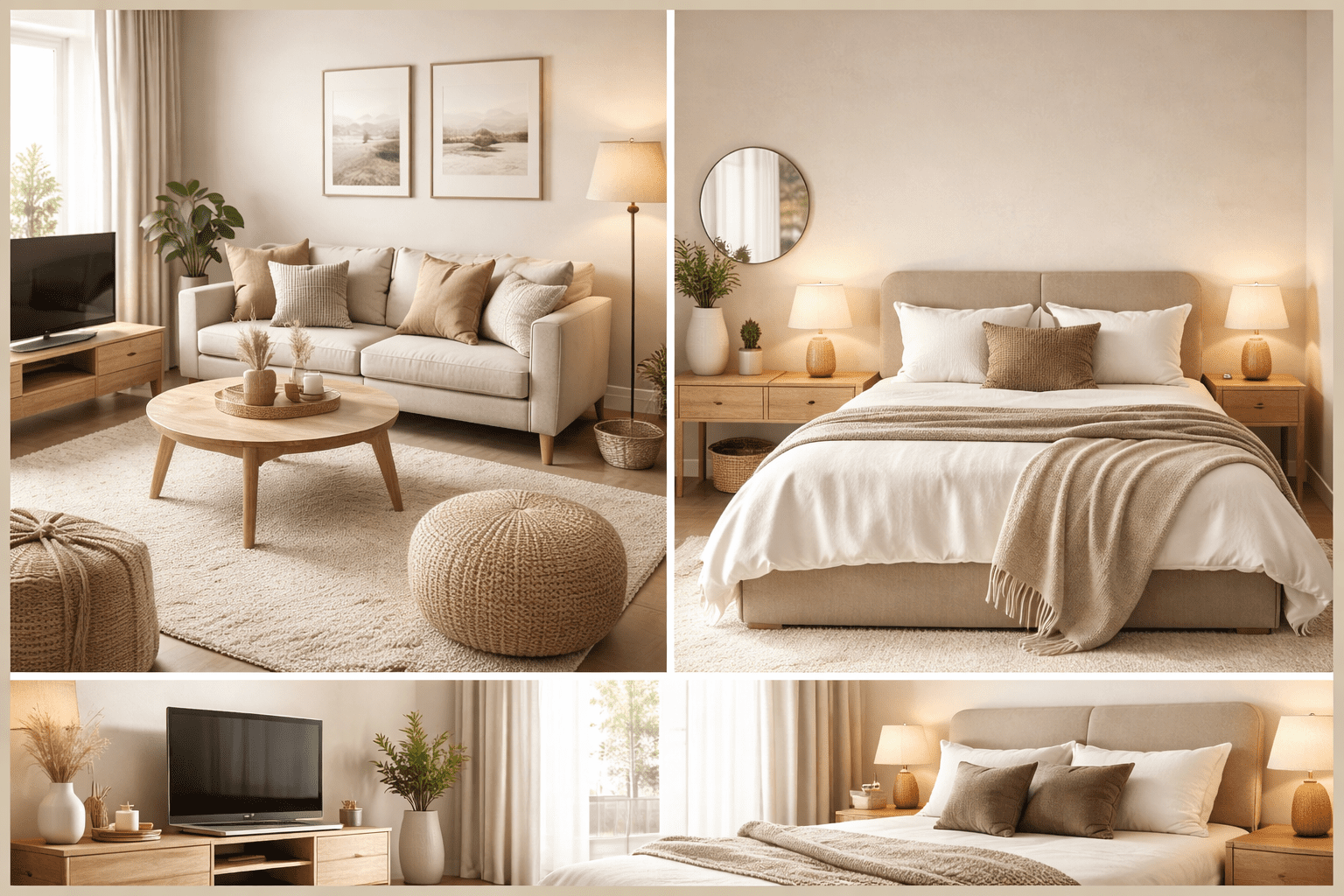
Choosing a decorative style does not mean confining oneself to a rigid aesthetic, but rather giving coherence to the property. When the accommodation mixes elements without a criterion, the overall perception is less professional. In contrast, when there is a clear visual line, even if it's simple, the house seems better thought out, more cared for, and more competitive.
The best style is not always the most eye-catching, but the one that fits best with the type of property, location, target guest, and the actual maintenance capacity of the property.
It is often one of the most profitable because it combines light, neutrality, wood, order, and a sense of cleanliness. It works very well in listings, does not fatigue the eye, and allows for simple replacements without breaking harmony.
It fits very well in coastal areas or homes with plenty of natural light. Beige, white, natural fibers, ceramics, and small touches of blue or terracotta can work very well if applied in moderation.
Useful in city environments, contemporary apartments, or accommodations aimed at business stays or urban escapes. It is advisable to soften it so that it doesn't come off as cold: an excess of gray, black, or metal can detract from warmth if not balanced well.
It can work well when the location supports it, as long as it doesn't fall into excessive clichés. It's better to suggest a relaxed atmosphere with sand and white tones than to fill the home with obvious thematic references.
There's no need to copy a pure style. In many cases, the most effective approach is to build a neutral base and add accents that are coherent with the area or guest profile. The important thing is that the final result looks clean, orderly, and consistent in photographs and in the actual experience.
Repairs and Minor Improvements with Greater Returns
Not all investments generate the same impact. In tourist accommodation, it is advisable to prioritize improvements that combine three effects: enhance the guest’s perception, reduce incidents, and improve the visual material of the listing. Sometimes, a relatively small change in lighting, paint, textiles, or furniture yields more return than an expensive intervention with little real impact on the experience.
The best strategy is usually to intervene first in what the guest perceives and uses the most: entrance, living room, bed, bathroom, heating/cooling, lighting, textiles, and basic kitchen.
Common Mistakes in Decoration and Maintenance
Many accommodations lose profitability not due to a major fault, but due to an accumulation of minor errors: postponed repairs, poor-quality items, overly personal decoration, excess objects, lack of wear control, or a mistaken idea of saving. What is cheap becomes expensive when it generates complaints, constant replacements, or an image of improvisation.
Practical Recommendations
Once the property is up and running, the key is often not to make radical changes, but to implement consistent habits. What differentiates a basic accommodation from a clearly professional one is the discipline of review, replenishment, and continuous improvement. This discipline does not have to be complex, but it must be constant.
The following recommendations help maintain the quality of the accommodation in the medium and long term without relying solely on the owner's intuition.
Schedule monthly, quarterly, and annual reviews. Assign responsibilities. Document incidents. Maintain a small maintenance fund and do not wait until there’s a chain of problems to act.
Work with a simple palette, pleasant materials, and contained decoration. Periodically review the property as if you were a guest entering for the first time.
Purchase easy-to-replace items, simple sets, and textiles that you can match in the future. Consistency is lost when each replenishment is made without a common criterion.
Conduct an annual review comparing your property with others in its segment. If the competition looks more modern, brighter, or better cared for, it is advisable to react before noticing a decline in conversions or pricing.
Conclusion
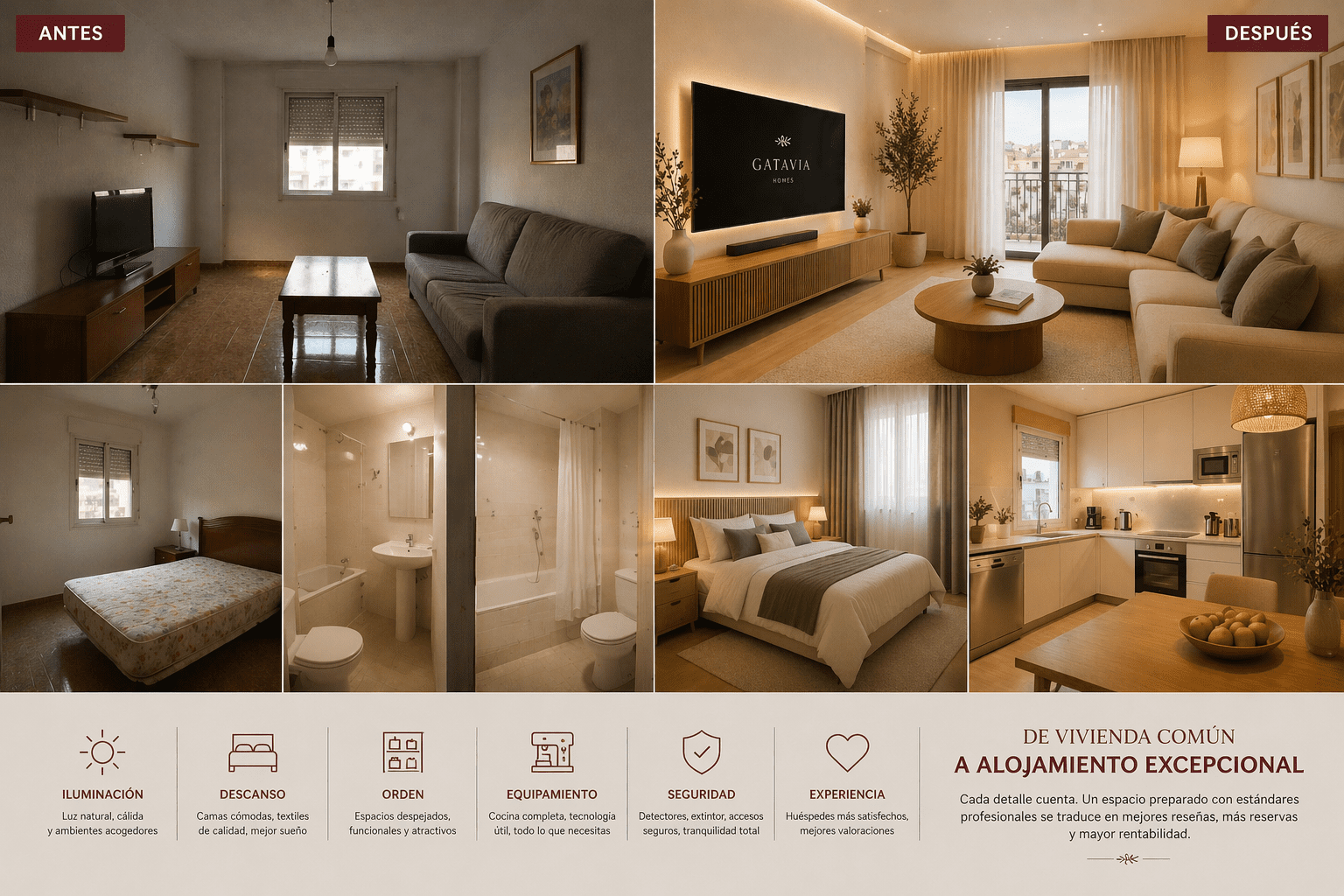
Maintenance and decoration are two of the most undervalued levers in the management of tourist homes. When worked on with criteria, they reduce problems, elevate the perception of the accommodation, and sustain profitability quietly but steadily. When neglected, the property deteriorates inside and out, even while still receiving some bookings.
A well-maintained property not only generates fewer unexpected expenses but also increases bookings, improves reviews, conveys trust, allows for better price defense, and contributes to the guest remembering their stay as a comfortable and well-managed experience. This is exactly what sets apart an amateur accommodation from a professional tourist product.
Your holiday rental is not just a place where a guest sleeps. It is a professional product that needs to function well, look good, and hold up well. Managing it this way is one of the smartest ways to protect income, reputation, and growth.