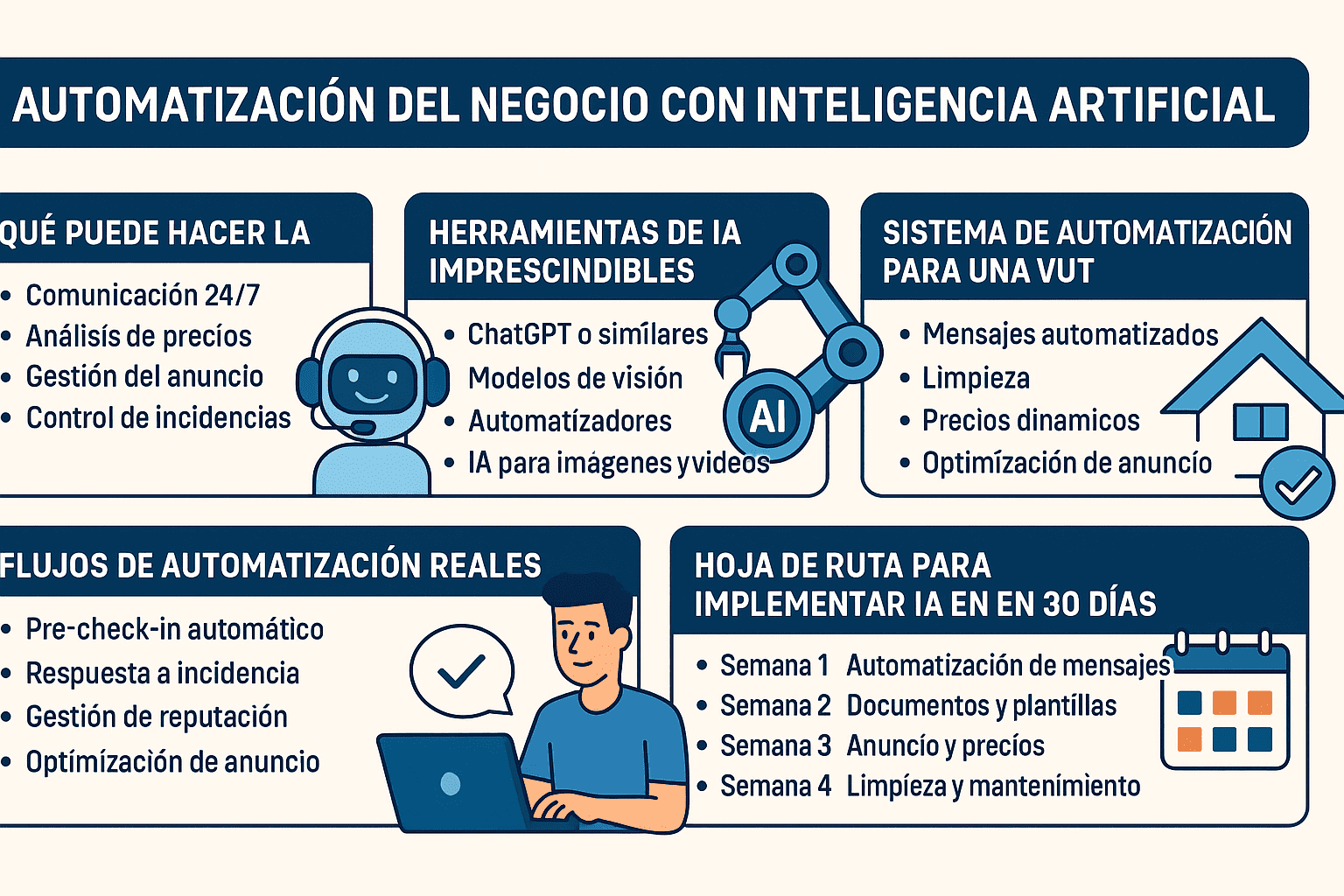
Automation and Artificial Intelligence Applied to Vacation Rentals
How to save time, reduce errors, improve guest experience, and manage your accommodation as a modern and efficient business.
Automation in vacation rentals is no longer an option reserved for large managers or companies with complex structures. Today, it is part of the professional management of any accommodation that wants to operate with more order, less friction, and greater profitability. Automating does not mean dehumanizing the service, but rather freeing up time from repetitive tasks to focus more on what truly enhances the guest experience and the quality of the business.
Artificial intelligence, for its part, has become a very valuable support for drafting messages, improving listings, streamlining guest communication, translating information, detecting patterns, and helping make quicker and better-informed decisions. Used judiciously, it allows for working with a much more professional structure, even if you only manage one property.
In this chapter, you will see how to apply automation and AI in a practical, realistic, and profitable way, which processes to automate first, which tools can help you, what mistakes to avoid, and how to build a modern operating system for your vacation rental without losing control, quality, or personal touch.
Introduction: Why This Chapter is Key in Current Management
Modern vacation rentals can no longer rely solely on the host's memory, on hurriedly sent manual messages, or on operations based on constant improvisation. When management relies too much on being constantly aware of everything, the margin for error increases, the guest experience suffers, and the business becomes difficult to scale.
Well-implemented automation allows certain actions to be executed on their own, in an orderly fashion and at the right time. AI, in addition, adds an extra layer of support in communication, analysis, and content generation. The result is not just more convenience: it is a more robust, coherent, and professional operation.
Thanks to technology, you can now:
This chapter teaches you precisely how to implement all of this in a practical, logical, and tailored way to the real business of a vacation rental.
What is Automation in a Vacation Rental?
To automate means to create processes that are executed partially or completely automatically, without the need for constant manual intervention. It does not mean the accommodation operates "by itself," but that certain repetitive, predictable, or programmable tasks are organized to occur at the right moment, with fewer forgetfulness, fewer errors, and less dependence on constant oversight.
In a vacation rental, automating does not just mean sending programmed messages. It can also involve generating temporary access codes, notifying the cleaning team when a departure is confirmed, logging incidents, adjusting prices according to occupancy, launching internal reminders, collecting data, or activating quick responses to frequent situations.
Processes That Can Be Automated in a Vacation Rental:
The ultimate goal is very clear: to free up time, reduce dependence on manual tasks, and create a more robust, professional, and scalable operation.
What does artificial intelligence contribute to the business?
Artificial intelligence adds an additional layer of support over traditional automation. While automation executes programmed actions, AI helps to draft, summarize, analyze, classify, propose responses, detect patterns, and generate useful content at high speed. In other words, it not only performs tasks but also assists in thinking better and working faster.
In the context of a holiday rental, this holds immense value. The manager needs to communicate effectively, resolve doubts quickly, keep ads updated, respond to reviews, create manuals, review incidents, and adapt messages according to language, tone, or situation. AI can become an operational assistant for all that.
AI can help you:
The key is to understand that AI should not replace the host or manager's control but serve as a supportive tool to do the job better and reach further with less friction.
What to automate first: logical order of implementation
One of the most common mistakes is trying to automate too many things at once. The most effective approach is to start with the processes that consume the most time, are repeated most often, and have the greatest impact on the guest experience or daily operations. Automation works much better when implemented in layers, with a clear and verifiable foundation.
Recommended order for automating a holiday rental:
1. Basic communication with the guest
Reservation messages, pre-arrival, check-in, stay, pre-check-out, and review.
2. Access and check-in
Temporary codes, automatic instructions, and arrival notices.
3. Cleaning and operational shifts
Automatic task assignment, digital checklists, and housing status validation.
4. Pricing and restrictions
Price adjustments, minimum stays, and demand rules.
5. Maintenance and alerts
Preventive reminders, sensor monitoring, and technical incidents.
6. Analysis, reporting, and AI support
Summaries, pattern detection, responses, documents, and overall business tracking.
This approach avoids saturation, reduces implementation errors, and allows verification of which automations truly add value before advancing further.
Essential Automated Messages
Every professional holiday rental should have a well-thought-out sequence of automated messages. It's not about bombarding guests with notifications, but rather guiding them at every stage with the right information, in the correct tone, and at the appropriate time.
Automation here brings significant value as it improves response times, prevents forgetfulness, conveys a sense of order, and reduces repeated questions. Additionally, when the sequence is well-crafted, it enhances the perception of professionalism even before the guest arrives at the accommodation.
Mandatory or highly recommended messages in professional operations:
AI can enhance these messages to make them:
When these messages are well constructed, they not only reduce manual work but also decrease misunderstandings, improve the experience, and avoid many of the questions that actually arise due to insufficient prior communication.
AI for Guest Responses: Chatbot or Assisted AI
One of the most useful applications of AI in holiday rentals is guest service. A complex chatbot is not always necessary. Often, having a well-designed set of response templates and relying on AI to draft, translate, summarize, or quickly adapt messages is sufficient.
In accommodations with a higher volume, a well-configured AI can handle frequent queries almost immediately, especially during the night or in times of high operational load. This improves the perception of service and significantly reduces pressure on the manager.
What a well-informed AI can respond to:
Expected outcome: faster service, fewer interruptions, fewer improvised messages, and a better perception of service. When AI is combined with good configuration, average response time can be dramatically reduced, which also benefits visibility and performance on platforms.
Access Automation
Access automation is one of the strongest changes in the operation of a holiday rental. It saves time, reduces waiting, avoids unnecessary in-person deliveries, and improves guest autonomy. Moreover, it provides control, security, and traceability.
The ideal combination usually includes a professional smart lock, generation of temporary codes, integration with PMS or calendars, and an alternative backup system in case something fails. This makes access to the accommodation a smoother process and much easier to scale.
Ideal combination for a professional implementation:
Expected professional operation:
With this you avoid:
❌ Lost keys.
❌ Delays due to in-person deliveries.
❌ Uncomfortable waits for the guest.
❌ Risks arising from copies or misuse of physical keys.
Cleaning and Logistics Automation
Cleaning and internal logistics are one of the major critical points in any holiday rental. Poor coordination here creates delays, problematic check-ins, restocking errors, undetected maintenance issues, and ultimately, negative reviews. Therefore, automating this part of the business has a huge impact.
Good automation not only notifies that there has been a departure. It also assigns tasks, records the state of the accommodation, forces checklist completion, allows for photo uploads, and activates alerts if something is missing or if an issue arises.
Automation can manage:
Frequently used tools for this part:
• Turno
• Breezeway
• TIDY
• Properly
• PMS with a housekeeping or internal tasks module
Maintenance Automation
Preventive maintenance is one of the major forgotten elements in many holiday rentals. However, it is often the difference between stable operation and a constant chain of minor breakdowns, emergencies, improvisations, and unnecessary costs. Automating reminders and checks helps maintain the accommodation in good condition and avoid larger problems.
You can automate, among other things:
An automated maintenance structure not only prevents major breakdowns. It also protects your reputation, reduces urgent costs, and conveys a sense of a well-maintained and managed accommodation.
AI for price optimization and automated revenue
Dynamic pricing is one of the areas where automation and AI have the greatest economic impact. Manually adjusting prices every day is unrealistic for most managers, especially when there are multiple platforms, changing events, gaps between reservations, or seasonal, advance, and duration variations.
Dynamic pricing tools analyze market conditions, occupancy, competition, local events, demand patterns, and other factors to continuously suggest or apply rate changes. This does not replace human judgment, but it allows for much greater precision and quicker reactions to market changes.
AI pricing platforms typically help to:
Recommended tools in this area:
• PriceLabs, highly valued for its balance between depth and cost.
• Beyond.
• Wheelhouse.
• Airbnb Smart Pricing, useful as support but insufficient as the only strategy.
Automated revenue works best when combined with supervision. The tool suggests or adjusts, but the manager must review price ceilings, floors, critical dates, unique events, and the overall consistency of pricing positioning.
Official source — BOE · consolidated TRLGDCU, Article 20
AI for writing descriptions, ads, and operational content
Another highly profitable use of AI is generating and improving texts. Many accommodations have acceptable but undifferentiated ads, repetitive descriptions, poorly translated texts, or messages that do not convey the full value of the accommodation. AI allows for an elevated quality of copy and keeps it updated more easily.
AI can generate or improve:
It's especially useful for:
• Creating new listings.
• Improving old listings that have become stale.
• Adapting copy for the high season, getaways, families, remote work, or long stays.
• Generating versions by language without starting from scratch each time.
That said: AI can draft very quickly, but it’s always advisable to review accuracy, tone, and consistency with the reality of the accommodation. Speed should not take precedence over truthfulness or the final quality of the message.
Sensors and devices that work automatically
The physical automation of the accommodation is also an important piece of the system. Smart sensors and devices can detect abnormal situations, save energy, anticipate problems, and better protect the home without the need for constant intervention.
Noise Sensor
Detects abnormal noise levels and sends an early alert to send a preventive message to the guest, reducing the risk of parties, disturbances to neighbors, or conflicts. On Airbnb, decibel monitors are allowed indoors if they are disclosed in the listing, are not placed in bedrooms, bathrooms, or sleeping areas, and do not record audio.
Window Opening Sensor
Can integrate with climate control to turn off or limit the air conditioning when a window is open, reducing energy waste and inefficient use of the system.
Motion Sensor
Very useful for passage areas, access points, or common areas, as it allows for automated lighting and optimizes energy consumption without compromising comfort.
Humidity or Leak Sensor
Helps detect water leaks, excessive condensation, or abnormal humidity before they become major and costly damages.
Outdoor Cameras
When installed correctly and respecting privacy, they serve to monitor accesses, verify arrivals, or detect abnormal situations outside the accommodation. Airbnb prohibits any camera that monitors indoor spaces, even if it is switched off; outdoor cameras must be disclosed in the listing, stating their location, and cannot be installed where greater privacy is expected, such as an enclosed outdoor shower or a sauna. Data protection law also requires a visible information sign, capturing the public highway only to the extent strictly necessary, and deleting recordings within one month at most, unless they must be kept to prove an incident (Article 22 of the LOPDGDD).
These systems do not replace supervision but do expand the manager's control capacity and help act before a small incident turns into a serious problem.
Automation of the Guest Experience
Automation not only serves the business's backstage. It can also greatly enhance the guest experience when used wisely. The goal here is to provide useful information, reduce friction, and give autonomy without overwhelming the traveler with unnecessary messages.
Smart Welcome QR
A well-designed QR code can condense all the key information of the accommodation into a single point, reducing repeated questions and improving autonomy.
It can include:
Integration with WhatsApp Business
WhatsApp can become an automated and very effective channel to assist the guest before, during, and after their stay.
Typical messages:
Automated Recommendations with AI Support
AI can suggest or send useful content based on the guest's profile, language, or type of trip.
Well-implemented automation does not make the experience impersonal. On the contrary: it makes the guest feel that everything is thought out and prepared to facilitate their stay.
Business Automation for Advanced Managers
When the volume grows and multiple properties are managed, automation stops being an improvement and becomes a structural necessity. Without systems, the business becomes chaotic. With systems, it is possible to maintain control, standardize quality, and scale with more serenity.
If you manage multiple properties, you can automate:
This level of automation transforms the business into a more serious operation, more measurable and much less dependent on memory or daily improvisation.
What AI Can Do for the Manager Even Without Being Integrated into Complex Software
You don’t need to have a large technological infrastructure to start benefiting from AI. Even in an assisted and manual manner, if used well, it can save the manager a lot of time. The key is to use it as a daily work assistant and not just as a one-off curiosity.
Immediate practical uses for day-to-day:
This assisted use already represents a significant leap in productivity, even before addressing more complex integrations.
Common Mistakes in Automation and AI
Automating does not always mean improving. When done hastily, without review or operational logic, it can generate cold messages, repeated errors, a sense of rigidity, or even security issues. That’s why it’s crucial to thoroughly review each automation before considering it acceptable.
Frequent mistakes to avoid:
Automation should bring clarity, not unnecessary complexity. If an automated system creates more doubts than it resolves, it needs to be redesigned.
Practical roadmap for implementing automation without complicating things
Phase 1: basic communication
Automate key messages and ensure each has a clear objective and appropriate tone.
Phase 2: access and arrival
Implement automated access or, at the very least, very well-structured arrival instructions.
Phase 3: cleaning and internal operations
Create checklists, alerts, and incident logs with photos and responsible parties.
Phase 4: dynamic pricing
Activate a revenue tool and define minimum and maximum limits and basic rules.
Phase 5: AI as an assistant
Use it for messages, manuals, responses, translations, and process improvements.
Phase 6: measurement and improvement
Review what is working, what really saves time, and what needs adjustment.
Conclusion
Automation and artificial intelligence are neither a trend nor an extra decorative element in the management of tourist accommodations. They are one of the most effective ways to professionalize operations, reduce daily wear, and build a more stable, profitable, and scalable business.
Doing automation well does not mean losing closeness. It means gaining consistency. It means that messages arrive when they should, that cleaning is better coordinated, that check-in flows smoothly, that pricing responds to the market, that guest information is more organized, and that the manager can dedicate their time to higher-value tasks.
Implementing them allows you to:
The key is not to automate for the sake of trend but to do so judiciously. Each process you automate correctly brings you closer to a more solid, modern, and intelligent management. And each well-planned use of AI gives you more capacity to communicate better, decide better, and operate better.
Ultimately, automation and AI are already a central part of professional tourist accommodation. This chapter provides the foundation to incorporate them sensibly, step-by-step and with a real business vision.