
Gatavia Spain · Management and Profitability · 2026
DANA and Tourist Accommodations: Cancellations, Insurance, Damages, and How to Protect Your Profitability
Practical guide for owners and managers of tourist accommodations in Spain. A DANA can block access, disrupt stays, and generate unforeseen expenses. This guide explains when to review a cancellation, how to prepare a file for insurance or the Consortium, and how to calculate the real impact on profit. This is general information: current alerts and specific obligations must be verified at all times.
What to Do Before, During, and After a DANA
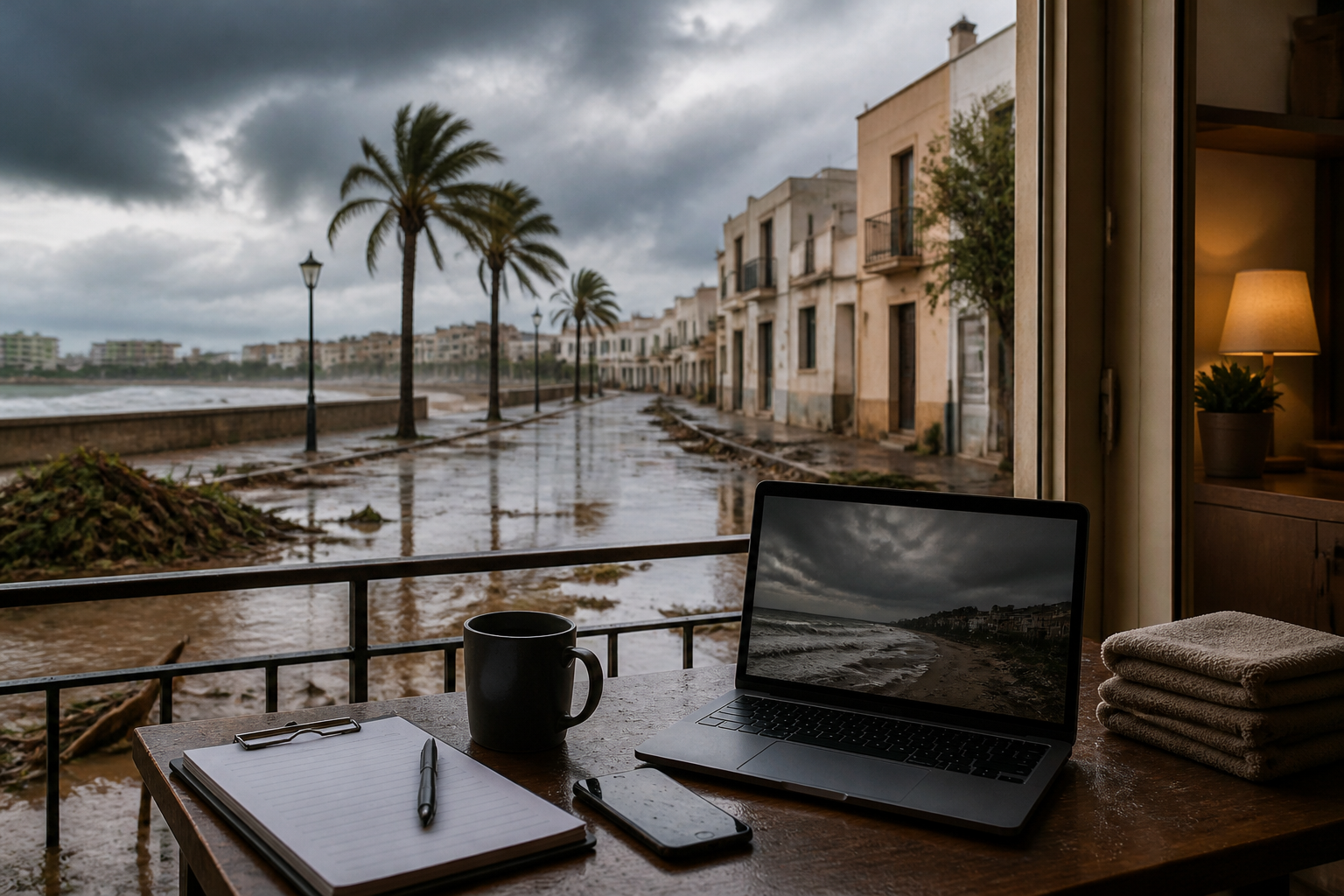
A DANA can affect a tourist accommodation even without water entering the property: blocked access, guests unable to arrive, workers unable to travel, essential services interrupted, or cancellations. The correct decision is not to apply a general rule to all bookings but to distinguish the risk to people, habitability, and contractual and economic effects. This guide uses the meteorological episode of the Mediterranean in October 2026 as context, but the measures apply to any flooding episode. Specific alerts must be verified in real-time.
First 15 Minutes: Decisions That Avoid the Most Costly Mistakes
- Locate the property, not just the province. Check the current alert by municipality and time frame on AEMET and the regional 112.
- Confirm where the guests are. Are they inside, traveling, or waiting to check in? Do not encourage them to drive if authorities request avoiding travel.
- Check access and habitability without exposing yourself. Do not visit basements, garages, riverbeds, or flooded roads to check for damages.
- Communicate facts, not exaggerated forecasts. Distinguish a recommendation from a prohibition or mandatory evacuation.
- Preserve evidence. Keep official alerts, messages, photos, and invoices if there is a real incident.
Practical Table: What to Do According to the Situation
| Situation | What to Do Now | What Not to Assume |
|---|---|---|
| Weather alert without damage | Inform, review official recommendations, and plan cautiously | That all bookings are canceled for free |
| Road or access blocked | Keep the alert or resolution, contact the guest and platform, agree on a safe alternative | That any travel difficulty automatically activates an exceptional policy |
| Evacuation or confinement order | Follow the authority, prioritize safety, document the restrictions | That the contract can continue to be executed normally |
| Water inside or damaged facilities | Avoid dangerous areas, request a professional inspection, and notify the insurer/Consortium as appropriate | That any leak is covered by the Consortium |
| Delay in cleaning or maintenance | Do not send personnel to unsafe travel; communicate changes and document costs | That sending a substitute always resolves the incident |
Cancellations: What Happens with Airbnb, Booking, and Direct Reservations
Airbnb: Red Alert Does Not Imply Automatic Refund
Airbnb has a Cancellation Policy for Extraordinary Circumstances for large-scale events that legally prevent or prohibit making the reservation. It includes, under conditions, mandatory restrictions, extensive interruptions of essential services, and certain extreme phenomena. Non-binding recommendations do not necessarily equate to prohibitions, and Airbnb determines whether the specific situation is covered. Each reservation and its applicable policy must be consulted. Official Airbnb Policy.
Booking and Other Platforms
Check the reservation conditions, communications from the channel, and any applicable instructions. Do not assume an extraordinary policy is activated merely due to the existence of an alert. Record the reservation identifier, the incident, and the support response before modifying the charge or calendar.
Direct Reservations
Examine the agreed conditions and applicable legal rights. If the property is uninhabitable or an order prevents access, document the situation and offer a solution according to the contract and regulations. Do not promise that a no-refund clause always prevails over legal obligations.
How to Communicate to Guests Without Causing Alarm
Before Arrival: "We are following the alerts from AEMET and Civil Protection for the accommodation area. Before traveling, please check the official guidelines. If any access restrictions are established or there is an incident affecting your stay, we will inform you immediately to find a safe solution."
During the Stay: "Please avoid traveling through flood-prone areas or blocked roads and follow the instructions from 112. If authorities order any measures, prioritize them. You can contact us if you need information about the accommodation."
After Damage: communicate only about services or spaces that are actually affected, the date of inspection, and the solution being managed. Avoid promising repair schedules that are not yet confirmed.
Insurance and Consortium: What Can Be Covered and How to Claim
A extraordinary flood is not the same as a leak from the roof, a broken pipe, or a maintenance defect. The Consortium of Insurance Compensation can indemnify damages resulting from extraordinary risks when its requirements are met and there is valid insurance. Other causes may correspond to the ordinary insurer or be excluded.
Important Deadline: the Consortium recommends reporting damages as soon as possible, preferably within seven days after the incident as provided in the Insurance Contract Law, but notes that it accepts later requests. Do not confuse that recommendation with an automatic denial on the eighth day. Communication can be made on its website or by calling 900 222 665. Official FAQs.
Before removing damaged items, document their condition if you can do so without risk; keep estimates, invoices, and communications. Take necessary urgent safety measures without delaying them while waiting for an assessment.
Loss of Income: that certain material damages are indemnified does not mean that all lost reservations are covered. Check the policy, its limits, and the possible coverage for loss of profits or interruption of activity.
The Real Cost of a DANA: How to Make a Useful Calculation
Avoid limiting yourself to adding repair invoices. The economic impact of an incident can include additional expenses, net income that ultimately does not materialize, and possible indemnities received. Do not record the same amount twice or confuse gross income with margin.
Illustrative Example, Not Actual Result: a canceled reservation had a price of €600. The channel commission would have been €90 and the variable expenses avoided by not hosting the guest, €80. The potential contribution margin of that reservation was €430 (€600 - €90 - €80). If there are also €250 in repairs and €110 in extraordinary cleaning, the estimated economic effect prior to possible coverages would be €790 (€430 + €250 + €110). If €200 are recovered through an indemnity applicable to those costs, the net impact would be €590. Each figure must be adapted to the property's data.
If the repaired expense constitutes a long-lasting improvement and not ordinary maintenance, its accounting or tax treatment may be different. Do not assume immediate deductibility without analyzing the nature of the expenditure.
Documents to Gather: Unique File per Incident
- Date, time, address of the accommodation, and description of the incident.
- Screenshot of the relevant official alert in that locality and time frame.
- Evidence of restricted access, damages, or lack of habitability, when they exist.
- Identifier and conditions of each affected reservation, without publishing personal data.
- Messages exchanged with the guest, channel, and suppliers.
- Photos, inventory of damages, estimates, invoices, and proof of payment.
- Insurance or Consortium file number, date of communication, and resolution.
- Date when the property is back in operation and final expenses incurred.
It is advisable to separate estimated expenses from paid expenses, requested refunds from received refunds, and blocked nights from canceled reservations.
After the Storm: Deciding When to Resume Accepting Guests
Do not reopen just because the alert has ended. Check habitability, electrical installation, water, access, and cleanliness. If there are structural, electrical, or sanitation damages, consult qualified professionals before offering new stays. Document who confirmed each repair and when the property was considered safe.
As soon as it is operational, review the calendar, prices, and promotions; avoid lowering rates automatically to recover lost time without analyzing the margin of each reservation.
Frequently Asked Questions
Does a red alert always require evacuation?
No. A red alert from AEMET expresses extraordinary danger, but an evacuation or confinement depends on the instructions from the competent authorities.
Can a guest cancel for free due to rain?
Rain alone does not always activate exceptional policies. The contract, the specific incident, and the coverage applicable by the platform must be checked.
How many days do I have to request from the Consortium?
The Consortium recommends doing it as soon as possible, preferably within seven days; it accepts later requests according to its official information.
Does insurance cover nights not rented?
Not automatically. It depends on the policy and whether there is coverage for interruption of activity or another applicable guarantee.
What happens if the cleaner cannot access?
Prioritize their safety; inform the affected guests and document changes in schedule and extraordinary costs.
Conclusion: Safety First, Profitability Later
A weather alert is not yet an economic loss. A modified reservation does not automatically equate to a compensable cancellation. And material damage does not necessarily imply that the accommodation has ceased to be profitable.
The difference between acting blindly and managing wisely lies in documenting facts, protecting people, and understanding the real effect on the accounts. That is Gatavia's approach: to provide financial clarity so that owners can make better decisions, even when the unexpected happens.
More clarity. More time. More life.